
The England we left at the end of the fourteenth century had endured almost everything history could throw at it. The Black Death had returned more than once. War with France dragged on for generations. Harvests failed. The Peasants’ Revolt exposed deep social tensions. Great families rose and fell, while villages disappeared from the landscape altogether.
It would have been perfectly reasonable to assume England’s best years were behind her. Yet history has a habit of refusing to follow the obvious script.
Driving through England today, passing market towns, parish churches and neatly cultivated fields, it is easy to imagine that medieval life simply resumed once the Calamitous 14th Century, to coin Barbara Tuchman‘s description, was over. That is comforting—but it is not quite true.
England did recover. It simply did not recover by becoming the country it had been before. Instead, something more interesting happened. The old order had been shaken loose. Land, labour and opportunity were quietly being rearranged. People adapted to new circumstances, often despite repeated attempts by those in authority to restore the familiar patterns of the past.
Recovery, it turned out, did not mean going backwards. It meant finding a different way forward.
Labour Became More Valuable
England could not replace the people it had lost overnight. Instead, it gradually learned to make better use of those who remained.
For centuries, much of medieval life had depended upon an abundant supply of labour. After the Black Death, that was no longer possible. Recovery therefore required something different: finding ways for fewer people to accomplish more.
Workers became more mobile, moving to places where their skills were most needed. Labour services increasingly gave way to money rents, giving both tenants and landlords greater flexibility. Employers competed more actively for skilled workers, while families found new opportunities in growing market towns and expanding rural industries.
Farmers also began to rethink how land itself was used. With far fewer people to feed, England no longer needed to cultivate every acre capable of growing grain. Some of the poorest arable land was allowed to return to pasture, where sheep could graze. Wool had long been one of England’s greatest assets, and it became increasingly important to a growing pastoral economy.
Work itself also became more specialized. Rather than every household producing a little of everything, people increasingly concentrated on particular skills. As they became better at particular tasks, the economy became more productive—and increasingly interconnected.
England was also able to make better use of technologies that had existed for generations. Watermills and windmills, improved ploughs, horse harnesses and other labour-saving innovations were hardly new, but in a world where workers had become scarce they suddenly became more valuable. Investing in better tools or more efficient methods often made better economic sense than simply relying on additional hands.
Underlying all these changes was something even more important: people responded to incentives. Tenants who could keep more of what they produced had greater reason to improve their land; skilled workers sought opportunities where their abilities commanded higher wages; landowners invested where their limited resources would generate the greatest return.
None of this happened quickly. But England was gradually learning to make better use of its people, land and capital.
Towns Formed a Living Network
England had few great cities; its population was more widely distributed, in hundreds of villages, market towns, ports and regional centres linked across the landscape.
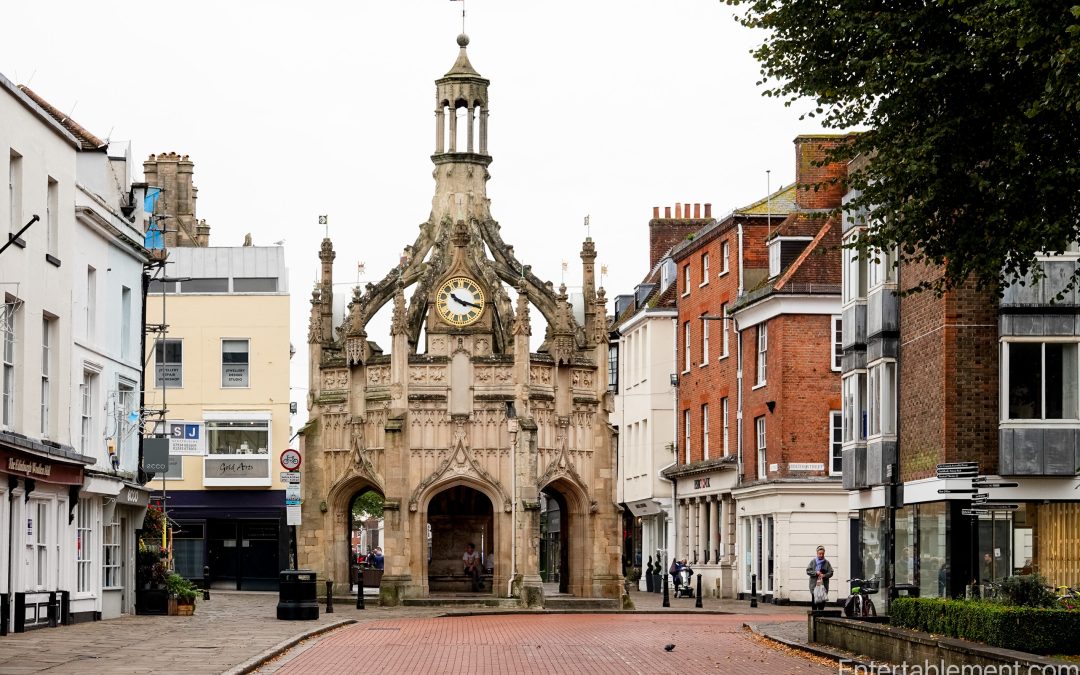
Most had grown organically. Roads converged upon a market square or high street. A church stood near the centre, often accompanied by a school, guildhall, inn or courthouse, depending on the size of the town. Smaller villages looked towards several nearby centres for different purposes; towns in turn connected with larger cities and ports.
The result was a loose hub-and-spoke system, repeated at several levels. Produce, wool and labour travelled inward from the countryside. Finished goods, credit, information and opportunity travelled outward. A local market town might depend upon a regional centre, while that centre looked towards London, Bristol, Norwich, York or the ports of the Channel and North Sea.
To North American eyes, the pattern can seem almost unfamiliar. Much of North America’s urban growth occurred later, when abundant land and new transport technologies allowed cities to spread outward on a vast scale. England’s settlement pattern had already been taking shape for centuries. It was composed not only of cities, but of countless smaller centres, each serving the countryside around it.
This mattered during the long recovery. Economic life did not have to be reconstructed from scratch. Weavers, dyers, merchants, carriers and craftsmen could settle where opportunity appeared, while markets and roads connected their work to the wider economy.
England’s towns were not simply picturesque remnants of the medieval world. They were part of its operating system.
England Began Keeping More of the Value It Created
Not every important change was visible in a castle, a cathedral or a battlefield. Some began with a sheep.
For centuries, England had produced some of the finest wool in Europe. Vast flocks grazed on hillsides from the Welsh Marches to the Cotswolds, and sacks of raw fleece travelled to the great weaving centres of Flanders and northern Italy. Wool was already one of England’s greatest exports, bringing considerable wealth to landowners and the Crown.
But there was a catch. The wool left England in one form and returned, if it returned at all, as something far more valuable. Between the sheep in an English field and the finished cloth on a merchant’s stall lay an extraordinary amount of skilled work. The fleece had to be sorted and washed, spun into thread, woven into cloth, fulled, dyed, finished, packed and transported.
A sack of wool could support only so much economic activity. A bolt of finished cloth supported far more.
This transformation had begun before the Black Death, but England’s long recovery accelerated it. More of the skilled work remained at home instead of crossing the Channel with the raw fleece. That created work for spinners, weavers, fullers, dyers, merchants and carriers, while allowing more of the wealth generated by English wool to circulate within England itself.
Nor was this work confined to the great towns. Although guilds remained important, much of the spinning, weaving and finishing took place in villages and households across the countryside. Rural families became connected to regional and international markets in ways that would have seemed remarkable only a few generations earlier.
The sheep remained exactly where they had always been. What changed was how much happened after the fleece left them.
The Machinery Kept Running
One of the easiest mistakes to make in history is to imagine that countries are governed entirely by kings. Kings certainly mattered. A wise ruler could strengthen a kingdom. A foolish one could make an astonishing mess of it. England had its share of both. Yet as the centuries passed, governing England became less dependent upon the abilities of any single individual.
Long before the Tudor period, the country had acquired something rather useful: institutions that could remember how to do their jobs.
The kingdom was divided into shires administered by sheriffs. Local juries, sheriffs and manorial officials handled much of England’s everyday administration, while the royal courts gradually developed a common body of law that applied across the kingdom. Written records and legal precedent meant decisions could be remembered, referred to and applied with increasing consistency.
None of this guaranteed good government. Far from it.
The fourteenth and fifteenth centuries produced weak kings, child kings, deposed kings and rival kings who spent years arguing over whose claim to the throne was the more convincing. Wars were fought. Factions manoeuvred. Powerful families pursued their own interests with varying degrees of subtlety.
And yet… Taxes continued to be collected. Property changed hands. Lawsuits were heard. Markets operated. Sheriffs carried out their duties. The machinery occasionally ground and squealed, but remarkably little of it stopped altogether. That was no small achievement.
Parliament, too, quietly became more significant while The Exchequer kept accounts. Kings, particularly during expensive wars, had an inconvenient habit of needing money. Those who voted taxation gradually discovered that supplying funds also gave them opportunities to present petitions, negotiate grievances and scrutinize royal policy. No one intended to create a modern constitutional monarchy, but practical necessity has often been one of history’s most inventive forces.
By the end of the Middle Ages, England was still far from politically stable. But it had become increasingly capable of functioning even when its politics were anything but.
The kingdom bent, but it did not collapse.
Land, Wealth and Influence Began to Move
Not all the changes could be measured in wages or woven into cloth. Some appeared in who owned the land, who exercised local authority and who found themselves entrusted with responsibility.
England’s old landed aristocracy remained immensely powerful, but the upheavals of the fourteenth and fifteenth centuries quietly rearranged the landscape of wealth. Plague, inheritance, marriage, debt and war all played their part. Some great families disappeared altogether. Others accumulated vast estates. Monasteries, colleges, merchants, lawyers and prosperous farmers also acquired land that might once have remained in aristocratic hands for generations.
Below the highest nobility, another group steadily grew in importance.
England gradually developed two governing elites. The aristocracy provided national leadership—advising the Crown, serving in the House of Lords and commanding armies. Alongside them, the landed gentry increasingly assumed responsibility for local government.
By the Tudor period, the Crown could not possibly govern every county from Westminster. It relied upon educated, prosperous local gentlemen to serve as Justices of the Peace, sheriffs, Members of Parliament, commissioners and estate administrators. They were not salaried civil servants but local leaders exercising authority on the Crown’s behalf.
This was not a social revolution. England remained a deeply hierarchical society, and birth still mattered enormously. Yet birth was no longer the only route to influence. The Crown needed people who could read accounts, understand the law, collect taxes, settle disputes and administer counties. Competence, education and practical experience had become not merely useful, but marketable: skills for which institutions, landowners and merchants were increasingly willing to pay, and through which capable people could acquire wealth, responsibility and influence.
Knowledge Became Easier to Preserve, Share and Use
As England became more complicated, it also became more dependent upon something surprisingly fragile: information.
A growing economy generated contracts, accounts, court cases, wills, tax records, property transfers and commercial agreements. All of them depended upon people being able to read, write, calculate and remember accurately. And that required a different kind of workforce.
Not only priests and scholars, but clerks, lawyers, merchants, accountants, schoolmasters, administrators and physicians. Many worked quietly behind the scenes, leaving few monuments and attracting little attention from chroniclers. Yet they formed an increasingly important part of the country’s hidden infrastructure.
Schools expanded. The universities at Oxford and Cambridge continued to educate clergy, lawyers and administrators. The Inns of Court trained those who would operate England’s legal system. Monasteries and cathedral schools remained centres of learning, preserving and copying manuscripts long before printing arrived.
Then, towards the end of the fifteenth century, came one of history’s great accelerators: the printing press. It did not create England’s appetite for knowledge; it arrived in a society already becoming increasingly dependent upon written records and educated people. Printing simply made it easier for ideas to travel further, more quickly and with fewer opportunities for error.
Every generation discovers useful ideas, but civilizations advance when they discover reliable ways of ensuring those ideas survive the people who first had them.
England’s growing ability to record, preserve and share knowledge meant that each improvement became a little less likely to disappear with the person who made it.
The Baton Was Not Dropped
Looking back across these centuries, it is tempting to see only disaster. Plague. War. Political turmoil. Failed harvests. Rebellion. Dynastic conflict.
Yet the story is not really about catastrophe. It is about continuity.
When Roman government disappeared from Britain in the fifth century, much of the machinery that held society together disappeared with it. Systems of taxation, justice and large-scale administration ceased to function. The baton was dropped, and generations had to rebuild what had been lost.
The fourteenth century was different.
England endured extraordinary demographic, economic and political shocks, yet its underlying institutions survived. Roads still linked towns. Markets continued to trade. Courts still dispensed justice. Parliament met. Counties and parishes carried on. Bruised and tested though they were, the country’s hidden frameworks remained intact.
That made all the difference.
Recovery did not require England to begin again. It could build upon what earlier generations had already created. As prosperity gradually returned, those medieval institutions expanded. More people were educated. More gentry accepted local responsibility. Parliament became more central to government. The common law reached further.
The remarkable story of Tudor England was not one of reinvention so much as scaling.