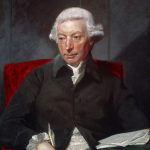

In eighteenth-century Edinburgh, a remarkable group of thinkers was attempting to understand how human societies worked. David Hume examined the habits and conventions that made cooperation possible, while Adam Smith explored moral judgment, commerce and the division of labour. Their friend Adam Ferguson approached these questions from another direction. He wanted to understand how people developed the institutions of civilized life, often without intending the larger consequences of their actions, and whether increasing prosperity might eventually undermine the qualities that made civilization possible.
It was an intriguing combination of interests for a man whose early career had been spent with a Highland regiment rather than in a university lecture hall.
From the Highlands to Edinburgh
Adam Ferguson was born in 1723 at Logierait in Perthshire, the son of a Presbyterian minister. Gaelic was his first language, and he grew up in a Scotland where Highland society retained customs and loyalties that differed considerably from those of the increasingly commercial Lowlands. Educated at Perth, St Andrews and Edinburgh, he initially prepared for the ministry, but in 1745 became chaplain to the Black Watch, serving with the regiment during the War of the Austrian Succession. He was present at the Battle of Fontenoy, where British forces suffered heavy losses fighting the French.
The experience left him with a lasting interest in courage, discipline and the bonds that develop among people facing danger together. Ferguson admired the capacity for collective action and personal commitment he associated with military life, although he was not blind to the violence and rivalry that accompanied it. These concerns would later inform his thinking about civic virtue: the qualities that enable individuals to act on behalf of something larger than their immediate interests.
After leaving the regiment in 1754, Ferguson settled into Edinburgh’s intellectual world. He succeeded David Hume as librarian to the Faculty of Advocates and, in 1759, became Professor of Natural Philosophy at the University of Edinburgh. Five years later, he moved to the chair of Moral Philosophy, placing him at the centre of one of Europe’s liveliest intellectual communities. Hume, Smith and Ferguson shared an interest in human nature, history and the development of social institutions, although their conclusions were not always identical.
The Institutions Nobody Designed
Ferguson’s best-known work, An Essay on the History of Civil Society, appeared in 1767. He rejected the idea that society could be adequately explained by imagining isolated individuals who eventually agreed to live together. Human beings, he argued, were social creatures from the beginning. They formed families, communities, alliances and political associations through the ordinary activities of living alongside one another, and the arrangements they developed changed as their circumstances changed.
His most enduring observation was that nations often arrived at institutions that were “the result of human action, but not the execution of any human design.”
Consider the development of a market town. A castle might be built to control territory, a market authorized to encourage trade, and a church established to serve the local population. Merchants arrived, inns opened, rules developed to govern transactions, and charitable institutions appeared as prosperity increased. Each undertaking had a recognizable purpose, yet nobody designed the complete network of relationships that eventually emerged. The town became something more elaborate than any of its founders could have anticipated.
Ferguson was not suggesting that planning was unnecessary or that institutions developed without human intervention. His point was that the consequences of human action frequently extended beyond the intentions of the people involved. Customs, laws and organizations accumulated through experience, adaptation and sometimes conflict. Their development could be understood historically without assuming that someone had conceived the finished arrangement in advance.
This was an important contribution to the Scottish Enlightenment’s understanding of social order. Hume had explored the conventions that made cooperation possible, while Smith examined how exchange and specialization coordinated the activities of people pursuing different interests. Ferguson shared their interest in unintended consequences, but placed particular emphasis on the political and civic life that developed alongside commerce.
The Price of Progress
Ferguson recognized the benefits of commercial society. Specialization increased productivity, supported prosperity and enabled increasingly complex institutions. But he worried that the division of labour might also narrow people’s horizons, leaving them proficient in their occupations but increasingly detached from public affairs. As responsibility passed to professional soldiers, officials and administrators, citizens risked becoming passive beneficiaries of institutions they no longer helped sustain.
For Ferguson, a flourishing society required more than material prosperity and efficient administration. It depended on courage, judgment and public spirit—qualities developed through participation and responsibility. He did not romanticize the insecurity or violence of earlier societies, but questioned whether commercial progress might weaken the civic habits on which its own achievements depended.
The Lessons of Rome
In 1783, Ferguson published The History of the Progress and Termination of the Roman Republic, examining how Rome’s expanding power altered the institutions and civic habits that had supported its success. Military ambition, growing wealth and competing political interests gradually undermined republican government, even as its constitutional forms survived. For Ferguson, Rome demonstrated how a society’s achievements could create pressures that its institutions were unable to withstand.
Ferguson was also involved in the political controversies of his own day. During the American Revolution, he supported the British government and served as secretary to the unsuccessful Carlisle Peace Commission of 1778. He retired from teaching in 1785 and died at St Andrews in 1816, aged ninety-two, having witnessed the American and French Revolutions and the beginnings of industrialization.
Civilization Is Not a Finished Achievement
Ferguson’s most famous observation explains how institutions emerge from human activity without an overarching design. But he was equally concerned with their decline. Laws, markets and political arrangements might remain intact long after the civic habits that sustained them had weakened.
The appearance of institutional stability was no guarantee of its substance.