
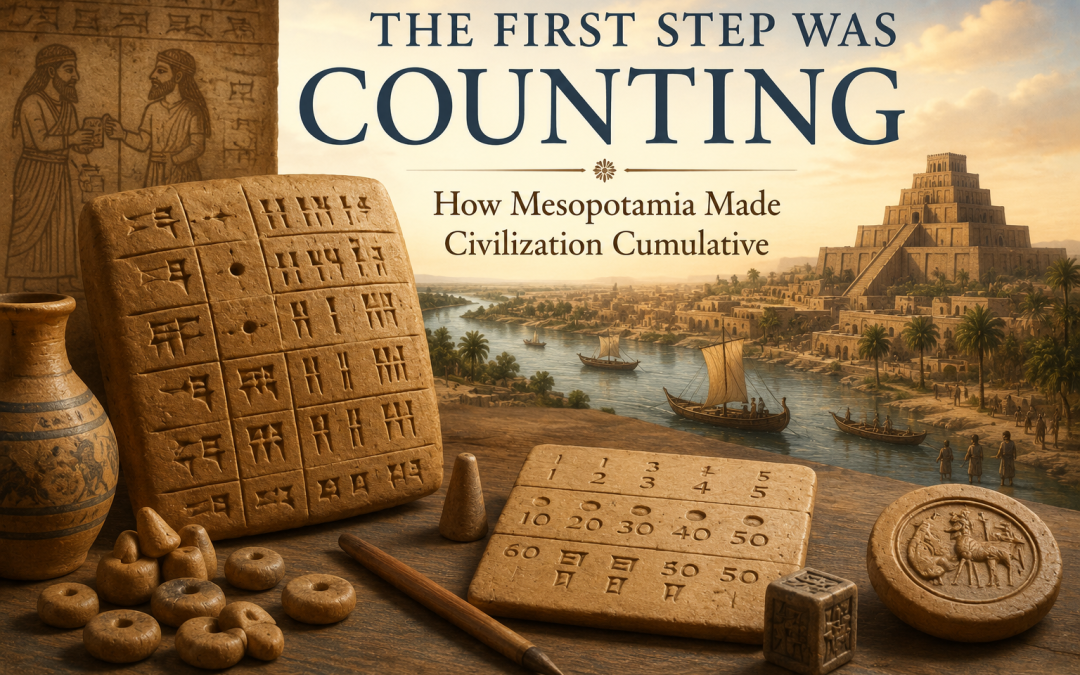
When we think about the beginnings of civilization, our minds often leap to pyramids, kings and great cities. The real story may have begun somewhere far less dramatic. It may have begun with someone trying to remember how many sheep, or sacks of grain, or jars of oil, belonged to whom.
When Memory Was Enough
For most of human history, memory was enough. Families hunted, gathered, traded and shared what they had. Everyone knew everyone else. A borrowed tool, a promised basket of grain or a favour owed to a neighbour lived comfortably in people’s heads.
That worked remarkably well—until it didn’t.
As villages grew into towns, everything became more complicated. The change was not simply that there were more people, but that they were becoming more dependent upon one another. Farmers produced surpluses that supported potters, builders, weavers, merchants, priests and administrators. Irrigation works required coordinated labour. Goods travelled between people who did not know one another.
As specialization increased, no household remained entirely self-sufficient. Civilization was becoming a network—and networks create information. Harvests grew larger, animals multiplied and land changed ownership Trade extended beyond family and neighbours. Promises accumulated.
Memory, which had served humanity well for thousands of years, finally reached its limit. Civilization had encountered its first scaling problem.
The First Great Breakthrough
The solution was surprisingly simple.
Count.
Count the sheep, the sacks of grain, the jars of oil. Count what had arrived, what had been distributed, and what remained. Planning requires counting. Trade requires counting. And, perhaps surprisingly, trust requires counting. As long as agreements existed only in people’s memories, they depended on everyone remembering the same conversation.
Did I promise you three sacks of grain or four? Have I already repaid the loan? Which field changed hands?
Then someone had an idea that changed history. Instead of carrying the count in their head, they could leave it behind. A clay tablet could remember what people might forget.
Suddenly the question was no longer, “What do you remember?” but “What does the tablet say?”
Memory no longer belonged to one person. It became something people could share.
Marks in Clay
Like most great breakthroughs, this probably didn’t happen all at once. People almost certainly experimented with many different ways of keeping track of the world around them. Tallies cut into wood, knots tied in cord, pebbles gathered into piles and small clay tokens may all have helped preserve information beyond the limits of memory.
In southern Mesopotamia (now Iraq). however, something remarkable began to emerge. In cities such as Uruk and Ur, those simple records gradually evolved into clay tablets impressed with wedge-shaped marks that we now call cuneiform. What began as a practical system for recording grain, livestock and trade slowly became something much more powerful.
Writing had begun.
Yet writing did not solve every problem. A record was only as useful as the system behind it. People still needed to agree on what the marks meant, how quantities should be measured, and which agreements could be trusted.
Those would become civilization’s next great challenges.
Civilization Becomes Cumulative
The earliest writing was not poetry. It was bookkeeping. Some of the oldest surviving tablets record grain deliveries, sheep, labour and beer rations. They are wonderfully ordinary. Yet they mark one of history’s great turning points.
For the first time, practical knowledge no longer disappeared when the people who created it died. Each generation could inherit not only stories, but working solutions.
Civilization had become cumulative.
The First Inheritance
Every civilization that followed built upon that foundation. Egypt would demonstrate how careful administration could endure for millennia. Babylon would refine measurement, law and scholarship. Persia would learn to govern a vast multicultural empire. Greece would transform the way people reasoned about the world. Rome would weave many of those earlier discoveries into one of history’s greatest systems of coordination.
None began from nothing.Each inherited the capabilities that had come before—and added a few more of its own.
Perhaps that is the real story of civilization. Not a succession of empires, but an accumulation of capabilities, each generation quietly solving another difficult problem before handing its solution to the next.
The first great inheritance of civilization was not a monument. It was a method.
Long before children learn algebra or calculus, they learn to count. It is one of the first things we teach them because it remains one of the first things civilization had to learn. Before we could build pyramids, or write laws, or govern empires, we first had to answer a far simpler question.
How many?