
A World Out of Sync
For most of human history, time was local. Towns set their clocks by the sun, with noon defined as the moment it reached its highest point in the sky. When people and information travelled slowly, the small differences between one town’s time and another’s scarcely mattered.
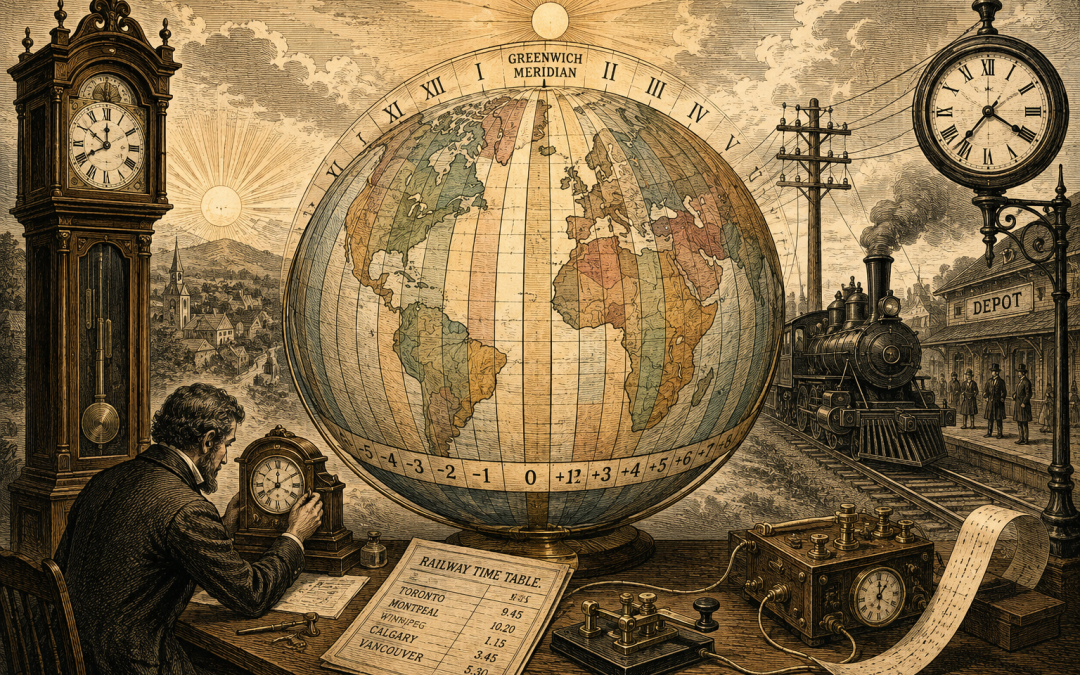
Then came the railways and the telegraph. Trains crossed in hours distances that had once taken days, while messages travelled almost instantaneously. Suddenly, a patchwork of local times became a logistical problem. Railway timetables were bewildering, connections uncertain, and coordinating activity across long distances increasingly difficult. The world had become connected faster than its clocks had.
The Birth of Standard Time
Sandford Fleming, a Canadian railway engineer, saw that the problem required more than better timetables. His interest is often traced to an 1876 mishap in Ireland, when confusion over a railway schedule caused him to miss a train. In the years that followed, he began advocating internationally for a universal system of timekeeping based on a common reference point.
Practical necessity was already pushing railways in the same direction. In 1883, North American railways adopted standard time zones, replacing the bewildering array of local railway times then in use. A year later, delegates from 25 nations met at the International Meridian Conference in Washington and selected Greenwich as the international prime meridian.
Greenwich Mean Time was already familiar to mariners, who used a common reference time to calculate longitude. Fleming’s larger vision was to bring that same principle of coordination onto land. What had once been determined by the sun overhead was becoming part of a global system.
Canada: A Nation That Needed Time to Behave
Few countries illustrated the need for standardized time more vividly than Canada. As railways pushed across enormous distances, coordinating trains by dozens of local solar times became increasingly impractical. Fleming understood the problem intimately: railway engineering had shown him that a continental transportation system required a continental way of measuring time.
From Keeping Time to Sharing Time
Long before standard time, clocks were already ordering daily life. Church bells summoned worshippers, public clocks marked the business day, and household clocks governed meals, appointments and routines.
At St James’s Palace, clocks punctuated a world governed by appointments, ceremony and protocol. Whilst on a recent tour of the Palace, I noticed that clocks seem to be everywhere—mantel clocks, bracket clocks and elaborate ornamental timepieces, accumulated through generations of royal occupation. Keeping them all running must be practically a full-time job!
At Monticello, Thomas Jefferson’s elaborate seven-day clock extended through the floor, its descending weights marking the days of the week. And in prosperous homes, the longcase—or grandfather—clock imposed its steady mechanical rhythm on domestic life.
But these clocks were keeping local time. A clock in one town might differ from one in the next by several minutes. That scarcely mattered when a journey took half a day. It mattered enormously when a train was due in six minutes.
Standard time didn’t teach people to watch the clock; it taught the clocks to agree. The clock on the mantel, the clock at the railway station and, eventually, clocks thousands of miles apart became part of the same invisible framework. For the first time, increasingly, everyone was watching the same clock.
Daylight Saving: Still Arguing About the Hours
Standard time solved many problems, but didn’t end the debate about what time “should be.”
In the United States, towns once chose whether or not to observe Daylight Saving Time, leading to absurd journeys where travellers passed in and out of different “times” just driving across a single state. It wasn’t until the Uniform Time Act of 1966 that national coherence returned.
And still, the squabbles continue. Every year, bills surface in various countries to abolish, modify, or permanently adopt daylight saving. It seems time is as much a political argument as a mathematical one.
Conclusion: Why Time Still Tugs at Us
Sandford Fleming’s legacy is profound but quiet. We don’t marvel at the invention of time zones the way we do electricity or flight, but they are equally transformative. Every synced phone, every airline itinerary, and every international Zoom call owes something to the man who thought time should make more sense.
And yet, there’s something deeply human in our resistance to time’s regimentation. From Jefferson’s philosophical clocks to farmers resisting Daylight Saving, we still wrestle with how time fits into our lives.
Today, thousands of Canadian students attend schools named in honour of Sir Sandford Fleming, perhaps unaware that their class schedules, bus timetables, and synced phones trace back to the man whose name is etched on their ID cards—a man who once missed a train and changed the world so the rest of us wouldn’t have to.