
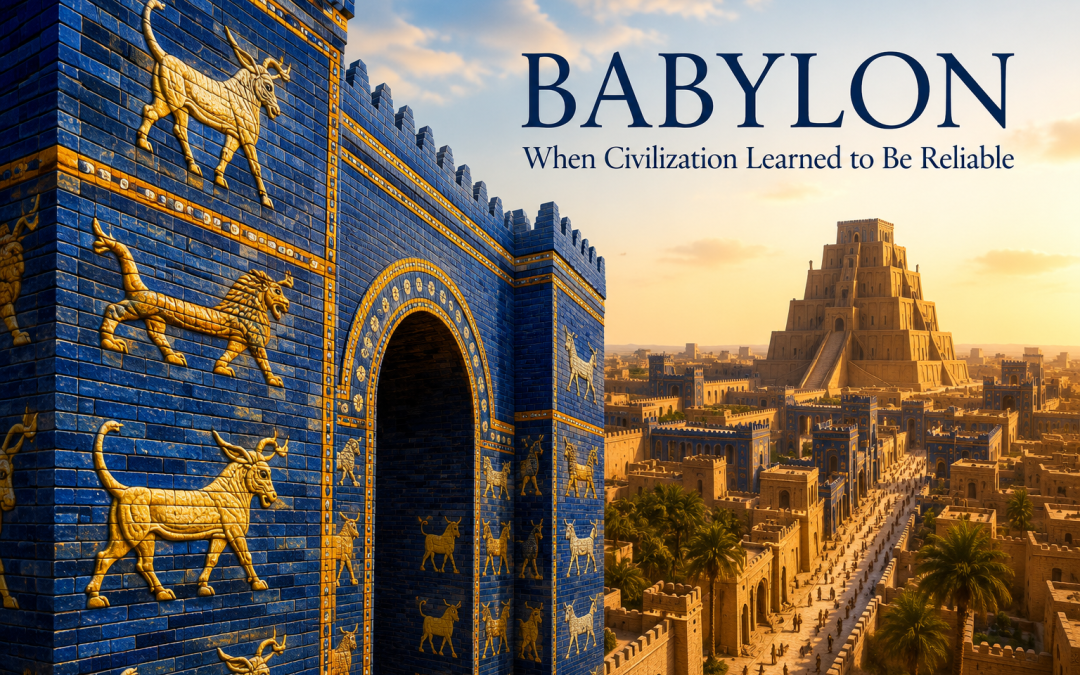
Few ancient cities have accumulated as many meanings as Babylon.
Its name conjures a tower reaching towards heaven, its builders suddenly unable to understand one another. It recalls Nebuchadnezzar and the Babylonian Captivity, the mysterious writing on the wall during Belshazzar’s feast, and the Hanging Gardens, whether they stood exactly where later generations believed or not. For centuries, Babylon became more than a city. It became a symbol of splendour, ambition, excess and imperial power.
Yet none of these stories explains why Babylon still shapes our lives. To discover that, we must leave behind the famous tower and legendary gardens and walk instead into the ordinary bustle of the city itself.
The City That Shouldn’t Work
Imagine arriving in Babylon around 600 BC.
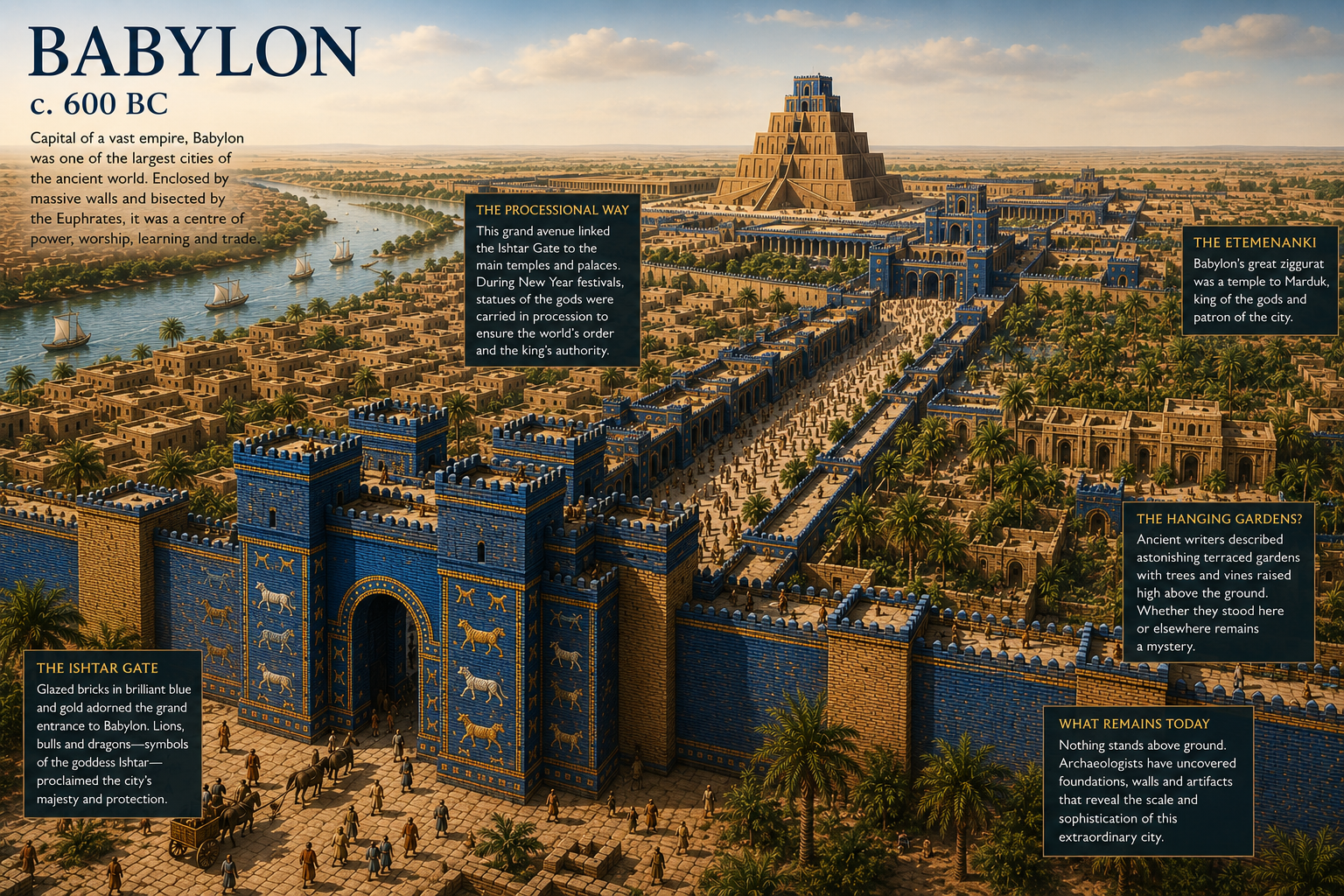
Ahead rises the magnificent Ishtar Gate, its deep blue glazed bricks shimmering beneath the Mesopotamian sun. Lions stride confidently across its walls, joined by great bulls and dragons whose colours still seem astonishingly fresh after twenty-six centuries. As an aside, the Ishtar Gate was built from glazed bricks whose brilliant cobalt blue still survives today. The reconstruction in Berlin is assembled from many of the original bricks excavated at Babylon. How cool is that??
Beyond stretches the Processional Way, leading towards palaces, temples and markets that made Babylon the envy of the ancient world.
But splendid architecture is only the beginning.
Boats unload grain along the Euphrates. Caravans arrive from distant lands with timber, metals and precious stones. Farmers bring carts laden with barley and dates. Officials carry clay tablets between warehouses while merchants bargain in several languages.
Almost nobody knows everyone else. The farmer delivering grain has never met the merchant buying it. Neither knows the boatman at the quay or the official recording taxes for the palace. Yet, somehow, the city works.
Thousands of people who will never become friends still cooperate well enough that one of the largest cities on earth wakes each morning expecting business to continue as usual.
That is Babylon’s real mystery. Not how its walls were built. But how strangers learned to trust one another.
From Memory to Reliability
As we saw in Mesopotamia — The First Step Was Counting, the peoples of Mesopotamia had already solved one of civilization’s first great scaling problems.
For countless generations, memory had been enough. Families remembered boundaries, debts and promises. But as villages became towns and towns became cities, memory reached its limits. There were simply too many people, too many transactions and too many strangers.
The Mesopotamians responded with one of humanity’s greatest inventions. Information no longer had to remain inside a person’s head. Agreements could be impressed into clay. Harvests recorded. Inventories counted. Knowledge could survive the people who first possessed it. Civilization had learned to remember.
Babylon inherited that extraordinary achievement. But memory solved only the first problem. Writing preserves information. It does not, by itself, make information trustworthy.
Imagine two merchants meeting for the first time. Each possesses a written contract. Excellent. But what if one uses different weights and measures? What if neighbouring cities interpret contracts differently? What if every judge reaches a different decision? What if each new ruler abandons yesterday’s rules?
Babylon’s challenge was no longer remembering. It was making civilization reliable.
Agreeing on the Same Measure
We rarely notice systems that work well. Nobody thinks about measurements until two builders disagree about the length of a wall. Nobody worries about contracts until somebody fails to repay a loan.
Modern life rests upon countless quiet assumptions. We expect a litre to contain the same amount tomorrow that it does today. We assume a title deed still describes the same piece of land, and that similar disputes will be judged according to similar principles. None of those assumptions is inevitable. Every one had to be built.
Babylon became one of history’s great laboratories for doing precisely that. What Babylon demonstrated was how much further civilization could travel once enough people agreed that the same thing should mean the same thing. Shared standards are among civilization’s least glamorous achievements. They are also among its most valuable.
When Justice Became Predictable
Hammurabi did not invent law. Long before he came to the throne, communities throughout Mesopotamia had settled disputes and enforced agreements. His achievement lay elsewhere. He helped make judgement visible.
His great basalt stele, now in the Louvre, recorded decisions covering everything from agriculture and trade to inheritance and wages. Rather than asking every judge to invent justice anew, earlier judgements became a guide for later ones. The laws themselves were often harsh, and justice was certainly not equal. Babylon remained an ancient kingdom, not a modern democracy.
Yet something important had changed. Justice had begun to leave a permanent record.
Predictability changes behaviour.
A merchant embarking on a long journey could have greater confidence that a contract would mean tomorrow what it meant today. A farmer disputing ownership of a field no longer depended entirely upon fading memories or the mood of a local official. People lend money. They plant orchards whose fruit they themselves may never harvest. They undertake ambitious building projects because they believe tomorrow will resemble today closely enough for planning to make sense.
Reliable institutions encourage long-term thinking.
Measuring the World by 60
The same instinct appears in Babylonian mathematics.
Most of us never stop to wonder why an hour contains sixty minutes or why a circle contains 360 degrees. Yet sixty is remarkably practical. It divides neatly into halves, thirds, quarters, fifths and sixths, making it invaluable for builders, surveyors, merchants and astronomers alike.
The Babylonians were not searching for mathematical elegance. They were solving practical problems. Thousands of years later, we still live inside their solution.
Elegant, isn’t it?
Learning Across Generations
Astronomy tells a similar story. Night after night, Babylonian scholars observed the heavens, recorded what they saw and compared today’s observations with yesterday’s. One lifetime reveals very little. Centuries reveal patterns that no individual could ever discover alone.
No Babylonian astronomer could watch the skies for five hundred years but a civilization could.
Knowledge no longer depended upon extraordinary individuals. Each generation inherited careful observations, added another layer of understanding and passed the whole collection onwards. Civilization was no longer merely remembering. It was learning.
I was reminded of that unexpectedly while standing beneath the remarkable celestial ceiling of the Marble Hall at Mount Stuart on the Isle of Bute.

Marble Hall, Mount Stuart, Isle of Bute, Scotland
Above me, hundreds of tiny crystal stars traced the familiar constellations across a deep blue sky. Around the room, visitors began pulling out their phones and opening astronomy apps. One after another, the constellations appeared on their screens.
It worked.
For a moment, the centuries seemed to disappear.
The designers of Mount Stuart were drawing upon astronomical knowledge accumulated over thousands of years. Those generations built upon Renaissance scholarship, which built upon the Islamic world, which preserved and extended the learning of Greece and Alexandria, whose own understanding rested upon observations patiently accumulated in Mesopotamia.
Civilizations are often described as though they replace one another. More often, they inherit from one another. Babylon did not merely study the stars. It helped teach later civilizations how knowledge itself could accumulate across generations..
The Babylon Everyone Remembers
Under Nebuchadnezzar II, Babylon became one of the most magnificent cities on earth. The Processional Way, the brilliant blue Ishtar Gate, the immense walls and perhaps even the Hanging Gardens captured the imagination of visitors from across the ancient world.
The Bible remembered Babylon differently. It became the city of exile, of the Tower of Babel and of the writing on the wall—a reminder that even the greatest kingdoms remain accountable to something beyond themselves.
Those stories shaped how later generations remembered Babylon. They are part of its inheritance.
Its greatest contribution, however, was far less visible. Babylon demonstrated that trust alone is not enough.
Complex societies require dependable systems that allow complete strangers to cooperate with confidence. Reliable measures. Accuraterecords. Predictable judgements. The more trustworthy those systems became, the more ambitious civilization itself could become.
Mesopotamia had taught civilization how to remember. Babylon taught it how to become reliable.
Babylon’s Quiet Inheritance
Babylon reminds us that civilizations are built not only by visionaries, conquerors and kings, but also by generations of ordinary people who patiently agree how things shall be measured, recorded, judged and remembered.
It is rarely dramatic work; it seldom attracts attention.
When dependable systems function well, we scarcely notice them at all. We simply assume that a litre will still contain the same amount tomorrow, that a contract will mean what it says, and that similar disputes will be judged according to similar principles.
Yet those assumptions are surprisingly fragile. People can cheat. Records can be altered. Measures can be manipulated. Trust can be squandered. Every generation must decide whether reliability still matters, because dependable systems do not maintain themselves.
Perhaps that is Babylon’s most enduring lesson. Civilization advances only while people continue doing the patient, often unglamorous work of making cooperation possible. We notice that work most clearly when it stops.
Babylon’s walls have long since crumbled.
Its greatest inheritance has not.