To understand the world is itself a form of power.
Long before a ship reached the harbour of Alexandria, sailors knew they were approaching something remarkable.
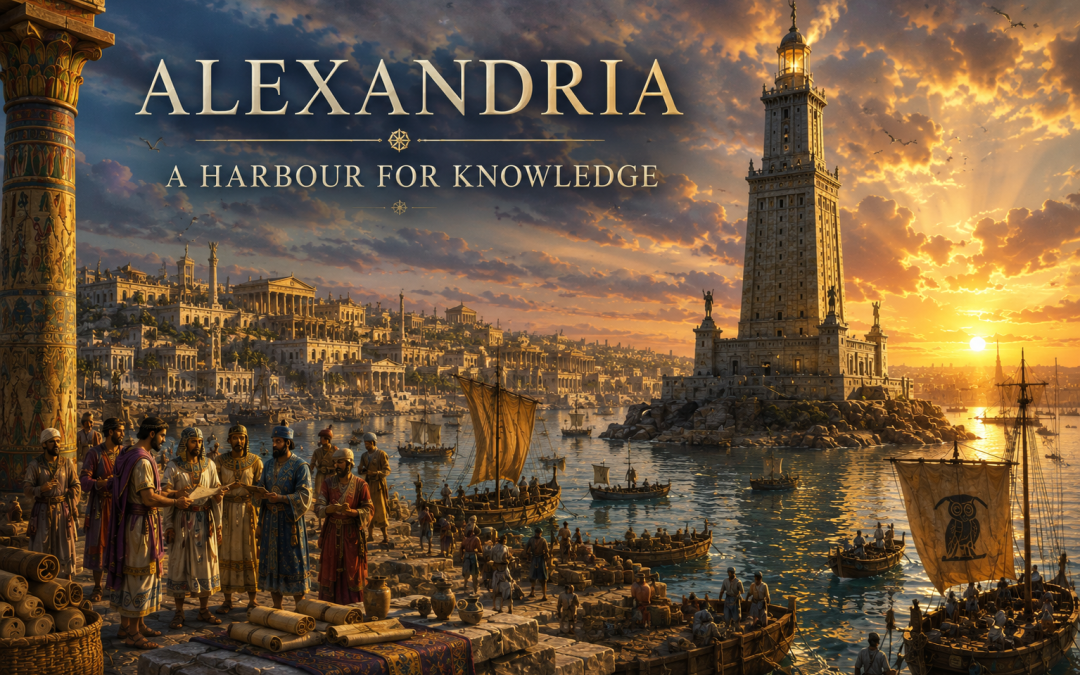
By day, a gleaming white tower rose above the Mediterranean horizon. By night, a great fire burned from its summit, visible for miles across open water. The Pharos of Alexandria, one of the Seven Wonders of the Ancient World, guided vessels safely towards Egypt’s greatest port.
To modern eyes, it may seem an obvious piece of maritime infrastructure. Yet imagine seeing it for the first time. For centuries, sailors had relied upon coastlines, stars and local knowledge. Suddenly, here was a structure built for a single purpose: to reduce uncertainty. Someone had decided that careful engineering, observation and planning could make the sea a little less dangerous.
The lighthouse did more than guide ships. It embodied the philosophy of an entire city.
Alexandria believed that knowledge could change what was possible.
The Ptolemaic Wager
When Ptolemy took control of Egypt, he acquired one of the richest and most sophisticated kingdoms in the ancient world. Egypt possessed fertile land, immense agricultural wealth and a long tradition of administration. It also possessed its own language, priesthood, religious traditions and sense of identity.
The Ptolemies therefore faced a problem familiar to every new dynasty: how could foreign rulers make their authority appear not merely effective, but legitimate?
Alexandria became part of their answer.
The city would certainly be a royal capital, but the Ptolemies wanted it to be more than another seat of government. They set out to make it indispensable—to merchants, scholars, diplomats and anyone seeking access to the intellectual life of the Mediterranean world.
They understood that power did not reside only in territory, armies and taxation. A kingdom that attracted talented people, accumulated valuable knowledge and became a centre of learning possessed another kind of authority.
Supporting scholarship was not simply an act of enlightened generosity. Knowledge could strengthen administration, navigation, medicine, engineering and royal prestige. It could help the Ptolemies govern more effectively while announcing that Alexandria was not merely another city founded through conquest.
It was a place from which the world might be understood.
The wager was extraordinary: that knowledge itself could become a form of wealth.
Time to Think
At the heart of Alexandria stood the Mouseion, the Temple of the Muses. Despite its name, it functioned less like the towering sacred buildings we might imagine and more like a scholarly community. Ancient descriptions suggest colonnades, gardens, dining rooms and spaces where people could read, teach, debate and work together.
In some respects, it would have felt surprisingly familiar to anyone who has wandered through an old university quadrangle.
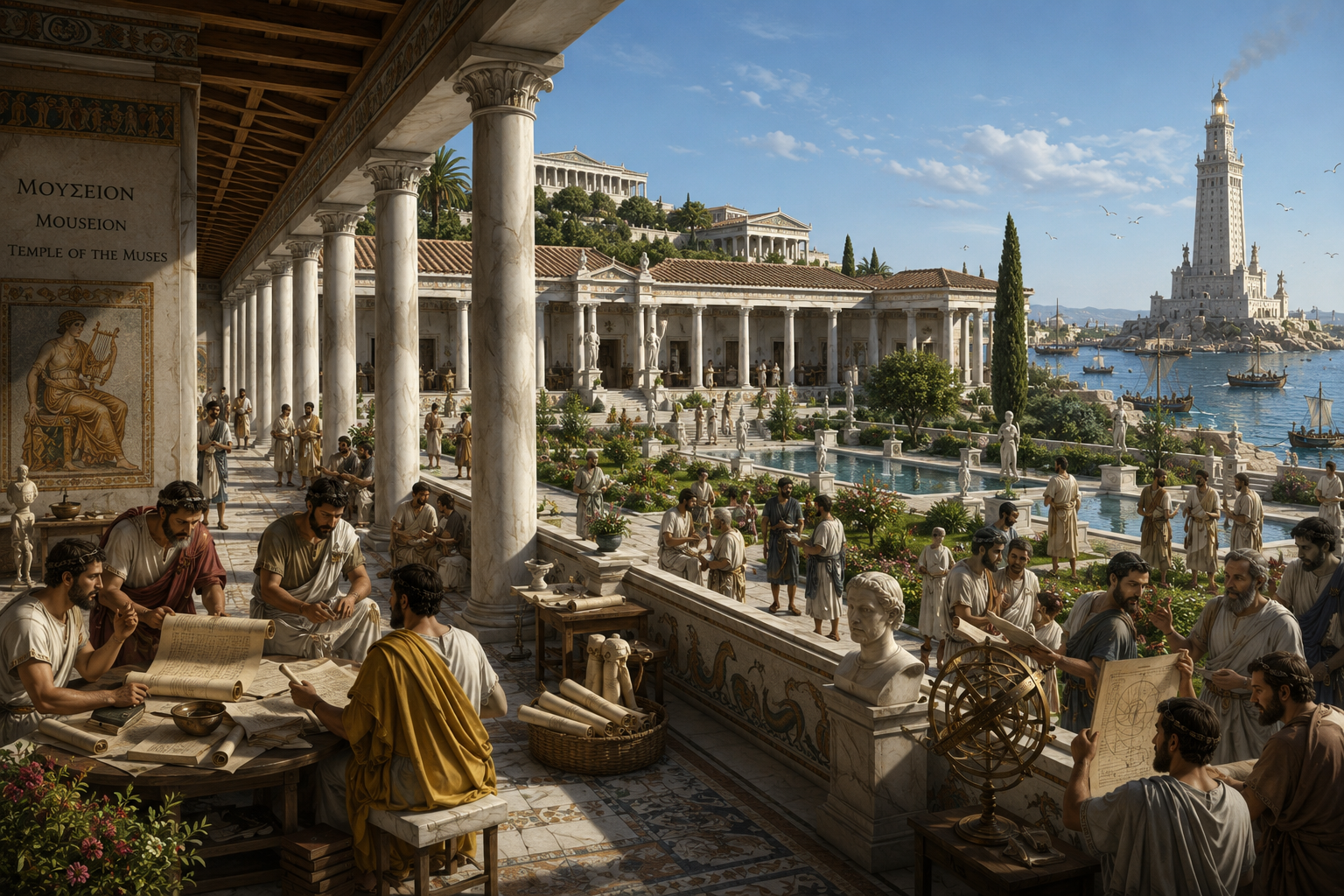
Scholars came from across the Mediterranean and beyond. The state provided accommodation, meals and access to an extraordinary collection of texts. More precious still, it gave them something few people in any age possess in abundance: time.
Time to read and debate. Time to compare one account with another. Time to calculate, observe, translate and write.
Universities and research institutes are now so familiar that we rarely pause to consider the idea behind them. But in the third century BC, deliberately supporting people so they could expand human understanding was remarkably bold.
The Ptolemies had chosen to make curiosity part of the work of the state.
Collecting the World’s Memory
The Library of Alexandria has become almost mythical. Entire novels have been written about its destruction, while stories about its scale and contents have grown with every retelling.
The remarkable thing is that its ambition was real.
The Library did not seek merely to preserve Greek learning, nor even Egyptian learning. Its aim was to gather knowledge from across the known world.
Ships arriving in Alexandria were reputed to have their scrolls copied before continuing their journeys. Texts came from Greece, Egypt, Persia and beyond. Jewish scholars translated the Hebrew Scriptures into Greek, producing the Septuagint and opening them to a far wider audience.
It is easy to think of a library simply as a storehouse. Alexandria was attempting something more ambitious. It was collecting the inheritance of many civilizations and placing it within reach of people who might compare, question and extend it.
The Library gathered knowledge. The Mouseion gave scholars the means to work upon it.
Beginning Where Others Finished
Collecting books matters only when someone does something with them.
The scholars of Alexandria preserved earlier discoveries, but they were not content merely to copy them. Euclid drew generations of mathematical thought into a logical structure whose influence remains recognizable today. Eratosthenes combined geometry, observation and reports from two Egyptian cities to calculate the circumference of the Earth with astonishing accuracy. Physicians investigated anatomy, astronomers refined their understanding of the heavens, and geographers attempted to measure the known world.
Not all their conclusions proved correct. They lacked many of the experimental methods that later science would develop, and some ancient assumptions remained stubbornly resistant to evidence.
Even so, something fundamental had changed.
Scholars could begin not from the beginning, but from the best work already available. Earlier observations could be checked. Competing explanations could be compared. Discoveries made in one field could inform another.
Knowledge was becoming cumulative. Each generation could begin where the previous one had finished.
Conversations Across Cultures
Perhaps Alexandria’s greatest strength was not the number of books it contained, but the number of conversations it made possible.
Walk through its streets and you would have heard a remarkable mixture of voices. Greek merchants bargained beside Egyptian craftsmen. Jewish scholars debated scripture. Sailors arrived from Cyprus, Phoenicia and distant ports, bringing not only cargoes but stories, languages and ways of seeing the world.
Every ship entering the harbour carried more than goods.
It carried another perspective.
We often think of translation as an act of preservation, as though its purpose were simply to carry an idea safely from one language into another. Alexandria suggests something richer. Once ideas crossed cultures, they rarely remained unchanged. They encountered different assumptions, unfamiliar questions and alternative ways of organizing the world.
They were compared, challenged and sometimes transformed. Translation did not merely preserve knowledge. It generated new conversations.
Alexandria became one of history’s great meeting places—not simply for commerce, but for human understanding.
Not a Golden Age
Looking back across more than two thousand years, it is tempting to imagine Alexandria as a peaceful city of scholars reading scrolls beneath marble colonnades while the Pharos shone serenely across the harbour.
Reality was rather messier.
Like most great trading cities, Alexandria was prosperous, energetic and frequently turbulent. Dynastic rivalries became deadly. Different communities did not always live together peacefully. Religious and political tensions sometimes erupted into violence.
Over the centuries, the city passed from Greek to Roman rule, then into the Byzantine world and eventually the Islamic one. Its institutions changed with its rulers, its population and the priorities of those who controlled it.
Even the famous Library seems to have shared that gradual history rather than meeting a single dramatic end. Its disappearance was probably not one catastrophic event, but the cumulative result of political upheaval, conflict, neglect and changing patterns of patronage.
That matters because it overturns one of our favourite historical myths. Civilization does not flourish only when the world is calm.
Alexandria never enjoyed perfect stability. Its achievement was to create places where learning could continue while the world around them kept changing.
Like the harbour itself, the city was built for arrival, exchange and departure.
Alexandria’s Enduring Gift
Alexandria did not invent mathematics, astronomy, medicine or geography. Brilliant minds had been making discoveries for centuries before the city was founded.
Its achievement was to bring inherited knowledge, talented people and sustained support together in one place.
The result was not simply a great Library or an unusually distinguished group of scholars. It was a working model of shared inquiry. Earlier discoveries could be preserved, compared and challenged. Scholars could begin where others had finished. Translation could open one culture’s knowledge to another. Curiosity became something a civilization could deliberately cultivate.
The model was never perfect. Alexandria remained politically turbulent, socially divided and vulnerable to changing rulers and priorities. Nor did its great institutions survive intact.
The Library disappeared. The Mouseion vanished beneath the streets of the modern city.
The Pharos eventually collapsed as well. Its enormous stones now lie beneath Alexandria’s harbour, where underwater archaeology continues to reveal fragments of one of the wonders of the ancient world. Each discovery reminds us that the ancient city has not finished telling its story.
Yet its deepest contribution does not lie beneath the water.
Alexandria demonstrated that understanding advances when knowledge has somewhere to arrive, people have time to work upon it, and each generation can begin with more than the one before.
The buildings were lost. The idea endured.