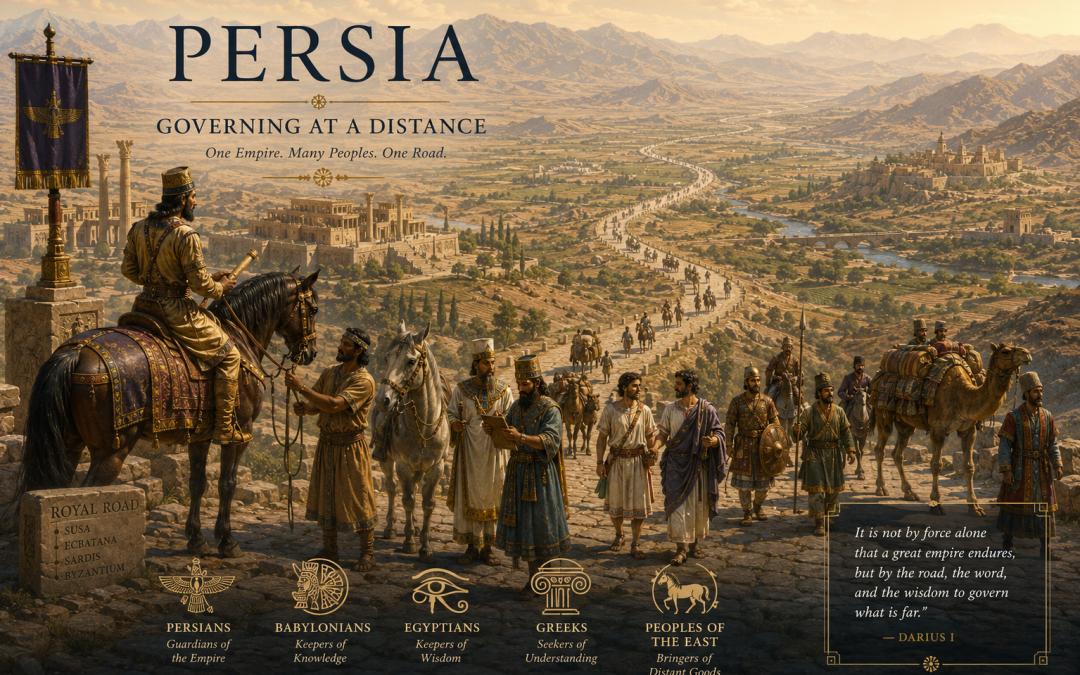
How do you govern people who speak different languages, worship different gods, and live thousands of kilometres apart?
For much of human history, the answer was simple: you didn’t. Kingdoms grew only as far as a ruler could reasonably communicate, collect taxes and enforce his authority. Beyond that point, local governors became independent, supplies became unreliable and rebellion became almost inevitable. Distance defeated ambition.
Then, in the sixth century BC, something remarkable happened.
The Persian Empire demonstrated that it was possible to govern a vast multicultural realm without forcing every province to become the same. Stretching from Egypt to the Indus Valley, the empire of Cyrus the Great and his successors encompassed dozens of peoples, languages, religions and traditions. It became the largest empire the world had yet seen—not simply because Persia conquered territory, but because it discovered how to administer it.

The Persians did not invent government. Mesopotamia had developed record keeping. Egypt had demonstrated the power of long-term administration. Babylon had refined law and measurement.
Persia solved a different problem. It discovered how to make administration work across continental distances.
The Problem of Scale
Large empires had existed before Persia. The Assyrians, for example, built an empire through military conquest and fear. Their armies were formidable, but their rule depended heavily upon intimidation and the constant suppression of rebellion. It was expensive, exhausting, and it rarely survived weak rulers.
The Persian Empire adopted a different approach. Instead of attempting to erase local identities, it largely accepted them: Local customs, local religions and local laws largely continued. People were expected to pay taxes and acknowledge Persian authority—but they were not generally required to become Persian.
That distinction proved enormously important.
Cyrus the Great
When Cyrus captured Babylon in 539 BC, he did something unusual for an ancient conqueror. Rather than destroying temples and deporting populations, he presented himself as the legitimate successor to Babylonian kings. He restored temples. He permitted displaced peoples—including many Jews exiled in Babylon—to return to their homelands.
Whether motivated by generosity, pragmatism or political calculation, the effect was profound. The empire gained legitimacy instead of merely obedience.
Persian authority rested not simply upon military strength, but upon the recognition that stability often grows from respecting existing institutions rather than destroying them. It was an early lesson in stewardship.
The Satrapies
The real innovation, however, lay in administration. The empire was divided into provinces known as satrapies. Each satrapy was governed by a satrap—something like a provincial governor. But governors were never entirely independent.
Military commanders answered separately, as did tax officials. Royal inspectors travelled continuously throughout the empire. Even governors were monitored. The Greeks later described these inspectors as “The King’s Eyes and Ears.”
It was an early recognition that large systems require checks as well as authority. It was an early example of trust, but verify.
Roads Before Railways
Administration depends upon communication. The Persians, therefore, invested heavily in roads. The most famous, the Royal Road, stretched roughly 2,700 kilometres (1,700 miles) from Sardis in western Anatolia to Susa in modern Iran. Along the route, relay stations allowed official couriers to change horses and continue almost without interruption.
Herodotus famously admired their efficiency:
“Neither snow nor rain nor heat nor gloom of night stays these couriers from the swift completion of their appointed rounds.”
Whether those exact words referred specifically to the Persian postal system or later became associated with it, the principle remains true. (And you thought it was the motto of the U.S. Postal Service, didn’t you?)
The road itself was only part of the achievement. The communication network mattered even more. Orders travelled, reports returned and information flowed. Distance became less of an obstacle.
Diversity as an Asset
Modern observers sometimes imagine successful empires imposing uniformity. The Persian Empire demonstrates a more subtle possibility. It held together extraordinary diversity:
- Egyptians remained Egyptian.
- Babylonians remained Babylonian.
- Phoenician cities retained their commercial traditions.
- Jewish communities preserved their religious identity.
- Different languages continued to be spoken.
- Different gods continued to be worshipped.
The empire functioned because political loyalty did not require cultural uniformity. That idea would echo repeatedly throughout history.
What Greece Learned
Persia is often remembered through the lens of its wars with Greece: Marathon, Thermopylae and Salamis.
These battles loom large in Western memory because Greek writers told the story so vividly. Yet focusing only upon the conflict obscures something equally important. The Greeks admired much of Persian administration.
Alexander the Great certainly did. After conquering the Persian Empire, he retained large parts of its administrative machinery rather than replacing it entirely. Rome would later inherit many of these same ideas through the Hellenistic kingdoms that followed Alexander.
Civilizations rarely begin from scratch.They inherit, adapt and pass knowledge forward.
What Persia Added
Persia’s greatest contribution was not conquest. It was administration across distance. Previous kingdoms could conquer large territories, but holding them together proved much harder. The further authority travelled from the capital, the more easily it dissolved into local independence or continual rebellion.
The Persian solution was neither relentless centralization nor complete local autonomy. Instead, it developed an administrative system that balanced both. The empire demonstrated that stable government across enormous distances required far more than military victories.
It required reliable communications, delegated authority, standardized taxation, local flexibility, administrative oversight, and institutions that outlasted individual rulers.
These are remarkably modern ideas. You will find that every multinational company. federal government. large university and global charity faces essentially the same challenge.
How do you coordinate many different communities while allowing enough local freedom for each to function effectively?
The Persian Empire confronted that question twenty-five centuries ago.