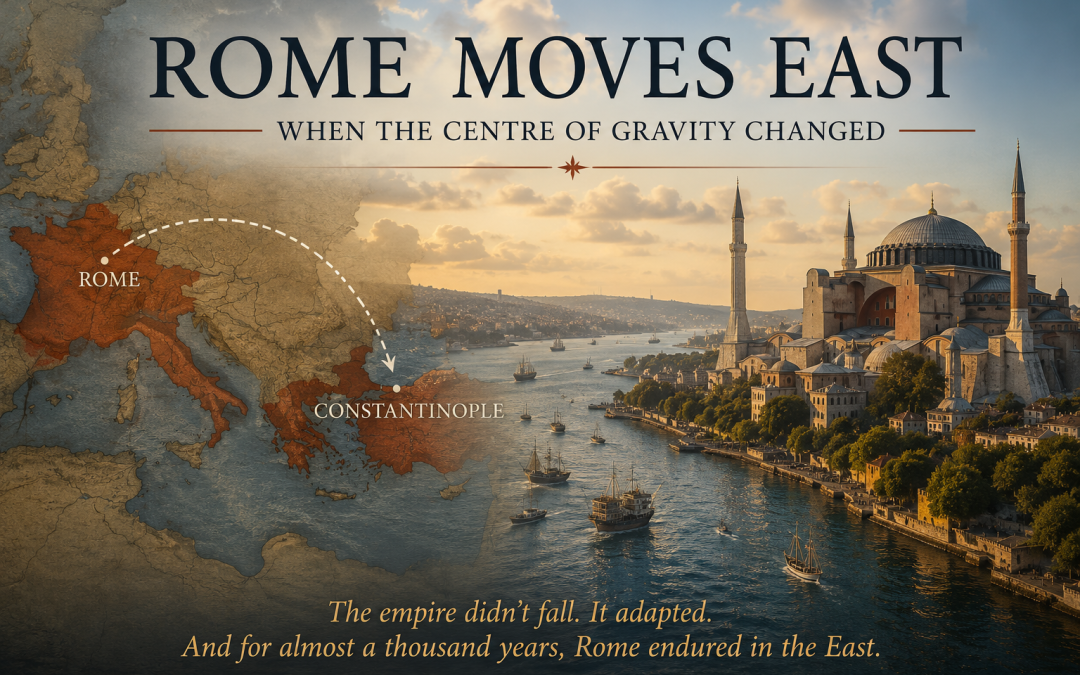
Ask almost anyone when the Roman Empire fell and the answer comes back without hesitation: 476 AD.
It is one of those historical facts that seems so well established we rarely think to question it. The difficulty is that it isn’t quite true. Part of the Roman Empire disappeared. Part of it simply moved.
To understand why, we need to stop thinking about Rome as a city and start thinking about it as a system.
When Success Becomes the Problem
We often imagine Rome disintegrating because it became weak. In many respects, the opposite was true. Rome had become astonishingly successful, and that success created its own difficulties.
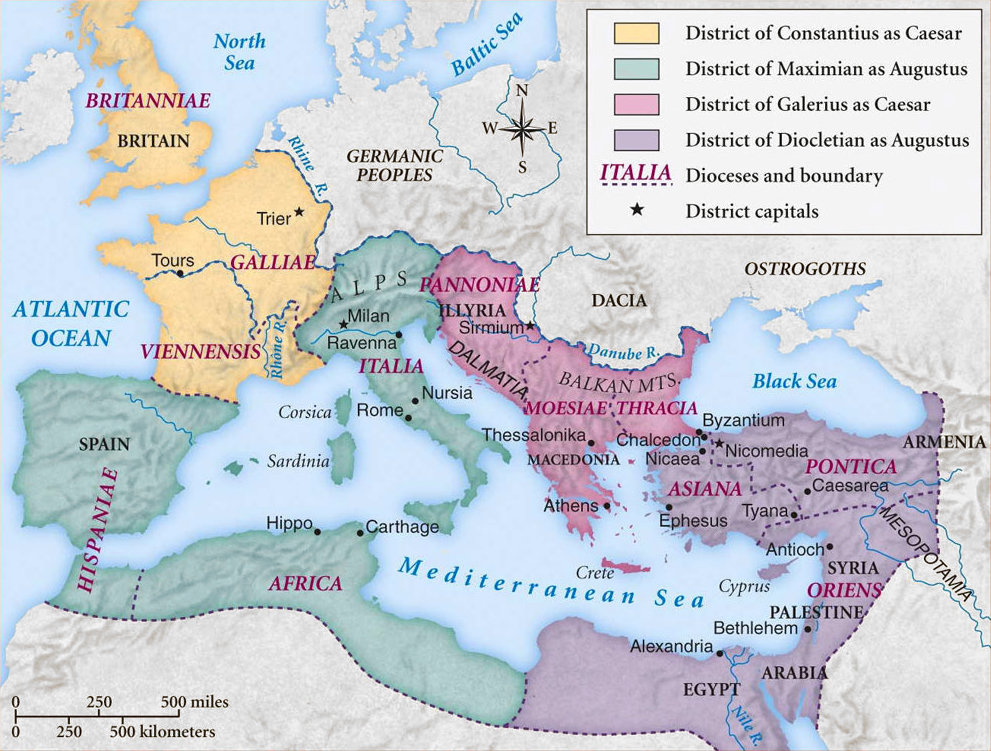
The empire now stretched from Britain to the Euphrates, from the Rhine to North Africa.
Source
Tens of millions of people lived under Roman rule. Messages took weeks to travel. Armies guarded thousands of miles of frontier. Emperors found themselves responsible for problems unfolding thousands of kilometres apart, often at the very same time.
The difficulty wasn’t simply finding better emperors, but that the structure itself was beginning to creak. Anyone who has watched a successful organization outgrow its original design will recognize the problem. The institutions that had once served Rome so well no longer quite matched the scale of the enterprise.
Learning to Govern Differently
The emperor Diocletian was one of the first to recognize that pretending nothing had changed was no longer an option. His solution was radical.
Instead of expecting one emperor to manage the entire empire, he divided responsibility among four rulers in what became known as the Tetrarchy. Regional capitals were established closer to the frontiers where decisions actually needed to be made.
The arrangement itself proved temporary, but the insight behind it endured. The Roman Empire had begun adapting its institutions to fit a changing world.
The Eastern Empire did not simply preserve Rome. Occasionally it even attempted to recover it. Under Justinian, Byzantine armies briefly reconquered much of Italy and North Africa. The achievement was extraordinary—but expensive. The Gothic Wars devastated Italy, and many of Justinian‘s gains proved difficult to hold. It was one more adaptation, not a permanent restoration.
Why Was the Capital Still in Rome?
Constantine‘s decision to found a new capital at Constantinople has often been portrayed as one of history’s great turning points. It certainly was. But perhaps not for the reason we usually imagine.
Viewed from Italy, moving the capital east seems extraordinary. Move yourself to the eastern Mediterranean, however, and a different question begins to emerge: why was it still in Rome?
Stand for a few minutes on the shores of the Bosphorus and the answer becomes easier to see. Europe lies on one side. Asia on the other. The Black Sea opens behind you. The Mediterranean stretches ahead. Ships, merchants, armies and ideas all funnel through one of the world’s great natural crossroads.
Suddenly, Rome feels a very long way from the problems that increasingly demanded imperial attention. Egypt supplied much of the empire’s grain. Asia Minor was among its wealthiest regions. Persia remained Rome’s great eastern rival, while the Danube frontier demanded constant military attention. The empire’s centre of gravity had quietly moved.
The empire’s centre of gravity had quietly moved. Looking at it from that perspective, Constantine wasn’t abandoning Rome at all. He was moving headquarters closer to where the work increasingly lay.
Adapting to Success
Looking back, it is easy to judge each emperor by what eventually happened, but history is seldom that generous.
Diocletian could not solve the problems of the seventh century. Constantine could not anticipate the fifteenth. Heraclius could only respond to the world he actually inhabited.
Each inherited a different reality and each adapted accordingly. Some of those adaptations lasted decades, others lasted centuries. None lasted forever. Perhaps that is the real lesson of Byzantium. Complexity was never the ambition. Survival was.
Over a thousand years the empire repeatedly adjusted its institutions to meet changing realities. Some adaptations worked brilliantly. Others merely bought time. None lasted forever.
That is not a failure of history. It is the nature of successful systems. They solve one problem only to discover that success has created another.
Constantinople would become one of history’s greatest examples of that truth.