
Steam & Smoke: The Real Engines of the Industrial Age
Before electricity lit streets and homes, the machinery driving the industrial world was hard to ignore. Steam hissed, pistons thudded and chimneys poured smoke into the air. At the heart of it all was something remarkably simple: boiling water.
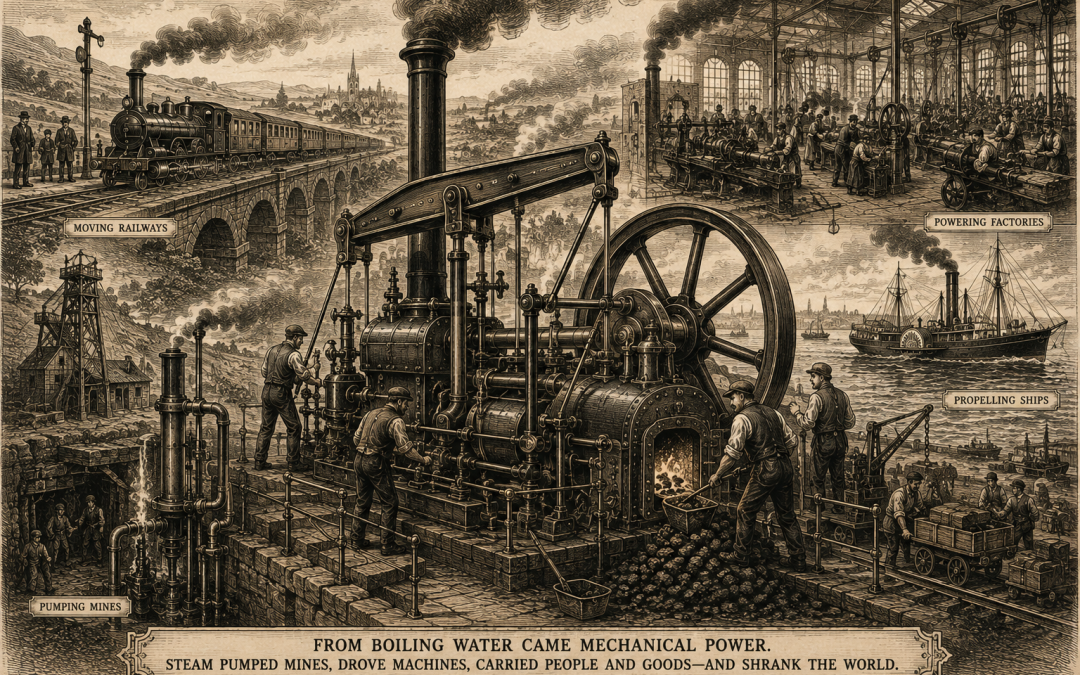
Over the eighteenth and nineteenth centuries, people found increasingly ingenious ways to turn steam into mechanical work. What began as a solution to a stubborn mining problem eventually powered factories, locomotives and ships, changing where people worked and lived and how quickly goods and people could move.
The Problem: Flooded Mines and Stubborn Geography
By the seventeenth century, Britain’s growing appetite for coal was driving miners ever deeper underground. As we explore more fully in Black Underfoot— Coal and the First Energy Abundance, this abundant, energy-dense fuel was already changing the country’s economy and landscape. But extracting it presented a stubborn practical problem: the deeper the mines went, the more water seeped into the shafts. Horses and hand pumps could remove only so much before flooding made deeper seams inaccessible.
In the early eighteenth century, Thomas Newcomen developed a steam-powered pump capable of lifting water from flooded mines. It was enormous and voracious, but coal was cheap at the pithead and efficiency mattered less than reaching the valuable fuel below. Coal was now powering machinery that made more coal accessible.
Newcomen’s engine repeatedly heated and cooled the same cylinder, wasting enormous amounts of energy with every cycle. When James Watt encountered a model Newcomen engine at the University of Glasgow, he began investigating where all that heat was going.
His solution was beautifully simple. Watt added a separate condenser, allowing the working cylinder to remain hot. Fuel consumption fell dramatically. Further refinements followed, many developed in partnership with the Birmingham manufacturer Matthew Boulton, and steam engines became increasingly efficient, versatile and useful far beyond the mines.
Factories Leave the River
For centuries, moving water had provided one of the most dependable sources of mechanical power. Mills therefore tended to go where the rivers went, and the landscape helped determine where industry could develop.
Steam engines gave manufacturers many more choices. A factory supplied with coal and water for its boilers no longer needed a convenient millstream rushing past the door. Towns with plentiful labour, good transport connections and ready access to coal became increasingly attractive places for industry.
The effects were especially dramatic across the Midlands and northern England, and into the industrial belt of central Scotland. Coalfields, factories, canals and eventually railways drew people and investment towards places that had once been comparatively small. Manchester became synonymous with cotton; Birmingham with metalworking and manufacturing; Glasgow with engineering and shipbuilding. Sheffield, Leeds, Bradford and countless smaller towns developed their own industrial specialities.
The countryside changed alongside the towns. Collieries appeared on estates whose wealth had once been measured largely in acres and rents. Canals and railway lines cut across old landscapes, while rows of workers’ houses gathered around mines and mills. Some landowners discovered that what lay beneath their estates could be considerably more valuable than what grew on top of them.
Factories grew larger and production became concentrated under one roof. Machinery could keep going as long as someone kept feeding the boiler, allowing work to continue on schedules less dependent on water, weather and daylight. Around the factories grew mills, warehouses, workers’ housing and railway yards. Within a few generations, large parts of Britain looked, sounded and smelled very different.
Steam Gets Moving
Engineers soon began experimenting with putting steam engines on wheels. Early locomotives were cumbersome, but improvements came quickly. George and Robert Stephenson’s Rocket, built for the Rainhill Trials of 1829, became one of the most famous demonstrations of what locomotive steam power could do.
Journeys that had once taken days could now be measured in hours. Farmers and merchants sent perishable food farther afield, newspapers reached readers sooner, and people could live, work and trade across distances that had previously made regular contact difficult.
Railways also encouraged a new expectation of predictability. A stagecoach might arrive when road and weather permitted; a railway published a timetable. That made the small differences between local clocks increasingly troublesome. A few minutes hardly mattered to a traveller on horseback. They mattered rather more when a train was supposed to leave at 10:17.
The eventual solution is a Hidden Framework story of its own, Standard Time—Sandford Fleming and the Order of Hours. Steam had allowed people to travel fast enough for agreeing on the time to become a practical necessity.
At sea, steamships gradually reduced sailors’ dependence on favourable winds. Paddle steamers and later screw-driven vessels made journeys more regular, mail more dependable and commercial schedules easier to plan.
A mile remained a mile, but increasingly it took less time to cross one. As railways spread, people began looking for ways to make their clocks agree.
Living with Steam
All this activity required fuel, and much of that fuel was coal. The smoke followed.
Industrial cities darkened beneath it. Soot settled on buildings, clothes and lungs. Factories could be noisy, hot and dangerous, while their demand for labour drew men, women and children into working conditions that ranged from tolerable to appalling. Rapid urban growth frequently outran housing, sanitation and public health.
Factory work also gathered large numbers of people together under increasingly regimented conditions. Owners, managers and workers occupied very different positions within the new industrial economy, and arguments over wages, hours, safety and political representation became part of nineteenth-century public life.
At the same time, industrial production made many goods cheaper and more plentiful. New occupations appeared—engineers, mechanics, locomotive drivers, machinists and inspectors—and people moved to industrial towns, invested in businesses, organized for better conditions, passed legislation and developed safer machinery.
Industrialization created opportunities and problems on an enormous scale, and people spent much of the nineteenth century adapting to both.
Traces of Heat and Pressure
Much of that world is still surprisingly easy to find.
At the London Museum of Water & Steam, enormous beam engines survive from the days when steam pumps helped supply a growing city with clean water. The Science Museum preserves engines associated with James Watt and Matthew Boulton. Across Britain, old pumping stations, railway viaducts, iron bridges, mills and brick chimneys remain embedded in the landscape.
Heritage railways provide perhaps the most visceral reminder. A steam locomotive has none of the discreet efficiency of an electric train. You hear it working. You smell the coal smoke and hot oil, feel the heat from the firebox and watch the exhaust burst from the chimney.
For those of us accustomed to power arriving silently through a socket, there is something wonderfully direct about it.