
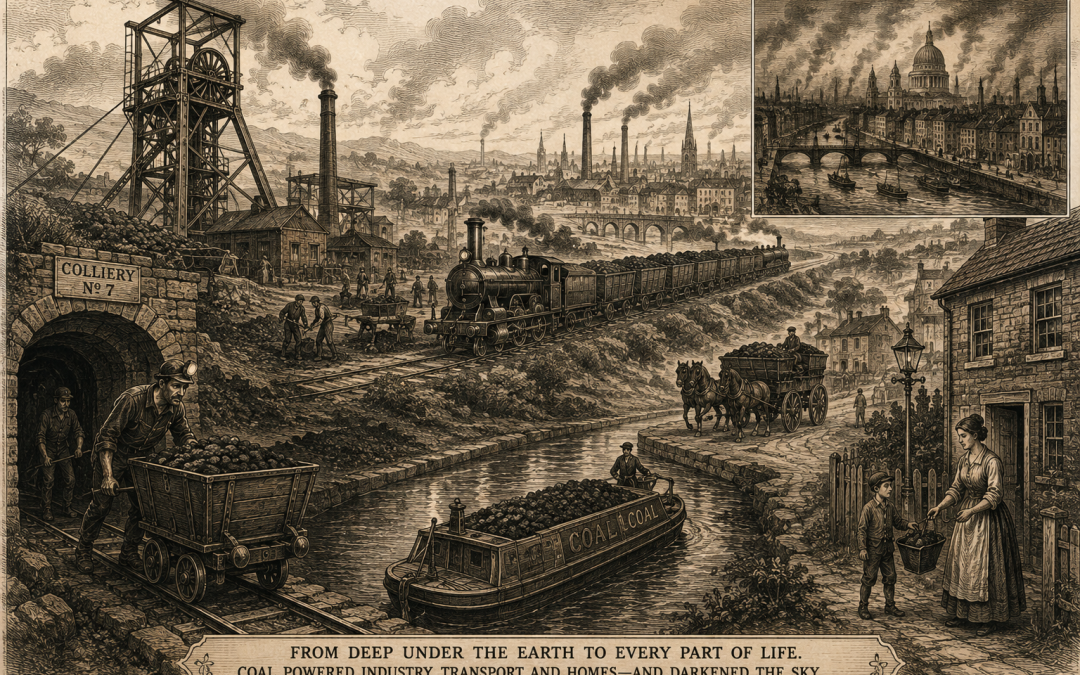
In the summer of 1976, London was preparing to celebrate the Queen’s Silver Jubilee. Some buildings had already been cleaned for the occasion; others were still waiting their turn. The contrast was startling. Pale stone gleamed beside façades darkened by decades of soot.
After a day spent walking around the city in open-toed sandals, a friend and I stopped for supper. Before sitting down, I detoured to the ladies’ washroom and gave my filthy feet a thorough scrub in the sink. The water ran black.
By then, coal had long since begun to lose its grip on London, but its traces were everywhere: in the brickwork, on buildings and, apparently, on the feet of anyone foolish enough to walk around the city in sandals. A century of coal smoke does not disappear simply because people stop lighting quite so many fires.
A Familiar Fog
For generations, Londoners lived with what became known as pea-soup fog: thick, yellow-green and acrid, muffling sound, swallowing distance and finding its way indoors through doors and window frames. Fog was sufficiently familiar to become part of the mythology of London, turning up in novels, jokes and popular imagery. Most of the time, people simply carried on around it.
Then, in December 1952, an especially severe combination of cold weather, coal smoke and a temperature inversion settled over the city. For four days, polluted air remained trapped close to the ground. Visibility fell to a few feet in places. Buses stopped running. Ambulances struggled to reach patients. Thousands of people died during the episode and in the weeks that followed; later estimates put the eventual toll as high as twelve thousand.
The Great Smog finally made the accumulated consequences of coal impossible to overlook. London had complained about coal smoke for centuries. Now the scale of the problem demanded a response.
Known for Centuries
Coal itself was hardly a modern discovery. It had been used in Britain since Roman times, particularly where surface seams made it readily available, and the Chinese had been using it as a fuel centuries earlier. For much of history, however, wood remained easier and more pleasant to burn wherever forests were plentiful.
England’s growing population began to change that calculation. By the sixteenth century, expanding towns and industries were putting increasing pressure on wood supplies. Timber became more expensive, forests receded farther from centres of demand, and abundant coal from northeastern England began arriving in London by ship.
Londoners immediately noticed the smoke. Complaints accompanied coal almost from the beginning, and attempts were made at various times to restrict its use. Yet the attractions were formidable. Coal was plentiful, relatively cheap and capable of producing intense heat. As demand for energy grew, those advantages became increasingly difficult to resist.
Fuel from Deep Time
Coal packed an extraordinary amount of energy into a relatively small volume. The ancient plant matter compressed within it over millions of years had effectively stored solar energy from deep time, ready to be released as heat.
That changed the possibilities available to human societies. Wood required large areas of forest and continual regrowth. Wind and water were wonderfully useful, but they depended on geography and weather. Coal could be dug up, transported, stored and burned when and where it was needed.
The consequences spread through the economy. Homes could be heated through long winters; furnaces could reach higher temperatures; workshops and factories could operate more reliably; cities could support populations that would once have placed impossible demands on nearby forests.
To the people adopting it, coal must often have felt less like an environmental bargain than an escape from constraints they had always assumed were permanent.
Coal Feeding Coal
here was, however, an awkward problem underground. As miners followed coal seams deeper into the earth, water followed them. Mines flooded, and removing the water by hand or horse power eventually became impractical.
That problem helped give birth to the steam engine. The earliest commercially successful steam engines were developed primarily to pump water from mines, allowing miners to reach coal that would otherwise have remained inaccessible.
The relationship quickly became self-reinforcing. Coal powered the steam engines that drained the mines, making it possible to extract more coal, which in turn could power more engines. An abundant fuel had helped create the technology needed to make itself more abundant still.
From there, steam escaped the mine. It entered mills, factories, ships and eventually locomotives, carrying coal’s concentrated energy into almost every corner of the industrial economy.
Living with the Cost
The benefits were obvious. So, increasingly, were the costs.
Coal reshaped landscapes and lungs alike. Mining scarred the ground; smoke darkened cities; soot settled on buildings, laundry, furniture and skin. Yet these effects arrived alongside warm houses, wages, manufactured goods and economic growth. For generations, people accommodated both sides of the bargain in the course of ordinary life.
That is perhaps difficult to appreciate now. Pollution tends to reach us as data—emissions, particulates, mortality rates. For people living in coal-fired cities, it was much more intimate. It was the extra washing, the grimy curtains, the stone that needed scrubbing, the cough that lingered and the fog that complicated the journey home.
And, decades later, it was still enough soot embedded in London to turn the water black when an unsuspecting Canadian washed her feet.
Correction, Not Conversion
The Great Smog of 1952 accelerated changes that had been building for years. Britain’s Clean Air Act of 1956 introduced smoke-control areas and encouraged households to move away from traditional coal fires toward cleaner fuels and appliances. Further legislation followed, while gas, electricity and other forms of heating became increasingly practical and attractive.
The transition took time. Coal had spent centuries becoming embedded in Britain’s houses, industries, transport networks and habits; it could hardly be removed from them at a stroke. As alternatives improved, however, coal gradually surrendered many of the jobs it had once performed.
There is a broader pattern here. Energy systems tend to change when a new combination of technology, economics, regulation and public preference makes another way of doing things workable. The old system rarely vanishes on command. It loses its hold piece by piece.
Cleaning the Air
The Great Smog of 1952 accelerated changes that had been building for years. Britain’s Clean Air Act of 1956 introduced smoke-control areas and encouraged households to move away from traditional coal fires toward cleaner fuels and appliances. Further legislation followed, while gas, electricity and other forms of heating became increasingly practical and attractive.
The transition took time. Coal had spent centuries becoming embedded in Britain’s houses, industries, transport networks and habits; it could hardly be removed from them at a stroke. As alternatives improved, however, coal gradually surrendered many of the jobs it had once performed.
There is a broader pattern here. Energy systems tend to change when a new combination of technology, economics, regulation and public preference makes another way of doing things workable. The old system rarely vanishes on command. It loses its hold piece by piece.
Underfoot
Coal helped build the modern world. It relieved an increasingly serious shortage of traditional fuels, provided concentrated and dependable energy, powered the steam engine and helped make industrialisation possible. In the process, it created consequences that accumulated alongside its benefits.
By 1976, London was busily cleaning those consequences from its buildings. One façade at a time, pale stone was emerging from beneath a century or more of grime. The city I saw that summer was therefore caught rather wonderfully between two eras: part of it still visibly belonged to coal-fired London, while the newly cleaned buildings offered a glimpse of what had been underneath all along.
I didn’t understand any of that as I stood in a restaurant washroom scrubbing my feet. I simply couldn’t believe how dirty they were.
Nearly fifty years later, that black water seems a rather good illustration of how infrastructure leaves its mark. The systems that make ordinary life possible can become so familiar that we cease to notice them. Sometimes we notice only when they stop working. And sometimes, long after their dominance has passed, we find their traces still underfoot.