Before electricity remade the night, people had become remarkably good at managing darkness. Candles and oil lamps had illuminated homes for centuries, until the nineteenth century brought gaslight to streets, factories, theatres and drawing rooms. Each improvement made artificial light cheaper and more dependable, but every lamp still required fuel and, usually, a flame.
Electricity offered an entirely different possibility. Energy could be generated in one place, transmitted over distance and delivered wherever people wanted to use it. Once the networks were in place, the same system that illuminated a room could drive a factory motor, propel a tram, operate an elevator or keep food cold.
Getting there took centuries.
Sparks and Curiosity
People had noticed electrical effects since antiquity. The Greeks observed that amber, when rubbed, attracted lightweight objects; indeed, our word electricity ultimately derives from the Greek elektron, meaning amber.
By the eighteenth century, electricity had become a fashionable subject among natural philosophers and gentleman experimenters. Glass globes spun, silk pads crackled and sparks jumped spectacularly in darkened rooms. Experiments with Leyden jars showed that electrical charge could be accumulated and released.
There was science here, certainly, but also plenty of theatre.
Benjamin Franklin’s famous experiments during the 1750s helped establish the connection between lightning and the electrical phenomena experimenters had been studying closer to the ground. His subsequent work on lightning rods also provided an early practical application: buildings could be protected by safely conducting an electrical discharge into the earth.
We were beginning to understand electricity; making useful quantities of it whenever they wanted was another matter.
Before the Grid: Gaslight
Understanding a phenomenon is one thing; turning it into something useful, reliable and widely available is another. While electricity was still largely confined to experiments, gas was showing what could happen when an energy source became part of an urban network.
London’s Pall Mall was famously illuminated with gas in 1807, and during the decades that followed, gas networks spread beneath growing cities. Central gasworks supplied pipes running to streets, factories, shops and eventually private houses. Urban nights became brighter and busier.
The infrastructure is worth noticing. Long before electrical grids, people were already becoming accustomed to receiving energy through a network. Instead of purchasing every unit of fuel individually, a household or business could connect to a system that produced energy elsewhere and delivered it through pipes.
Gaslight remained important well into the electrical age, and a small number of London’s historic gas lamps still burn today. But gas lighting brought flame, heat, fumes and the possibility of leaks into the places it illuminated. Engineers and inventors continued looking for other ways to produce light.
From Sparks to Systems
One of the crucial advances came from Michael Faraday’s experiments with electromagnetism. In 1831, he demonstrated electromagnetic induction: moving a conductor through a magnetic field could produce an electric current. That principle made the generator possible.
Instead of trying to accumulate small amounts of static charge, engineers could use mechanical motion to generate a continuous electrical current. Existing sources of mechanical power could now be put to another use. Steam engines drove generators; so did waterwheels and, later, turbines.
From there, the challenge expanded. Generating electricity was useful. Generating enough of it, moving it over distance and delivering it reliably to thousands—and eventually millions—of users required an entirely new kind of infrastructure.
Falling Water, Turning Turbines
Water fitted naturally into the emerging system. People had used moving water to turn wheels and machinery for centuries; generators provided another destination for that mechanical energy.
Hydroelectric plants used falling or flowing water to turn turbines connected to generators. Reservoirs could also store water until electricity was needed, giving operators some control over when that energy was released.
In countries and regions blessed with abundant rivers and elevation, hydroelectricity became enormously important. In Canada, the association became so strong that hydro entered everyday speech as a synonym for electricity itself. Canadians still receive the hydro bill, even when some of the electricity arriving at the house was generated by entirely different means.
Old water had found another job.
Bringing Electricity Indoors
The earliest practical electric lights were difficult to ignore. Arc lamps produced brilliant, harsh light and proved useful in places such as streets, railway stations and large public spaces. They were far less appealing on the dining-room table.
The incandescent lamp offered something gentler and more manageable. Many inventors contributed to its development, including Joseph Swan in Britain and Thomas Edison and his collaborators in the United States. The challenge extended beyond producing a glowing filament. A commercially useful lamp needed to last, be affordable and form part of a dependable system supplying electricity to it.
That last requirement was crucial. Edison and others weren’t simply selling lamps. They were developing generators, wiring, meters, switches and distribution networks capable of making those lamps useful.
Electricity was beginning to come through the front door.
Building the Grid
Generating electricity was one problem. Sending it any useful distance was another. Early direct-current systems worked reasonably well within compact areas, but transmitting electricity farther afield was inefficient. Alternating-current systems offered an important advantage: transformers could raise the voltage for efficient transmission over long distances and lower it again near the point of use.
The resulting competition between electrical systems became famously contentious. Edison promoted direct current, while George Westinghouse and Nikola Tesla became closely associated with alternating current. Technical arguments mixed with commercial rivalry, patents, publicity campaigns and some decidedly unpleasant attempts to frighten the public about competing systems.
Alternating current became the basis of most large-scale electrical networks because it allowed generating stations to serve much wider areas. That changed the scale of the enterprise. A generating station no longer needed to sit within a few blocks of everyone using its electricity. Power could travel.
The Wired World
Once generating stations and distribution networks spread, people found an extraordinary number of things to connect to them. Factories gradually replaced cumbersome systems of belts and shafts with individual electric motors. Electric trams and subways changed how people moved through cities. Elevators helped make taller buildings practical. Refrigeration altered how food was stored and transported. Radios brought distant voices into the home.
Domestic life changed more gradually. Houses had to be wired, appliances developed and electricity made affordable enough for ordinary households. Over time came electric irons, vacuum cleaners, refrigerators, washing machines, radios, toasters and an ever-growing assortment of devices designed to save labour or provide comfort and entertainment.
This is where electricity becomes particularly interesting as a hidden framework. The grid did not have to be reinvented for every new appliance. Once electricity was available at the socket, inventors and manufacturers could devise entirely new uses for a network someone else had already built.
Capabilities began to compound.
Keeping the Grid in Balance
From the earliest electrical networks to the enormous grids we rely on today, one stubborn problem has remained: electricity must be supplied at almost exactly the rate people are using it.
A coal pile can wait beside a power station. Gas can be held in storage. Water can sit behind a dam. Electricity itself is more difficult to store economically at enormous scale, although batteries and other technologies are rapidly expanding what is possible.
That awkward fact makes running an electrical grid an extraordinary exercise in continual coordination. As millions of people switch appliances on and off, operators and automated systems constantly adjust generation and flows across the network. As millions of people switch appliances on and off, operators and automated systems adjust generation and flows across the network. Some generating sources can respond relatively quickly; others are better suited to providing steady output.
Wind and solar power add another variable because their output depends on the weather and time of day. At favourable moments they can produce enormous quantities of electricity; at other times their contribution falls. Grid operators respond by combining different generating sources, transmission links, storage, demand management and increasingly sophisticated forecasting.
The engineering problem has evolved along with the technologies available to solve it.
When the Framework Becomes Visible
Most of the time, electricity reaches us so reliably that we scarcely think about the machinery and people behind the socket.
A blackout changes that remarkably quickly. Lights disappear, elevators stop, traffic signals fail, refrigerators begin warming and battery percentages suddenly become objects of intense interest. For a few hours, the network that usually sits quietly behind everyday life becomes impossible to ignore.
Always On
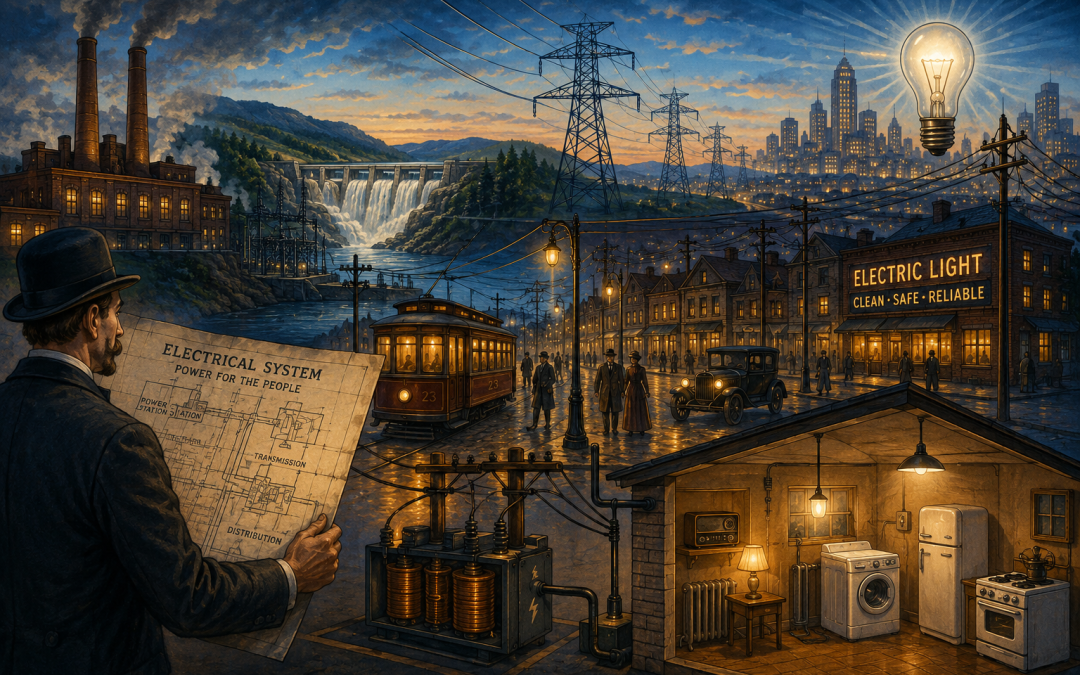
Behind the simple act of flipping a switch lies a remarkable chain of activity. Somewhere, energy is converted into electricity. Transformers change its voltage. Transmission lines carry it across long distances. Substations redirect it. Distribution wires bring it through neighbourhoods and eventually into individual buildings.
Thousands of people design, operate, repair, regulate and continually adapt that system, while millions more make use of it without needing to know very much about how it works.
Perhaps that is electricity’s most important contribution to Civilization Compounds. The people who built the first generating stations could never have anticipated everything later generations would connect to their networks. They didn’t need to.
They built a framework other people could build upon. And we have been plugging things into it ever since.