Few rulers altered the course of history as comprehensively as Constantine. He won decisive battles, founded a new imperial capital, and transformed the assumptions on which the Roman world operated.
By the time he died in 337, the Roman Empire had a new capital, a newly favoured religion, and a new relationship between political power and the Christian church. Rome was still Rome; paganism had not vanished. Christianity was not yet the empire’s official religion, but the direction of travel had changed.
For the next thousand years, European rulers would wrestle with questions Constantine had made unavoidable:
- Who protects the Church?
- Who decides religious doctrine?
- Can an emperor—or a king—claim authority in spiritual matters?
- And what happens when a faith built around a crucified teacher becomes associated with imperial power?
Those questions would shape Byzantium, the medieval papacy, the Holy Roman Empire, the Reformation, and much else besides.
Constantine did not create all of those outcomes. History is rarely so tidy. But he changed the setting in which they became possible.
The World He Inherited
Constantine was born around 272, into an empire that was still enormous, wealthy, and formidable—but increasingly difficult to govern.
The old Roman system had been designed for a city-state that had expanded into an empire. By the third century, that arrangement was under strain. The empire faced pressure along its frontiers, repeated civil wars, rapid turnover among emperors, inflation, and the sheer practical difficulty of governing territories stretching from Britain to Egypt and from Spain to Syria.
The emperor Diocletian had attempted to solve the problem by dividing authority among four rulers: two senior emperors and two junior colleagues. This arrangement, known as the Tetrarchy, was meant to provide stability, succession, and a more effective response to threats.
It worked for a time, but it also created a new problem. Once there were several emperors, there were several men with armies, ambitions, and claims to legitimacy. When Diocletian retired, the system began to fracture.
Constantine was the son of one of the emperors, Constantius Chlorus. When his father died in Britain in 306, Constantine was proclaimed emperor by his troops. What followed was not a smooth constitutional succession. It was a long and often brutal struggle for power.
By 312, Constantine was marching on Rome to confront his rival Maxentius. The decisive battle would become one of the most famous in Western history.
The Sign in the Sky
Before the Battle of the Milvian Bridge, Constantine later claimed to have seen a sign connected with the Christian God.
The exact story varies according to the source. In one version, he saw a cross or heavenly symbol in the sky, accompanied by words usually translated as “In this sign, conquer.” In another, he received the instruction in a dream. He then ordered his soldiers to place the Christian symbol known as the Chi-Rho—a monogram formed from the first two Greek letters of Christ’s name—on their shields.
The details are impossible to settle with complete confidence. Constantine’s conversion was not a single neat moment in the modern sense. He had grown up in a world where emperors regularly sought divine favour, and where military success was understood as evidence that a god had chosen a side. But whatever happened before the battle, Constantine clearly came to believe that the Christian God had helped him win.
At the Milvian Bridge, Maxentius was defeated and drowned in the Tiber. Constantine entered Rome as victor. The battle did not merely give him control of the western empire. It gave him a new explanation for his success—and a new political language through which to express it.
Christianity Moves from Margin to Centre
Christianity had existed within the Roman Empire for centuries. It had spread through cities, trade routes, households, and communities across the Mediterranean world. But it had often been vulnerable.
Christians were not persecuted continuously everywhere. Roman policy was inconsistent, local, and often pragmatic. Yet Christians could be regarded with suspicion because they refused to participate in the traditional religious rituals that helped bind Roman public life together. They would not sacrifice to the emperor or to the gods of the state. In moments of crisis, that refusal could look like disloyalty.
The great persecution under Diocletian, beginning in 303, had been particularly severe in some parts of the empire. Churches were destroyed, scriptures confiscated, clergy imprisoned, and believers pressured to conform.
Constantine’s victory changed the atmosphere. In 313, he and his eastern colleague Licinius issued what became known as the Edict of Milan. Christianity was not made the official religion of the empire. That would come later, under Theodosius. But Christians were granted legal toleration and the right to worship openly. Confiscated property was to be restored.
This was a profound shift. Christianity was no longer merely a tolerated minority faith living at the edges of public life. It had imperial protection, and soon it had something more than protection.
Constantine gave money to churches. He supported bishops. He granted privileges to clergy. He funded major building projects in Rome and the Holy Land. The great basilicas of St Peter’s and the Lateran were built under his patronage. The Church of the Holy Sepulchre in Jerusalem was created with imperial backing.
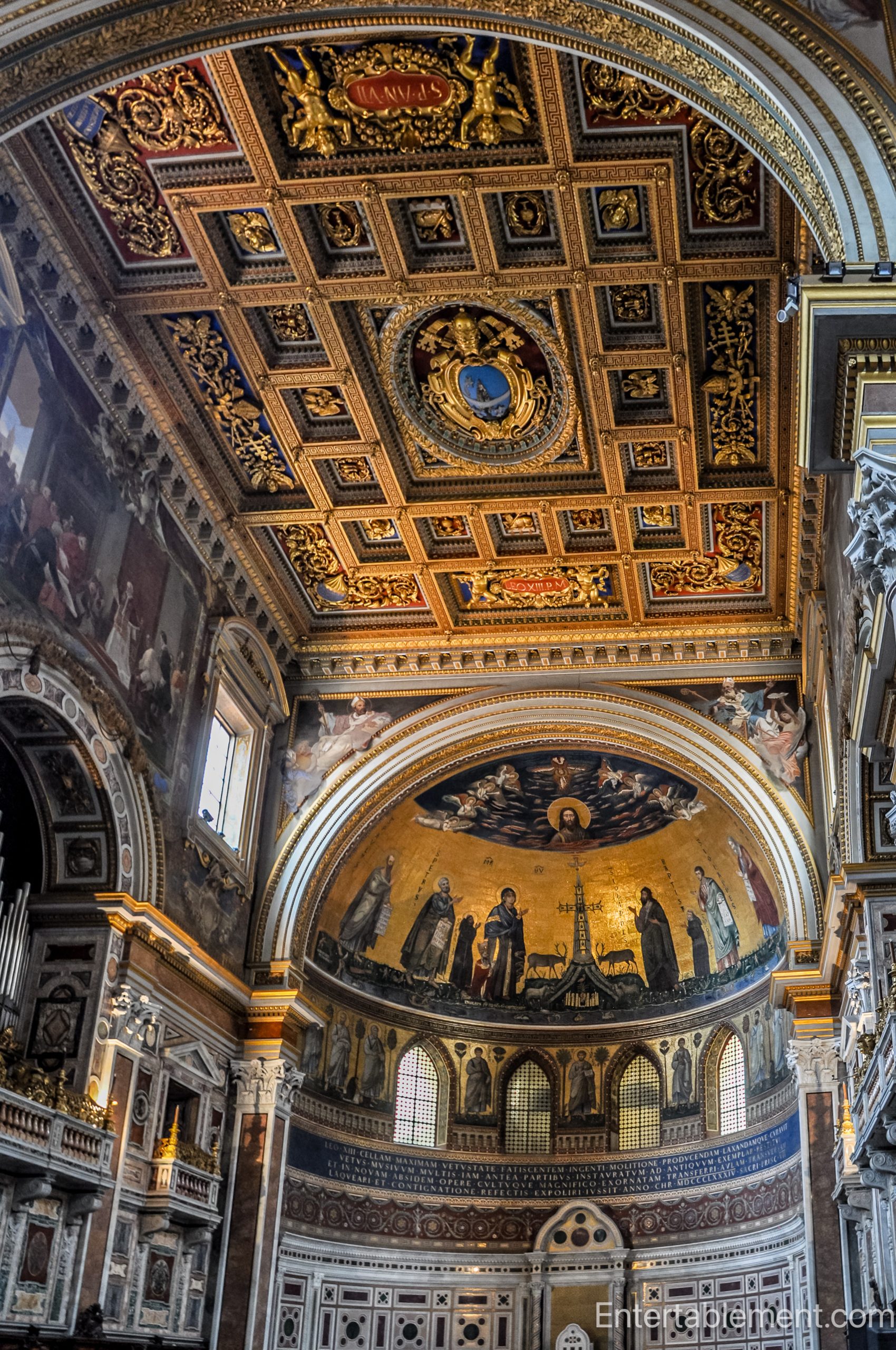
St John’s the Lateran
Christianity had not yet conquered the Roman world. But it had acquired the patronage of the most powerful man in it.
The Emperor and the Bishops
This new arrangement created immediate complications.
Christianity was not a single, perfectly organized institution waiting to be adopted by the state. It contained disagreements about doctrine, authority, scripture, discipline, and the nature of Christ himself.
One of the most serious disputes concerned a priest from Alexandria named Arius, who argued that Christ was not fully equal to God the Father. The argument spread rapidly and divided bishops, congregations, and regions of the empire.
Constantine was not a theologian. His primary concern was unity. Religious division looked to him like political division: a threat to the peace of the empire. So in 325, he called bishops from across the Christian world to meet at Nicaea, in what is now Turkey. The Council of Nicaea produced a creed affirming that Christ was of one substance with the Father. It condemned Arianism, at least formally, and established a model that would matter enormously in the future.
An emperor had convened the bishops. Further, an emperor had expected them to settle a doctrinal dispute. And significantly, an emperor had become involved in the internal affairs of the Church. This did not mean Constantine controlled Christianity in any simple sense. Bishops argued, resisted, formed alliances, and continued to disagree long after the council ended. Nor did it mean that later popes would accept imperial oversight willingly.
But a precedent had been created. The Christian Church had entered a new world in which theological disputes could become matters of imperial concern. That would prove both powerful and dangerous.
A New Rome in the East
Constantine’s other great act was the founding of Constantinople. Rome remained the symbolic heart of the empire. It had ancient prestige, senators, monuments, and memories. But it was no longer the most practical place from which to govern.
The empire’s strategic pressures lay increasingly in the east: along the Danube, near the Balkans, in Asia Minor, and on the frontier with Persia. Rome was distant from those regions. It was magnificent, but geographically inconvenient.
Constantine chose the old Greek city of Byzantium, on the Bosporus, and rebuilt it on an imperial scale. Its location was superb. It sat between Europe and Asia, controlled access between the Black Sea and the Mediterranean, and stood close to the empire’s wealthiest and most contested provinces.
In 330, the city was formally dedicated as Constantinople—“the city of Constantine.” It was not intended as an abandonment of Rome. Constantine did not imagine that the old capital would disappear from history. But he had shifted the centre of gravity. The consequences were enormous.
When the western empire later weakened and fragmented, the eastern half remained organized around Constantinople. It retained its bureaucracy, its tax base, its armies, its urban life, and its imperial identity.
The people we call Byzantines never called themselves Byzantines. They called themselves Romans. And in an important sense, they were right. Their empire was Roman in law, administration, political identity, and memory. It was Christian in religion. It was increasingly Greek in language and culture. Constantinople became the place where those elements fused.
Constantine had not created Byzantium as later generations would know it, but he had given it its capital.
The Complications
It is tempting to turn Constantine into a clean hero of Christian history: the emperor who saw the light, defeated persecution, and ushered in a new age, but the reality is less settled.
Constantine was a Roman emperor of his age: ambitious, ruthless, politically calculating, and willing to eliminate rivals. He ordered the execution of his eldest son, Crispus, under circumstances that remain unclear. Soon afterwards, his wife Fausta also died, perhaps on Constantine’s orders. The stories surrounding both deaths are murky, but the fact of the family tragedy is not.
He did not suddenly become a gentle Christian prince.
Nor did Christianity suddenly become a religion of humility detached from power. Once imperial patronage entered the picture, bishops gained wealth, influence, legal privileges, and access to the machinery of government. The Church could protect the vulnerable and preserve learning. It could also become entangled in the ambitions of rulers and elites.
Constantine himself was baptized only near the end of his life, which is not necessarily a sign of insincerity. Many Christians of the period delayed baptism, partly because baptism was understood to wash away sins and post-baptismal sin was treated very seriously. But it reminds us that Constantine’s religious life unfolded gradually, within the assumptions of his own world.
He was neither simply a saint nor simply a cynic. He was a ruler who came to believe that the Christian God had granted him victory—and who then used imperial power to reshape the world around that conviction.
The World He Helped Create
Constantine changed the relationship between belief and power.
Before him, Christianity was a growing religion within the Roman Empire. Rome was one great city among several centres of imperial power, in which bishops argued within a church that had often existed precariously alongside the state.
After him, Christianity became increasingly woven into the empire’s public life. Constantinople replaced Rome as the strategic and symbolic heart of the eastern empire; emperors and bishops had to negotiate a new and enduring question: who governs the Christian world?
The answer would never be settled.
In Byzantium, the eastern empire, emperors would often exercise immense influence over the Church. In the Western “Old Rome”, popes would eventually claim authority independent of kings and emperors. Medieval Europe would spend centuries working through the consequences: coronations, councils, investiture disputes, crusades, reform movements, and the long struggle between spiritual and temporal power.
Constantine did not resolve those tensions; he created the conditions in which they became unavoidable. That is why he belongs among the great pivotal figures of history.
He did not merely convert. He changed the terms of the argument.