
A visitor to Rome is immediately struck by the juxtaposition of ancient and modern life. Traffic whizzes past the Colosseum, while Romans go about their daily business, apparently taking for granted a monument that has stood for nearly two thousand years. Ancient buildings lend a reassuring sense of permanence, as though Italy has always been there, much as we know it today.

The Colosseum
But Italy wasn’t always a country. For centuries after the collapse of the Western Roman Empire in the fifth century, the peninsula was divided among competing kingdoms, territories and independent cities. By the thirteenth century, Florence, Venice, Genoa and other prosperous cities were governing many of their own affairs, competing for trade and frequently going to war with one another.
Florence was an unlikely candidate to become one of Europe’s great financial and artistic centres. It had no seaport, no vast empire and no particularly abundant natural resources. Yet its merchants developed trading networks that reached across Europe, its bankers financed kings and popes, and its wealthy families commissioned some of the most celebrated works of the Renaissance.
How did a landlocked city in central Italy become so influential?
One answer begins with sheep. English sheep, to be precise.
From Wool to Wealth
By the thirteenth century, England was a major exporter of wool. Its fleece was particularly prized by textile manufacturers in Flanders and Italy, where skilled workers transformed it into expensive cloth.
Florentine merchants purchased English wool and arranged its transport across Europe. Once it reached Florence, it passed through a succession of workshops where workers cleaned, combed, spun, wove, dyed and finished the fabric. The resulting cloth was sold in markets throughout Europe and the Mediterranean.
It was a complicated business. Merchants needed to purchase raw materials months before selling the finished product, pay workers and suppliers, arrange transportation and manage customers who might live hundreds of miles away.
Florence’s wool guild, the Arte della Lana, regulated much of the industry. Its members were wealthy merchants and manufacturers who exercised considerable influence over the city’s government. The people doing the actual washing, spinning and weaving? Not so much.
But the wool trade created something beyond expensive cloth. It encouraged Florentine merchants to develop the financial arrangements necessary to conduct business over long distances.
Banking Without Moving the Money
Imagine being a Florentine merchant purchasing wool in England. You need to pay your English supplier, but your money is in Florence. You could, of course, arrange to transport a heavy chest of coins across Europe, with all the expense and risk that involved.
And even if the coins arrived safely, what were they worth? Kings, princes and city-states minted their own coins, often with varying amounts of precious metal. Some rulers debased their coinage, while enterprising individuals clipped or shaved coins to extract a little gold or silver for themselves. For merchants trading across borders, establishing what a coin was actually worth could be a considerable headache.
The problem wasn’t the absence of coins. It was the absence of trust.
Florence’s answer was the gold florin, introduced in 1252. Containing approximately 3.5 grams of remarkably pure gold, it maintained a consistent weight and fineness, earning the confidence of merchants across Europe. Think of it as the original gold standard.
But we still had the issue of lugging the physical currency. Enter the bill of exchange: move a promise rather than the money itself.
Bills of exchange allowed merchants to arrange payments between distant cities through bankers and their agents. Our Florentine merchant could pay a banker at home, who would arrange for his English supplier to receive payment in local currency.
Of course, paper promises came with risks of their own. Would the banker honour the arrangement? Would his agent have the funds? What happened if either went bankrupt?
The Florentines hadn’t invented the idea of transferring money without physically transporting it. Merchants in the Islamic world had been using comparable arrangements for centuries, and other Italian trading centres had developed their own methods. But Florence became particularly adept at putting them to work.
By the early fourteenth century, Florentine banking families such as the Bardi and Peruzzi had established extensive international operations. They financed trade, transferred funds and extended credit to powerful clients, including kings and popes.
Lending to kings, however, presented difficulties of its own. A monarch might be an enormously valuable customer, but collecting an overdue debt from him was another matter entirely.
Both banking houses collapsed in the 1340s. Large loans to rulers contributed to their troubles, although their failures were more complicated than the familiar tale of an English king who neglected to repay his debts.
A City Changed by Plague
Florence had barely emerged from the banking crises of the 1340s when the Black Death arrived in 1348. The consequences were devastating. Families were decimated, businesses disrupted, and the city’s bustling workshops lost much of their workforce.
But the plague also produced an unexpected shift in bargaining power. With fewer hands available to do the work, surviving labourers could sometimes demand higher wages. For employers accustomed to having the upper hand, this was an unwelcome development.
It didn’t mean that Florence’s workers suddenly became prosperous. Far from it. The city’s textile industry continued to generate considerable wealth, but much of it remained concentrated in the hands of merchants and guild masters.
In 1378, the frustrations boiled over. The ciompi, poorly paid workers involved in wool processing, joined an uprising against Florence’s political and economic establishment. For a brief period, they gained a voice in the city’s government before the movement was crushed.
There was something decidedly awkward about a city whose prosperity depended so heavily on wool production denying many of the people who worked in that industry a meaningful say in how it was governed.
Florence’s merchants and bankers, meanwhile, continued their competition for wealth and influence.
The Medici Arrive
In 1397, Giovanni di Bicci de’ Medici established the bank that would become the foundation of his family’s fortune.
He wasn’t inventing a new industry. Florentine merchants had been trading internationally for generations, and the city’s bankers had already developed sophisticated financial networks. Giovanni’s achievement was to build a successful business in a competitive and sometimes perilous environment.
He expanded the bank’s operations, cultivated valuable relationships with the papacy and amassed a considerable fortune. When his son Cosimo took over in 1429, he inherited more than a thriving bank. He inherited the means to become Florence’s most influential political figure.
Cosimo, however, had a problem. Florence was a republic, and its citizens were distinctly suspicious of anyone behaving like a prince. The trick was to wield considerable power without appearing to do so.
He cultivated a comparatively modest public manner, relying on financial relationships, political alliances and the support of influential families to exercise power without claiming authority outright. Not everyone was convinced. His opponents managed to have him exiled in 1433, although he returned the following year and subsequently dominated Florentine politics.
Cosimo understood that appearing less powerful than he was could be a considerable advantage. He also recognized that money could accomplish rather more than buying political influence.
It could build churches, libraries and public buildings. It could attract scholars and artists. And, perhaps most appealingly, it could ensure that the Medici name would be remembered long after the bank’s ledgers had been closed.
Why So Much Art?
Florence’s extraordinary artistic achievements were not simply the result of wealthy people developing expensive tastes.
The city’s fierce commercial and political competition extended into architecture and the arts. Merchant families commissioned chapels, paintings and sculptures. Guilds financed public projects. Wealthy citizens supported churches and charitable institutions, partly from religious conviction, partly from civic pride, and sometimes because a magnificent building was an excellent way to demonstrate one’s importance.
There was a good deal to be gained from such generosity. A splendid chapel proclaimed a family’s wealth and devotion, while a public building could earn the gratitude of fellow citizens. And unlike a successful business transaction, a handsome piece of architecture might keep reminding people of its benefactor for generations.
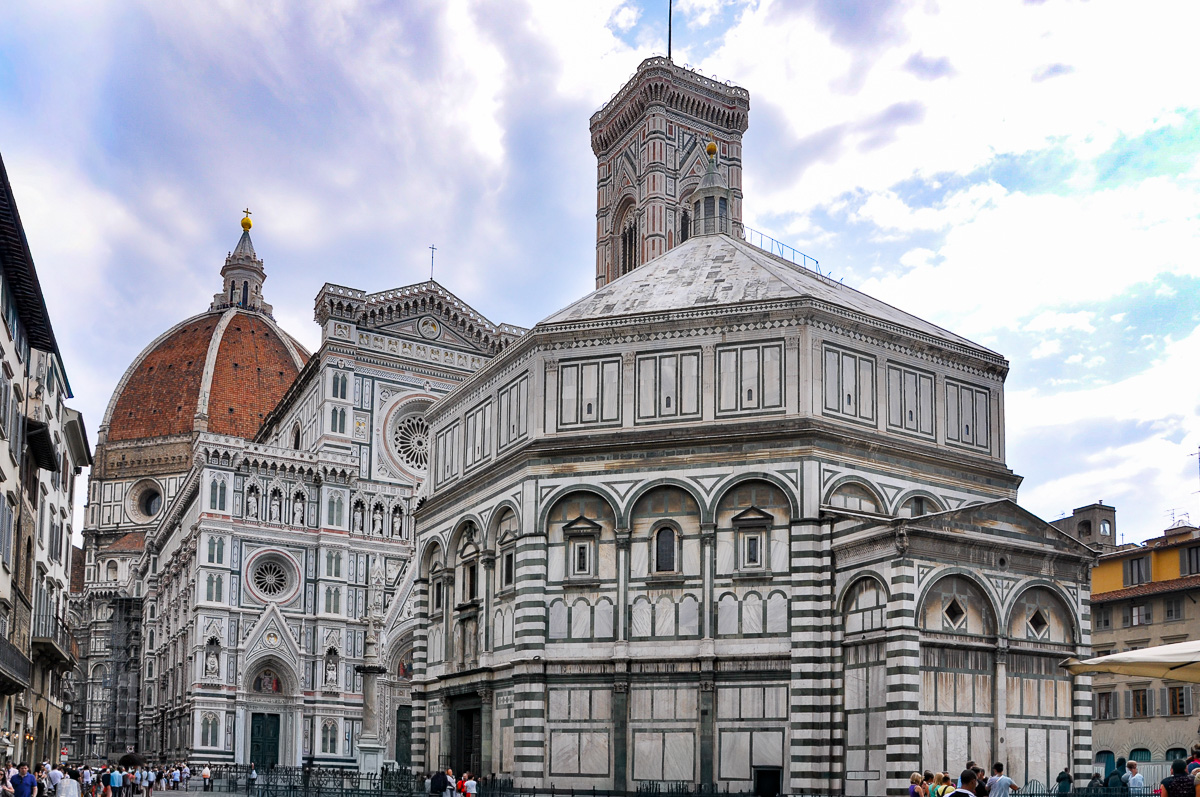
The cathedral provides a remarkable example. Construction of Santa Maria del Fiore began in 1296, long before the Medici became Florence’s dominant family. The enormous dome envisioned for the cathedral presented an engineering problem that remained unresolved for more than a century.
In 1420, the wool guild, which oversaw the cathedral works, entrusted Filippo Brunelleschi with the task of constructing it.
Brunelleschi had trained as a goldsmith. He had studied ancient Roman buildings, including the Pantheon, and developed a keen interest in engineering and mathematics. His solution involved a double-shell dome, carefully arranged masonry and ingenious lifting machinery. The dome was substantially completed in 1436.
There is something wonderfully appropriate about the connection. An industry built upon English wool helped finance one of the most ambitious architectural achievements of the Renaissance.
And Brunelleschi was hardly alone. Florence supported a remarkable community of artists, architects and craftsmen. Their workshops trained apprentices in drawing, sculpture, painting, metalworking and other practical skills. Knowledge passed between masters and pupils, while competition for commissions encouraged experimentation.
Leonardo da Vinci entered this world as a young apprentice in the workshop of Andrea del Verrocchio. Born near Florence in 1452, Leonardo learned within a tradition that valued craftsmanship, observation and technical ingenuity.
But Leonardo’s curiosity extended well beyond painting. He investigated anatomy, studied the movement of water, designed machines and filled notebooks with observations and ideas. The distinction we make today between artist, engineer and scientist would have seemed rather limiting to him.
He eventually left for Milan, where he entered the service of the ruling Sforza family. His career illustrates another consequence of Italy’s political fragmentation: artists, engineers and other talented individuals could move between competing courts and cities, finding patrons willing to support their abilities.
The Price of Influence
By the late fifteenth century, Florence had become one of Europe’s most celebrated artistic centres. Its commercial wealth, skilled craftsmen, ambitious patrons and fiercely competitive political culture had produced an extraordinary concentration of talent. But prosperity was no guarantee of political stability.
Cosimo de’ Medici’s grandson Lorenzo, known as the Magnificent, inherited the family’s dominant position and became an important patron of Renaissance culture. Yet the Medici Bank declined during his lifetime, and the family’s hold on Florence remained precarious.
Lorenzo died in 1492. Just two years later, the Medici were expelled from the city. Florence might have tolerated a family becoming extraordinarily powerful, but that didn’t mean its citizens had abandoned their republican instincts—or their rivalries.
And none of the people we’ve encountered were working towards something called the Renaissance. They were buying wool, manufacturing cloth, arranging loans, seeking employment, competing for influence and solving whatever problems confronted them. The extraordinary artistic achievements that followed were not inevitable. They emerged from the ambitions, skills and decisions of generations of Florentines.
Which brings us back to the English sheep. Florence became famous for Brunelleschi’s dome and the artists it nurtured, including the young Leonardo da Vinci, but much of the wealth that made those achievements possible began with wool imported from England.
It’s quite a journey from an English sheep pasture to the dome of Florence’s cathedral.