
While some kings inherit a kingdom, Edward III inherited a crisis. In 1327, his father, Edward II, was deposed and imprisoned. The crown passed to the fourteen-year-old Edward, but the real power remained in the hands of his mother, Isabella of France, and her ally Roger Mortimer. Though England had a king, he was not ruling. This tense situation lasted for three years.
In 1330, the young Edward struck back. Mortimer was arrested in a dramatic nighttime coup at Nottingham Castle and later executed. Isabella was removed from power, though treated far more gently than her cohort.
Within months, Edward III took control of his kingdom and would rule for the next fifty years.
The Return of Confidence
Edward proved to be almost everything his father was not. He was energetic, decisive, politically skilled, and personally courageous. Where Edward II had often struggled to command confidence, Edward III seemed to inspire it naturally.
England responded. The kingdom Edward inherited already possessed many of the institutions that had been developed over the previous two centuries. Royal administration functioned efficiently. Common Law continued to expand. Parliament had become an established part of government. Trade was growing, towns were prospering, and England’s population had reached levels never before seen.
Edward’s achievement was not creating these systems; it was leading a kingdom that increasingly believed in itself.
The Warrior King
If Edward’s domestic government restored confidence, his military campaigns created legend. His reign became closely associated with the opening phase of what later historians would call the Hundred Years’ War.
A century earlier, Henry II had ruled an empire that stretched across much of western France. By the early thirteenth century, however, most of those continental possessions had been lost, particularly during the reign of King John. Normandy, Anjou, Maine, and Touraine had slipped from English control, fundamentally altering the balance of power between England and France.
The losses lingered in the political imagination. They represented not merely territory, but prestige. For generations, English kings had grappled with the consequences. Edward III approached the problem differently. Rather than attempting to recover what had been lost piece by piece, he challenged the very legitimacy of the French monarchy itself.
In 1346, English forces defeated a much larger French army at Crécy. A decade later came another remarkable victory at Poitiers. The victories elevated England’s reputation throughout Europe. They also elevated the reputation of Edward’s eldest son, Edward of Woodstock, better known today as the Black Prince.
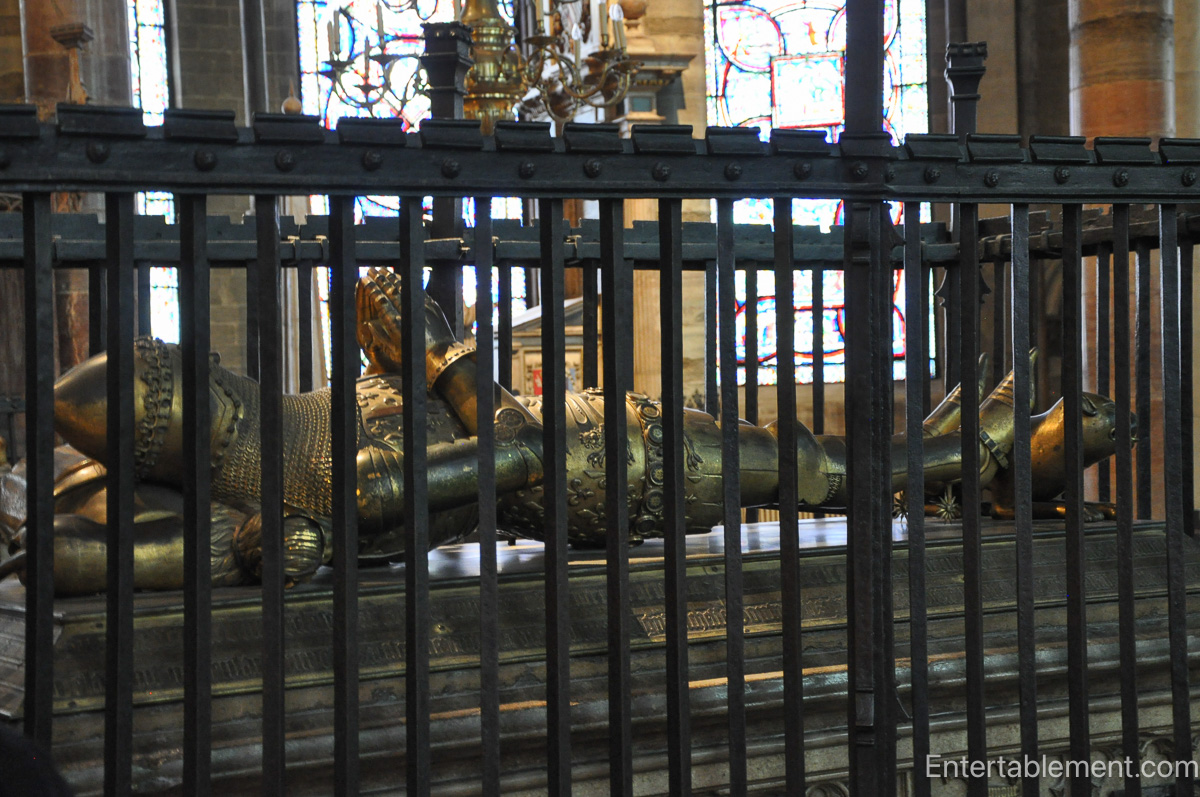
Tomb of the Black Prince
Together, father and son seemed to embody the ideals of medieval kingship and chivalry. Military success, noble conduct, and national confidence appeared to move in lockstep.It is easy to see why contemporaries regarded Edward’s reign as a golden age.
The Black Death
Then, in 1348, plague arrived. The Black Death swept across England with devastating speed and little discernment — noblemen, peasants, craftsmen, and monks were struck down. Some communities lost a third of their population The human cost was immense.
Yet what makes Edward’s reign so remarkable is that the kingdom did not collapse.
The plague transformed England. Labour became scarce, causing wages to rise. Landowners struggled to maintain traditional arrangements. Old assumptions about work, wealth, and social status began to shift. The arithmetic of medieval society had changed and the consequences would echo for generations.
But England endured.
The Order of the Garter
In the midst of these upheavals, Edward established one of the most enduring institutions of his reign. Around 1348, he founded the Order of the Garter. Part military fraternity, part chivalric society, and part expression of royal prestige, the Order reflected Edward’s vision of kingship.
Its ceremonies, traditions, and symbolism linked military service to national identity in ways that would outlast the medieval world itself. Nearly seven centuries later, it remains Britain’s highest order of chivalry. Though many of Edward’s victories have faded into history, The Order he created endures.
Storm Clouds Gather
For much of his reign, Edward appeared almost unstoppable. But even the most successful rulers cannot escape time.
The Black Prince died in 1376, depriving England of the heir many expected to continue his father’s successes. Edward himself grew older and less engaged in government. New favourites emerged at court and political tensions resurfaced. Economic strains created by plague and war remained unresolved.
The confidence of the earlier decades began to fade. Many of the problems that would dominate the reign of Richard II were already becoming visible, including questions about authority, taxation and social change.
The kingdom remained powerful, but the foundations were beginning to shift.
A Nation on the Brink
When Edward III died in 1377, he had ruled for fifty years. Few English kings left a greater mark on their age.
His reign witnessed military triumphs, growing national identity, expanding institutions, and extraordinary resilience in the face of catastrophe. And it also witnessed famine, plague, demographic collapse, and profound social change.
In many ways, Edward represented the high-water mark of medieval England. The kingdom he left behind was wealthy, confident, and influential. It was also changing in ways that few fully understood.
His grandson Richard II would soon inherit those challenges.
The storms that would define the late Middle Ages had not yet broken, but the clouds were already gathering.