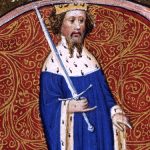
Few rulers have benefited more from success than Henry V.
To later generations he became the warrior king of Agincourt, the hero of Shakespeare’s plays, and the embodiment of English courage. His reputation grew so large that it sometimes obscures the man himself. Yet Henry’s greatest achievement was not a battlefield victory; it was legitimacy.
When Henry became king in 1413, the Lancastrian dynasty was relatively new. His father had seized the throne only fourteen years earlier. Questions still lingered about the circumstances surrounding Richard II‘s deposition and the rights of competing claimants.
The dynasty was established, but it was not yet secure.
A Disciplined King
Henry approached this challenge with remarkable focus. Unlike Richard II, he rarely became distracted by ceremony. And unlike his father, Henry IV, he did not spend most of his reign responding to crises. Instead, he projected competence, discipline, and purpose. He cultivated unity among the nobility and presented himself as the servant of a larger national cause.
That cause was France. The Hundred Years’ War had ebbed and flowed for decades, but Henry revived England’s claims with renewed determination. His campaign culminated in the Battle of Agincourt in 1415, where an exhausted and heavily outnumbered English army achieved one of the most celebrated victories in military history.
The battle entered legend almost immediately, for reasons that went beyond tactics or heroism. The Battle of Agincourt gave England a story. A disputed dynasty suddenly became associated with success. The son of a usurper became a conquering king. Political divisions that had troubled previous reigns were temporarily overshadowed by a sense of national achievement.
Henry understood the power of symbols. He cultivated an image of disciplined kingship and shared purpose. His victories strengthened not only his position but the credibility of the Lancastrian regime itself.
Peak Plantaganet
The culmination came with the Treaty of Troyes in 1420. Henry was recognized as heir to the French throne and married Catherine of Valois, daughter of the French king. For a brief moment it appeared that England and France might be united under a single dynasty. It was the high-water mark of Plantagenet ambition.
Then came the twist history so often provides. Henry died in 1422 at just thirty-five years of age. His heir, Henry VI, was an infant.
The king who had transformed legitimacy into belief left behind a kingdom that would soon discover how much depended upon his personal leadership. The achievements remained, but certainty was shattered. .
Henry V remains one of England’s most admired kings. His story is goes beyond mere military success. It is the story of a ruler who persuaded people to believe—in his dynasty, in his cause, and in the future he promised.
For a generation, that belief held. The question of what happened when it faded would shape the next chapter of English history.