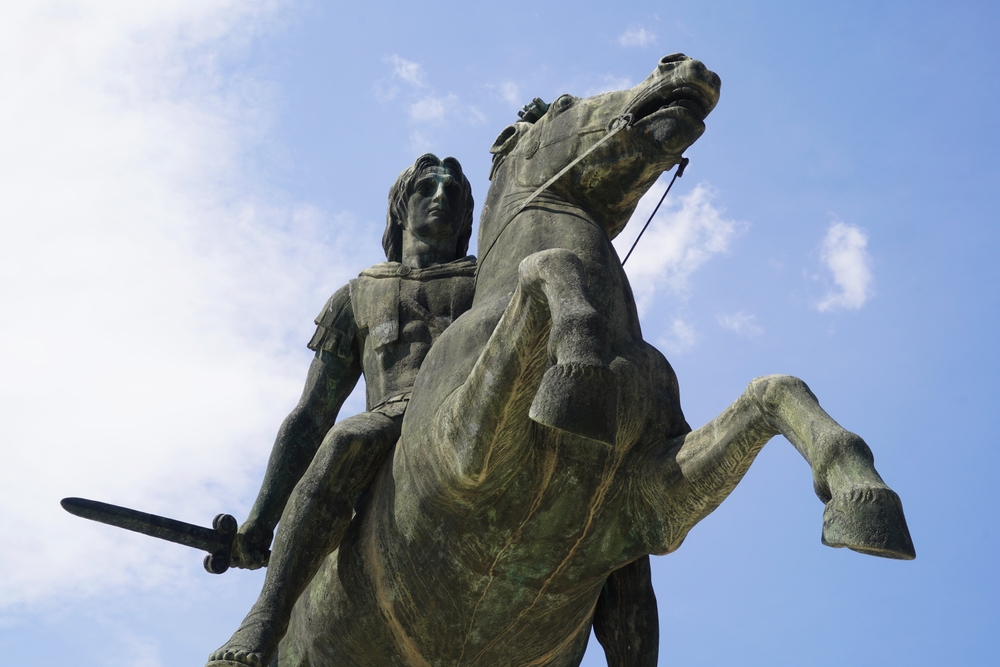
Alexander the Great never seemed content to stand still. Before he reached the age of thirty, he had marched farther than any king before him, defeated the greatest empire of his day, founded cities across three continents, and begun imagining a world unlike anything his contemporaries had known.
More than two thousand years later, his name remains almost synonymous with military genius. Schoolchildren learn of the Gordian Knot, the crossing of the Hellespont, the battles of Issus and Gaugamela, and the long march towards India. Yet those achievements, remarkable though they were, tell only part of the story.
The battles explain how Alexander conquered an empire, but they do not explain why people are still fascinated by him.
That fascination lies in the extraordinary combination of brilliance, ambition, imagination and restlessness that seemed to drive him throughout his short life. Alexander was never content simply to inherit his father’s kingdom. He wanted to discover how far the world extended—and whether one person could hold it together.
Raised to Think on a Grand Scale
Alexander was born in 356 BC at Pella, the capital of Macedon.
His father, Philip II, was one of antiquity’s greatest military reformers. Through diplomacy, warfare and careful political alliances, Philip transformed Macedon from a peripheral kingdom into the dominant power in Greece. His mother, Olympias, was intelligent, forceful and deeply ambitious for her son.
Alexander grew up believing that ordinary achievement would never be enough.
His education reflected those expectations. Aristotle became his tutor, introducing him to philosophy, literature, science and medicine. Homer remained a lifelong companion, and Alexander is said to have kept a copy of The Iliad close at hand during his campaigns, seeing in Achilles not merely a hero but an example to follow.
When Philip was assassinated in 336 BC, Alexander inherited not only a kingdom but an unfinished ambition.
He was twenty years old.
The Young King Who Wouldn’t Stop
Most rulers spend years securing what they already possess. Alexander did the opposite. Within two years he had secured Greece, crossed into Asia and begun dismantling the Persian Empire. Victory followed victory—at the Granicus River, at Issus and finally at Gaugamela, where the forces of Darius III collapsed before him.
Most kings would have stopped. Alexander kept going. He marched into Egypt, where he founded Alexandria. He crossed Mesopotamia, entered Persia, pushed through the mountains of modern Afghanistan, campaigned across Central Asia and eventually reached India.
It was not simply the distance that astonished his contemporaries. It was the pace. In barely a decade he created the largest empire the ancient world had yet seen.
A King Between Two Worlds
As Alexander’s empire expanded, something else began to change. He no longer behaved simply as a Macedonian conqueror. Increasingly, he presented himself as the successor to the Persian kings he had defeated. He adopted elements of Persian court ceremony, promoted Persians to senior administrative positions and encouraged his Macedonian officers to build relationships with the Persian nobility.
His marriages reflected that same ambition.
Modern readers often pause when they discover that Alexander had three wives. In the ancient Macedonian royal court, however, kings frequently married more than once to strengthen political alliances. Alexander first married Roxana, the daughter of the Bactrian noble Oxyartes, after securing Central Asia. Three years later, while Roxana was still living, he married Stateira, daughter of the defeated Persian king Darius III, and Parysatis, daughter of the earlier Persian king Artaxerxes III, during the great wedding ceremony at Susa.
These marriages were not simply matters of personal affection. They were acts of statecraft.
Rather than sharing a single household as we might imagine today, each queen maintained her own royal establishment with attendants and servants, while Alexander himself spent much of his life travelling or campaigning across an empire that stretched from Greece to India.
The marriages formed part of a much larger vision. Alexander hoped to create a ruling class that was no longer divided between conquerors and conquered but united by shared interests and family ties. Many of his Macedonian companions found the idea deeply unsettling.
The Cost of Greatness
Alexander inspired extraordinary loyalty, but he could also be impulsive, suspicious and fiercely proud. His temper sometimes had tragic consequences. During a drunken quarrel he killed Cleitus the Black, one of the officers who had once saved his life in battle. On other occasions he ordered brutal reprisals against those who resisted him. These actions should not be ignored or excused. Nor should they surprise us.
Alexander lived in a world where kings were expected to display strength, reward loyalty and crush rebellion without hesitation. Measured by modern standards, some of his actions seem ruthless. Measured by the expectations of his own age, they were far less unusual.
Like many remarkable historical figures, Alexander was neither hero nor villain. He was a gifted, complicated human being whose strengths and weaknesses were magnified by extraordinary power.
An Empire Without Its Founder
In 323 BC, while preparing new campaigns in Babylon, Alexander fell ill and died. He was only thirty-two. His death exposed the weakness at the heart of his achievement. Alexander had conquered an empire but he had not yet built institutions capable of surviving him.
His wife Roxana was pregnant—or discovered shortly afterwards that she was expecting. Several months later she gave birth to a son, Alexander IV, the only widely recognized legitimate heir to the empire. But there was no settled plan for succession.
Alexander’s half-brother, Philip III Arrhidaeus, lacked the capacity to rule independently, and real power passed into the hands of Alexander’s leading generals, known as the Diadochi—the “Successors.”
Among them was Cassander, the son of Antipater, Philip II’s trusted general and the man Alexander had left to govern Macedon while he campaigned in Asia. Cassander understood that as long as the young Alexander IV remained alive, someone could always claim to rule in the child’s name. Around 310 BC he arrested, then quietly arranged the murders of both Roxana and her son, eliminating the last widely recognized heirs of Alexander’s dynasty.
Ancient writers also remembered a personal bitterness between Alexander and Cassander, claiming that Alexander had once humiliated him publicly. Whether that story is true is impossible to know. What is certain is that politics was reason enough. With Alexander’s family gone, Cassander’s own claim to power became far stronger.
It was a bleak ending to one of history’s greatest adventures.
The Work Left Undone
Alexander changed the world. The cities he founded flourished for centuries. Greek became the common language of learning and commerce across much of the eastern Mediterranean and Near East. Trade expanded. Ideas travelled farther than ever before. The Hellenistic world that followed shaped the civilizations of Rome and, later, the early Christian Church.
Yet perhaps Alexander’s greatest legacy is more personal than political. He reminds us that extraordinary vision is not the same thing as permanence.
Some people inherit kingdoms. Some build empires. Few have the opportunity to create institutions capable of outliving them. Alexander began that work. His attempts to unite Macedonians and Persians suggest he understood that conquest alone could never be enough.
History simply did not give him the time to finish.