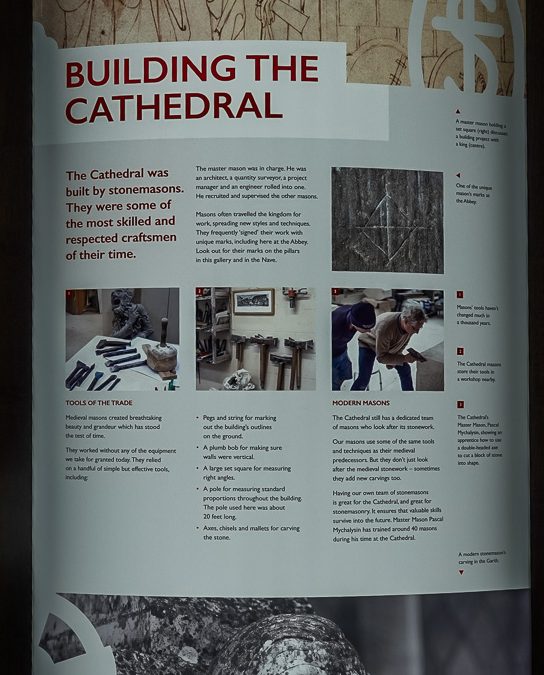
Civilizations depend upon skills. That may sound obvious, but it poses a surprisingly difficult challenge.
A cathedral does not build itself. Someone must know how to quarry stone, shape timber, design arches, and raise walls that will stand for centuries. Tools must be forged. Cloth must be woven. Bread must be baked.
The problem is not simply finding skilled people. It is ensuring that those skills survive.
How does one generation pass its hard-won expertise to the next? How does a society avoid having to reinvent the same knowledge over and over again?
Medieval England’s answer was the guild.
Today guilds are often remembered as restrictive organizations or early monopolies. Sometimes they became exactly that. Yet their original purpose was remarkably practical. They helped preserve competence.
Learning a Trade
Imagine arriving in a medieval town as a young apprentice.
You might spend years living in the household of a master craftsman, learning not only the techniques of a trade but also its standards, customs, and expectations.
- A mason learned from experienced masons.
- A goldsmith learned from goldsmiths.
- A weaver learned from weavers.
Skills that might otherwise have disappeared with one generation could instead be passed to the next.
Over time, this created something larger than individual expertise. Knowledge became institutional. A craft could outlast any single practitioner because the means of teaching it had become part of the system itself.
In much the same way that universities preserved and expanded scholarly knowledge, guilds helped preserve practical knowledge.
Maintaining Standards
Guilds served another important purpose. People buying goods wanted some confidence that those goods were fit for purpose. A poorly forged tool, a dishonest merchant, or a careless craftsman could damage not only individual reputations but trust within the wider community.
Guilds attempted to address that problem by establishing standards and protecting the reputation of their trades. At their best, they acted as an early form of quality control. Customers gained greater confidence in the goods they purchased, while craftsmen benefited from belonging to a community whose reputation carried weight.
The arrangement was not perfect, but it helped solve a challenge faced by every society: how to encourage trust between people who may never have met before.
The Double-Edged Sword
Like many successful institutions, guilds eventually encountered the problem faced by almost every organization. The same rules that protected standards could also limit competition. The same structures that preserved expertise could become resistant to change.
Over time, some guilds became more concerned with protecting their members than encouraging excellence. The tension is a familiar one. Institutions often begin by solving a problem and later struggle to avoid becoming one.
Echoes Today
The challenge guilds sought to address has never entirely disappeared. Modern societies possess more information than any civilization in history, yet information alone does not create competence. Practical skills still require practice, mentorship, and experience.
That is one reason apprenticeships remain important and why organizations such as the King’s Trust support the teaching of traditional crafts. Projects at places like Dumfries House remind us that preserving historic buildings often requires preserving the skills needed to maintain them.
Stone, timber, and glass can endure for centuries.
The knowledge required to work with them must be passed from one generation to the next.