History tends to remember kings. William Marshal was never king. Yet there were moments when the fate of England rested more securely in his hands than in those of the monarchs he served, and that alone makes him worth knowing.
His life reads like something from a medieval adventure story. He survived civil war, crusade, tournaments, political intrigue, rebellion, and dynastic crisis. He served five kings, accumulated vast lands and influence, and was widely regarded as the greatest knight of his age. Yet none of those achievements fully explain why he remains so admired.
The answer may lie in a quality that is harder to measure than military skill or political success: people trusted him. Though that may not sound remarkable, it is. Especially in the world of the Plantagenets.
The Boy Nobody Expected to Survive
William’s story begins during one of England’s most turbulent periods. The country was in the midst of The Anarchy, a prolonged struggle between King Stephen and the Empress Matilda. William’s father, John Marshal, supported Matilda’s cause and held a strategically important castle.
In 1152, a truce was negotiated. To guarantee his father’s good behaviour, the young William—then only about five years old—was handed over to King Stephen as a hostage. The arrangement was common enough in medieval politics, but what happened next was not.
John Marshal promptly broke the agreement. An infuriated Stephen threatened to execute the boy. When messengers informed William’s father, he reportedly replied that he still possessed “the hammer and the anvil” to make more sons. Father of the year, he was not.
Fortunately for William, Stephen proved more merciful than his father. The king is said to have become rather fond of the boy and refused to carry out the threat. William survived.
Learning the Knight’s Trade
As a young man, William entered the household of William de Tancarville in Normandy, where he trained as a knight. He quickly demonstrated courage, skill, and an unusual ability to survive dangerous situations and those qualities served him well.
Tournament fighting in the twelfth century was not the polished spectacle modern audiences imagine. It was closer to organized chaos. Large groups of mounted knights charged across open countryside attempting to capture one another for ransom. Success required strength, horsemanship, tactical awareness, and a certain tolerance for being repeatedly knocked off a horse. William excelled.
By his own account, he and a companion captured more than a hundred knights during a single season of tournaments. The winnings helped establish both his reputation and his fortune.
Long before he became a statesman, William had become a celebrity.
Loyalty in an Age of Ambition
William’s reputation grew further when he entered the service of Henry the Young King, the eldest surviving son of Henry II.
The Young King was charming, charismatic, and immensely popular, but he was also perpetually frustrated. Although crowned during his father’s lifetime, he possessed little real authority and spent much of his short life rebelling against the king. William remained loyal to him throughout.
When the Young King died unexpectedly in 1183, he asked William to fulfil a crusading vow on his behalf, and William honoured the request. It was one of many occasions in his life when he appears to have taken promises unusually seriously. And that quality would become one of his defining characteristics.
Serving Kings
Over the course of his remarkable career, William served five English kings:
Each presented different challenges.
Richard the Lionheart admired military talent and rewarded loyalty. William prospered under his reign and acquired extensive lands, including marriage to Isabel de Clare, one of the wealthiest heiresses in the kingdom. The marriage transformed his fortunes. Isabel was the daughter of Richard de Clare and granddaughter of Richard de Clare. Through her inheritance, William became Earl of Pembroke and acquired extensive estates in Wales, England and Ireland.
King John proved a far more difficult master. John’s reign was marked by military defeats, disputes with the Church, conflict with the barons, and growing mistrust. Many nobles abandoned him. William did not. This does not mean he agreed with everything John did. Few people seem to have done so. Rather, William appears to have believed that preserving stability mattered more than personal advantage.
It was a difficult principle to maintain, yet he maintained it.
The Kingdom in Crisis
When King John died in 1216, England stood on the brink of disaster. The kingdom was divided by civil war and many barons had rebelled. Prince Louis of France had invaded England and claimed the throne.
Magna Carta had failed as a peace settlement. And the new king, Henry III, was only nine years old.
If there was ever a moment when the Plantagenet dynasty might have collapsed, this was it. The obvious solution would have been to place power in younger hands—after all, William Marshal was nearly seventy. Instead, he became regent.
It was one of the most consequential decisions in English history.
The Battle of Lincoln
In 1217, the future of the kingdom hung in the balance. French forces and rebel barons held much of the country. Henry III’s government remained fragile and victory was far from certain.
At an age when most men would have retired from public life—assuming they had survived long enough to reach it—William Marshal led the royal army into battle at Lincoln. The result was a decisive victory. The Battle of Lincoln effectively broke the rebel cause and transformed the political situation. Within months, French ambitions in England had collapsed.
The Plantagenet dynasty survived, and with it, the reign of Henry III. William Marshal had saved the kingdom.
An Unexpected Legacy
William Marshal’s influence did not end with his death. Although he had five sons, none produced surviving heirs, and the vast Marshal inheritance eventually passed through his five daughters.
Through marriages into many of England’s leading noble families, William’s descendants spread throughout the aristocracy. Over the following centuries, lines descending from his daughters appeared repeatedly in the family trees of the Mortimers, de Clares, FitzAlans, Howards, and many others. The chart includes a veritable Who’s Who of British aristocracy.
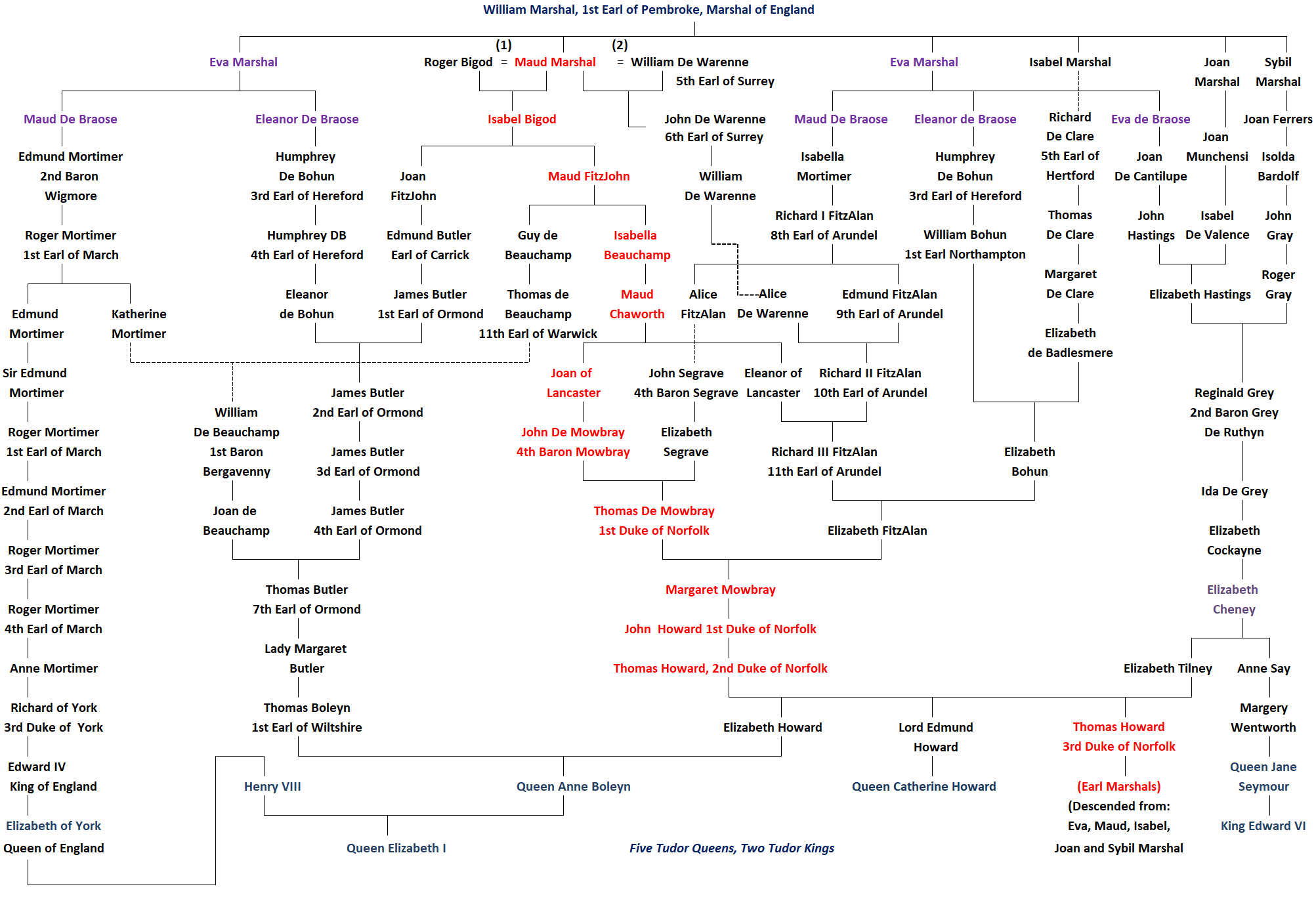
By the time of the Wars of the Roses and the Tudor period, a surprising number of England’s most powerful families could trace their ancestry back to William Marshal and Isabel de Clare.
The knight who helped save the Plantagenet kingdom ultimately became one of the ancestors of the families that would later compete to rule it.
William Marshal’s Credibility Won The Day
William’s achievements were considerable; he won battles, accumulated lands. served kings and acquired influence. Yet none of these fully explains why historians continue to admire him.
I suspect the answer may be credibility. Modern leadership researchers such as James Kouzes and Barry Posner have found that credibility lies at the heart of effective leadership. People follow leaders they believe. Honesty, consistency, and reliability matter.
William Marshal seems to have understood this instinctively. His reputation was built over decades. People trusted him because his actions generally matched his words. His promises meant something. His loyalty was not merely proclaimed, he demonstrated it.
In an age often marked by ambition, intrigue, and shifting allegiances, that made him unusual. And when England faced one of its greatest crises, credibility proved to be one of the kingdom’s most valuable assets.
William Marshal never wore a crown. Yet few men did more to preserve the kingdom that crowns depended upon.