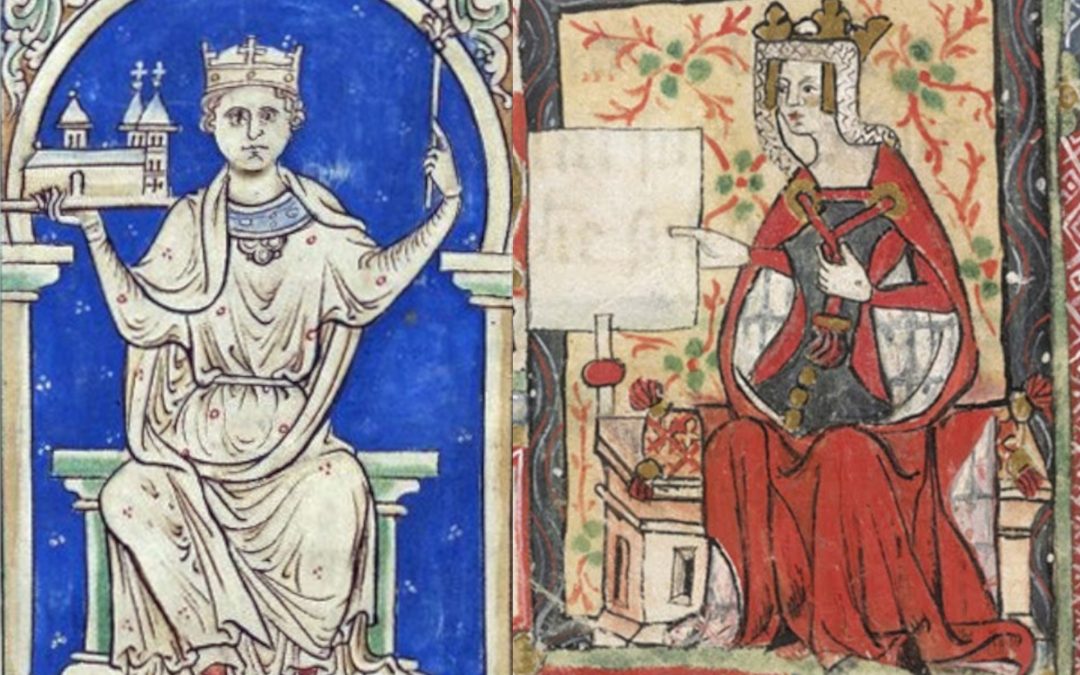
History often presents civil wars as contests between ambitious individuals. The Anarchy was something more complicated.
At its heart stood two claimants: Stephen of Blois and the Empress Matilda. Both possessed plausible claims to the English throne and attracted loyal supporters. And naturally, both believed themselves entitled to rule.
Yet the true protagonist of the story was neither Stephen nor Matilda. It was England itself.
When King Henry I died in 1135, he left behind a kingdom that appeared strong and increasingly well governed. The administrative foundations laid by his father, William the Conqueror, had been strengthened. Royal authority extended across the realm and order seemed secure.
Then a succession crisis exposed how fragile that order remained.
Henry’s only legitimate son had drowned in the wreck of the White Ship. In response, Henry persuaded his nobles to swear allegiance to his daughter Matilda as his heir. Yet when he died, many hesitated.
Matilda possessed the stronger legal claim; Stephen possessed the stronger political position. The result was nearly twenty years of civil war.
Stephen’s Position
For generations, historians portrayed Stephen as a weak king whose failures plunged the kingdom into chaos, but modern assessments are more sympathetic. Stephen appears to have been brave, generous, and personally well liked. Unfortunately, those qualities did not necessarily translate into effective kingship.
The challenge confronting him was immense: powerful magnates exploited uncertainty while rival loyalties fractured the kingdom. Castles multiplied. Local disputes became national problems.
Stephen was not so much a bad king as a king facing a problem larger than his abilities.
And Then We Have Matilda
Matilda presents an equally fascinating study.
As the daughter of Henry I and widow of the Holy Roman Emperor, she possessed impressive credentials and considerable determination. Contemporary chroniclers often criticized her for pride and imperiousness, though one has to wonder how much of that criticism reflected discomfort with a woman exercising authority in a deeply male society.
Whatever the explanation, Matilda repeatedly demonstrated competence while struggling to transform legitimacy into broad political support.
She could win arguments. Winning followers proved harder.
Where That Left Us: Anarchy
Neither side could secure a decisive victory and the war dragged on. And on. And on. Castles changed hands. Alliances shifted. Towns suffered. The kingdom endured.
The greatest damage was not necessarily physical destruction, though that was intense. The most acute problem was uncertainty—merchants hesitated, local disputes became harder to resolve, and investments that required confidence in the future became riskier. The kingdom remained intact, but it became less predictable. In essence, England had become a less attractive place in which to make long-term commitments.
The chroniclers gave the conflict a memorable reputation. One lamented that “Christ and his saints slept.” A kingdom cannot depend indefinitely upon individual loyalties and competing ambitions. Eventually both sides reached the same conclusion.
The Resolution
The settlement came in 1153 at Wallingford. Stephen would remain king for the rest of his life. Matilda’s son Henry would become his heir.
Neither claimant fully prevailed. The kingdom did.
The true legacy of the Anarchy was not victory or defeat. It was the realization that prosperity depended upon more than a ruler. It required institutions strong enough to survive uncertainty. The generation that followed became increasingly committed to stronger institutions, clearer administration, and more effective royal government.
When Henry II inherited the throne, he inherited something else as well: a vivid demonstration of what happened when authority fragmented and order weakened. Much of his reign can be understood as an attempt to ensure that England never again endured such uncertainty.
Stephen and Matilda are remembered because they fought over a kingdom.
The more enduring story is what the kingdom learned from them.