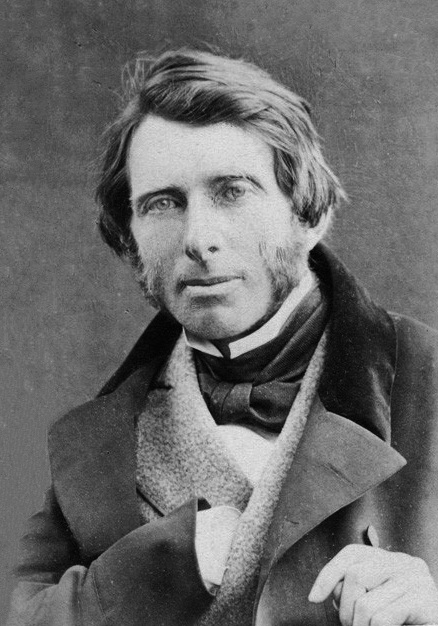
Why do some buildings move us while others leave us completely unmoved? It is a deceptively simple question, yet one that occupied John Ruskin for much of his life.
He wrote about paintings, cathedrals and architecture, but he was never really writing about art alone. Ruskin believed that the buildings people constructed, the objects they made and the landscapes they cared for revealed the values, priorities and ultimately the character of a civilization.
To him, beauty was never merely decorative. It was evidence of how a society understood itself.
Learning to See
Born in London in 1819, Ruskin travelled widely across Britain and continental Europe with his parents, sketchbook in hand. While many tourists hurried from one famous sight to the next, Ruskin lingered. He sketched landscapes, examined buildings and filled notebooks with observations.
He developed an extraordinary ability to notice details that others overlooked.
Today Ruskin is often remembered as an art critic, but that description scarcely captures the breadth of his interests. He wrote about painting, architecture, geology, education, economics, craftsmanship and the natural world. His early books defended the painter J. M. W. Turner, whose atmospheric landscapes many critics dismissed as unfinished or chaotic. Ruskin argued that Turner was painting nature more truthfully than artists who merely copied appearances.
Yet beneath all these subjects lay a single, recurring question: What do the things we create reveal about the society that created them?
To Ruskin, a building was never just a building. It reflected the values, priorities and aspirations of the people who built it.
The Stones of Venice
His fascination with architecture reached its fullest expression in The Stones of Venice, a work that changed the way many Victorians looked at medieval buildings.
Ruskin admired Gothic architecture not because it belonged to a romantic past, but because it celebrated individual craftsmanship. A carved leaf might differ slightly from its neighbour. A mason might leave the subtle marks of his own hand in the stone.

Chapter House at Southwell Minster
To Ruskin, those imperfections were not flaws. They were evidence that real people—not anonymous machines—had made the building.
The idea would profoundly influence a young William Morris and, through him, the entire Arts & Crafts movement, leaving a legacy that can still be seen in places such as Kelmscott Manor. and Hidcote Manor.
There Is No Wealth but Life
Ruskin’s interests gradually expanded beyond art. He began asking uncomfortable questions about industrial society. Britain had become wealthier than ever before. Yet its smoke-filled cities, harsh factory conditions and the uneven quality of many mass-produced goods led him to wonder whether material prosperity alone could measure genuine success.
One of his most famous observations remains remarkably relevant:
“There is no wealth but life.”
By this he meant that the true wealth of a civilization includes healthy people, thriving communities, meaningful work and beautiful surroundings—not merely growing incomes. He was not dismissing commerce or industry. Rather, he was reminding his readers that financial prosperity alone is an incomplete measure of a flourishing society.
It was a remarkably broad definition of wealth—one that still feels surprisingly modern.
A Lasting Influence
Civilizations are remembered not only for what they build. They are remembered for what they choose to value.
Ruskin’s influence reached far beyond architecture. In Unto This Last (1860), he included what would become one of the most quoted passages in business:
“There is hardly anything in the world that some man cannot make a little worse and sell a little cheaper, and the people who consider price only are this man’s lawful prey.”
It is a reminder that value and price are not the same thing—a distinction that remains just as relevant today as it was in Victorian Britain.
William Morris carried many of Ruskin’s ideas into the Arts & Crafts movement. Edward Burne-Jones gave them visual form through stained glass and painting. Conservationists drew inspiration from his defence of historic buildings, while generations of architects, designers and writers found themselves asking questions Ruskin had first posed.
His greatest gift may simply have been this: he taught people to look more carefully. Once you have learned to see craftsmanship, beauty and honesty in the world around you, it becomes difficult to settle for their absence.
It rarely attracts attention. But it can outlast kingdoms.