Visitors entering Leicester Cathedral often pause near a simple stone tomb set into the floor of the choir. The inscription bears only a name: Richard III.

For centuries Richard’s reputation has been anything but simple. Few English monarchs have inspired such persistent argument. To some he remains the ruthless villain of Shakespeare’s history plays; to others he is a misunderstood ruler whose character was distorted by Tudor propaganda.
The debate has lasted for more than five hundred years and shows little sign of ending.
The Last Plantagenet
Richard was born in 1452 into the powerful House of York during the turbulent years that later historians would call the Wars of the Roses. His father, Richard, Duke of York, died fighting for the Yorkist cause, and his elder brother eventually became king as Edward IV.
Richard grew up in a world shaped by political conflict, shifting alliances, and the ever-present possibility that fortunes could change overnight. By all accounts he proved a loyal supporter of his brother’s reign and an able administrator in the north of England, where he governed large territories from his base at Middleham Castle.
Few observers at the time would have predicted that he himself would one day wear the crown.
The Crisis of 1483
Everything changed when Edward IV died unexpectedly in April 1483. His twelve-year-old son briefly succeeded him as Edward V, while the boy’s uncle, Richard III, was appointed Lord Protector to govern until the young king reached adulthood.
At first the arrangement appeared straightforward. England had experienced royal minorities before, and the mechanisms of government were capable of functioning while a child king grew into his role. Within weeks, however, events took a dramatic and unexpected turn.
The Pre-Contract
At this point the story takes a turn that might feel almost fictional were it not preserved in contemporary records. A senior churchman, Robert Stillington, came forward with a remarkable claim. Years earlier, he said, he had witnessed a binding pre-contract of marriage between Edward IV and a noblewoman named Eleanor Butler.
Under medieval canon law such a pre-contract could carry the force of marriage itself. If Edward had already pledged himself in that way, his later marriage to Elizabeth Woodville might technically have been invalid. And if the marriage were invalid, the children born from it would be illegitimate.
The argument soon found its way into law. In 1484 Parliament passed an act known as Titulus Regius, which declared Edward IV’s children ineligible for the throne and recognized Richard as the rightful king.Whether the pre-contract claim reflected genuine memory, political calculation, or some mixture of the two remains uncertain. Eleanor Butler had died several years earlier and could neither confirm nor deny the story, while Edward IV himself was no longer alive to respond.
Like many episodes from the fifteenth century, the evidence leaves historians with more questions than answers.
The Shadow of the Princes
What followed only deepened the mystery. Edward V and his younger brother, Richard of Shrewsbury, were lodged in the Tower of London, where royal heirs traditionally stayed before their coronation. Gradually the boys disappeared from public view.
Their fate has never been conclusively established. Many contemporaries believed they had been murdered, though by whom remains the subject of continuing debate. The disappearance of the princes quickly became one of the most haunting episodes in English history and has shaped Richard III’s reputation ever since.
Shakespeare’s King
Richard’s reputation was cemented for generations by William Shakespeare, whose play Richard III presents the king as a brilliant but deeply malevolent figure, willing to eliminate rivals in pursuit of power. The drama remains one of Shakespeare’s most compelling works, though it reflects the political atmosphere of the Tudor age more than the uncertainties of the fifteenth century. Literature, once written, has a way of shaping historical memory.
Bosworth
Richard inherited more than a disputed crown. He inherited the accumulated consequences of a century of political instability. Since the Black Death, England had endured social upheaval, recurring financial pressures, the Peasants’ Revolt, constitutional conflict under Richard II, the Lancastrian usurpation, renewed war in France, and finally the dynastic struggles later known as the Wars of the Roses. Richard’s reign belongs not simply to the end of the Plantagenets, but to the closing chapter of a long period in which England repeatedly wrestled with the problem of legitimacy.
Richard’s reign lasted barely two years before events moved toward their final confrontation.
Across the Channel, a Lancastrian claimant who had spent much of his life in exile was preparing to challenge the king. His name was Henry VII, and his claim to the throne was distant enough that it might once have seemed improbable.
Yet England in the 1480s had grown weary of uncertainty, and several powerful figures were willing to consider an alternative to Richard’s rule. In August 1485 Henry landed in Wales and began marching eastward through the Midlands, gathering supporters as he advanced. Richard responded quickly, assembling a royal army and moving to intercept the challenger.
The two forces met near the village of Market Bosworth in Leicestershire. Even on the morning of the battle the outcome remained uncertain. Several powerful nobles, most notably the Stanley family, had not yet committed themselves decisively to either side. In the shifting political landscape that had characterized the Wars of the Roses, such hesitation could prove decisive.
As the battle unfolded Richard recognized a moment of opportunity. Henry’s position on the field was relatively exposed, and the king gathered a group of mounted knights for a direct charge aimed at ending the conflict in a single stroke. For a brief moment the attack came close to succeeding.
But the balance of the battle shifted when the Stanleys finally intervened in Henry’s favour. Richard’s charge was surrounded, his forces began to collapse, and the king himself was killed in the fighting.
With Richard’s death at Bosworth, the Plantagenet dynasty came to an end. More significantly, England’s long constitutional and dynastic crisis had reached its conclusion. The Tudors inherited a kingdom exhausted by generations of disputed succession and political violence.
A King’s First Burial
After the Battle of Bosworth Field, the body of Richard III was carried to the nearby town of Leicester. Chroniclers record that the corpse was displayed publicly for a short time, most likely to confirm that the king had indeed been killed and that the struggle for the throne had ended. In an age when rumours could quickly produce impostors and rival claimants, such confirmation mattered.
Richard was then buried in the church of the Greyfriars Friary, a Franciscan monastery within the town walls. The burial was neither royal nor dishonourable. Richard did not receive the elaborate funeral ceremonies that might accompany the death of a reigning monarch, but he was laid to rest in consecrated ground, within a religious house where prayers would be said for the dead.
For several decades the location of the grave was known. Then the friary itself disappeared following the Dissolution of the Monasteries.
The Problem with Judging the Past
Today the story comes to rest in Leicester Cathedral.
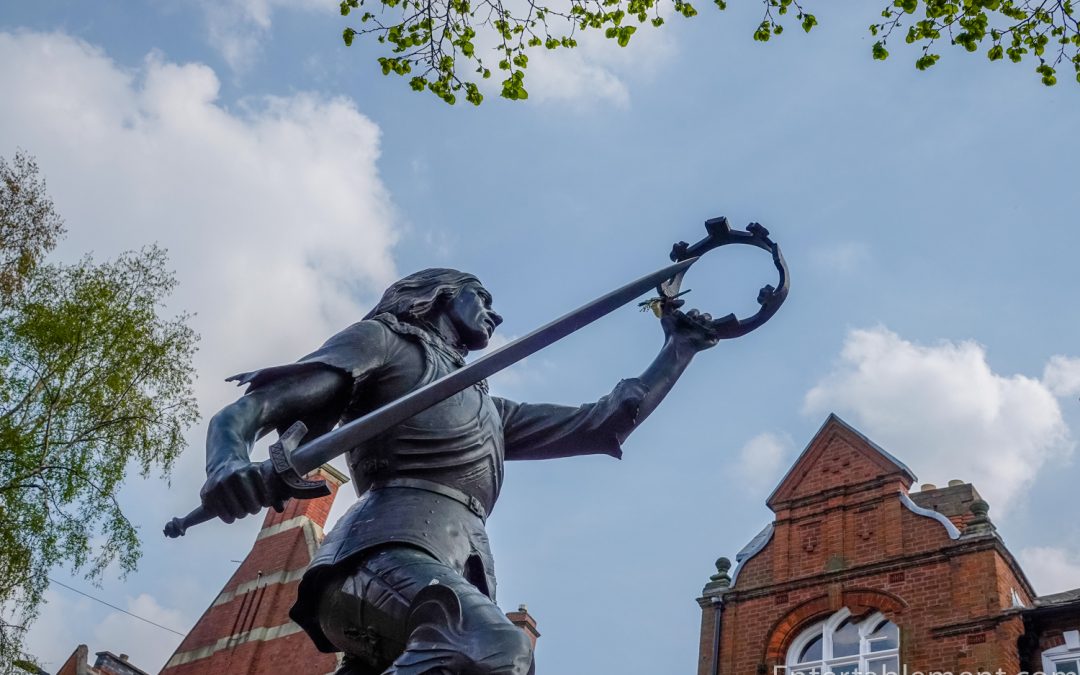
Just outside the cathedral stands a bronze statue of Richard III, his sword in one hand and his crown lifted toward the sky.

For centuries the king’s final resting place had been uncertain. Chroniclers recorded that his body was buried in the nearby Greyfriars Friary, but the monastery disappeared during the upheavals of the sixteenth century, and the exact location of the grave gradually faded from memory.
Then, in 2012, archaeologists excavating a small parking lot in Leicester uncovered a skeleton beneath the asphalt.
The bones showed the marks of violent injuries and a spine curved by scoliosis. DNA analysis eventually confirmed what had once seemed improbable: the remains belonged to Richard III. The identification was made possible in part through a living descendant of Richard’s sister, Anne of York, whose lineage led to a Canadian cabinetmaker named Michael Ibsen.
More than five centuries after the king’s death at the Battle of Bosworth Field, his remains had been found.
In 2015 Richard was reburied in Leicester Cathedral, not far from the place where he had originally been laid to rest. The tomb itself is simple, carved from pale stone and inscribed with the king’s name and dates.

Standing there today, it is easy to forget how fiercely Richard’s reputation has been debated. For generations he has appeared as villain, victim, usurper, reformer, or tragic figure depending on who tells the story. Perhaps that uncertainty is fitting.
Some historical figures resolve neatly into heroes or villains. Others remain suspended between competing interpretations, their lives shaped as much by memory and storytelling as by the events themselves.
Richard III belongs firmly in that second category.