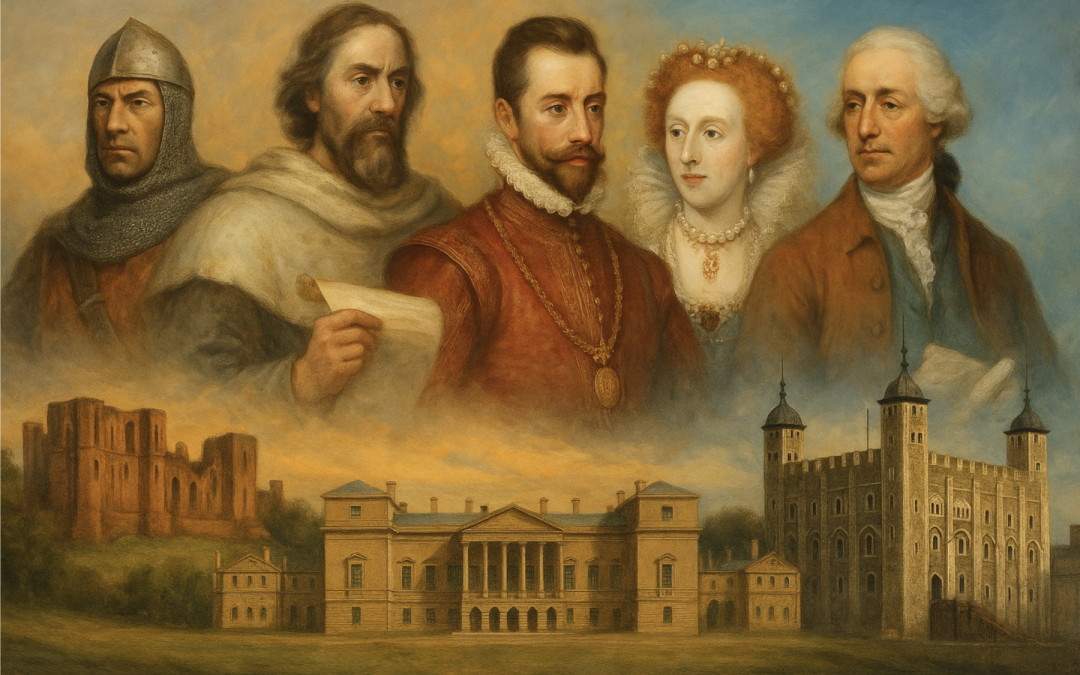
In the grand theatre of British peerage, few titles have seen more curtain calls than that of the Earl of Leicester. Created no fewer than seven official times between the Norman Conquest and the Victorian Age — and arguably worn de facto by one of England’s most revolutionary figures — it has served as a mirror to the nation’s shifting landscape of power, prestige, and patronage. Each resurrection of the title came with a new wearer, a new purpose, and often, a new kind of spectacle.
This isn’t just about aristocratic tradition. It’s about how titles shape memory, ambition, and access to influence. In a society where lineage matters, the Earl of Leicester has been a title that refused to die—even when its holder did.
1st Creation (1107): Robert de Beaumont
A Norman knight and trusted adviser to Henry I, Robert de Beaumont was the first to hold the title formally. A war hero and legal mind, he helped define early Anglo-Norman governance. The title passed to his descendants before becoming extinct in 1204. A classic story of feudal reward and dynastic ebb.
De Facto Power (1265): Simon de Montfort
After the Beaumont line ended, the title passed through marriage and inheritance to Simon de Montfort, who became Earl of Leicester in practice if not always by royal favour. De Montfort was no ordinary nobleman: his 1265 Parliament established a model for representative government, making him one of the forefathers of modern democracy. Though killed at the Battle of Evesham and posthumously disgraced, his influence persisted—like Robert Walpole, whose role as England’s first Prime Minister long preceded formal recognition. De Montfort illustrates how power often precedes permission.
2nd Creation (1267): Edmund Crouchback
Just two years after de Montfort’s death, Henry III awarded the title to his own son, Edmund. This swift reassertion of royal authority was part retaliation, part restoration. Crouchback’s inheritance marked the beginning of the powerful Lancaster line, ultimately absorbed into the crown when his descendant Henry IV seized the throne in 1399.
3rd Creation (1564): Robert Dudley
Elizabeth I’s favourite — and perhaps her great love — was granted the earldom in a blaze of pageantry. Dudley hosted extravagant entertainments at Kenilworth Castle, angling for marriage. It never came, but he remained at the Queen’s side until his death. His life was one of courtly theatre, scandal, and political finesse.
4th Creation (1618): Robert Sidney
Nephew of the poet Philip Sidney and a literary man himself, Sidney was granted the title by James I. His version of the earldom leaned more toward cultural prestige than battlefield prowess. His descendants held it until 1743, when it became extinct again.
5th Creation (1744): Thomas Coke
Our Enlightenment hero. Thomas Coke spent decades building Holkham Hall, the great Palladian temple to reason, beauty, and agricultural ambition. He was finally granted the title after years of lobbying and nation-building—only to die without a male heir. His earldom lasted just one generation.
6th Creation (1784): George Townshend
A general and political figure, Townshend was made Earl after service in the Seven Years’ War. His version of Leicester was short-lived; the title once again fell extinct in 1855. But his tenure reflected the military and colonial priorities of the era.
7th Creation (1837): Thomas William Coke (“Coke of Norfolk”)
Farmer, reformer, and reluctant peer. Thomas William Coke modernized British agriculture, supported Whig politics, and preferred his barley to ballrooms. He only accepted the title in his twilight years, securing his family’s legacy. The title continues through his descendants to this day.
A Title as Time Capsule
The story of the Earl of Leicester is a history of England in miniature. From feudal knights to Renaissance courtiers, Enlightenment thinkers to agrarian reformers, each bearer left a different stamp. Some wanted the title for power, some for prestige, and some—like Coke of Norfolk—nearly refused it entirely.
The title lives on, but the meaning of it has changed with every era. It has been a lover’s crown, a statesman’s reward, a royal afterthought, and a gentleman farmer’s final flourish.