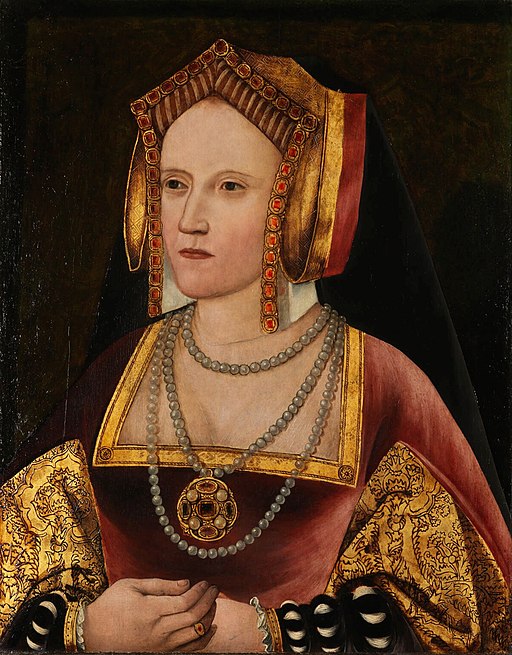
In the north aisle of Peterborough Cathedral lies the tomb of a woman who once sat at the centre of European politics.

Visitors often pause there longer than they expect. The inscription records her not as Queen of England but as Katherine, Dowager Princess of Wales—the title imposed on her after Henry VIII annulled their marriage. Yet the flowers and pomegranates that frequently appear on the grave suggest that many people remember her differently.
For more than twenty years Catherine of Aragon had been Queen of England.
She arrived in the country as a Spanish princess, daughter of two of the most powerful monarchs in Europe. She served as regent while her husband campaigned abroad. She defended the legitimacy of her marriage and the rights of her daughter in one of the most famous royal disputes of the sixteenth century.
And she spent her final years removed from court, dying in relative isolation at Kimbolton Castle in 1536.
History often remembers Catherine mainly as the wife Henry VIII set aside. The reality was far more interesting—and far more consequential.
A Princess of Spain
Catherine was born in 1485 into one of the most formidable royal families in Europe. She was the youngest daughter of Ferdinand of Aragon and Isabella of Castile, the monarchs whose marriage united Spain and whose sponsorship helped launch Columbus’s voyages across the Atlantic. Their court was known for its religious seriousness, political ambition, and intellectual culture.
Catherine received the kind of education expected of a Renaissance princess. She studied theology, languages, and classical literature, and she was raised with a strong sense of dynastic duty. Marriage would not simply shape her personal life; it would serve the political interests of kingdoms.
In 1501 that duty carried her to England.
The Widow of Arthur
Catherine arrived in England to marry Arthur, Prince of Wales, the eldest son of Henry VII and heir to the Tudor throne. The match was designed to strengthen an alliance between England and Spain, a valuable partnership for the still-new Tudor dynasty. Arthur and Catherine were both teenagers when they married at St Paul’s Cathedral.
Within months Arthur was dead.
His sudden death in 1502 left Catherine a young widow in a foreign country. For several years she remained in England while diplomats debated her future. One possibility soon emerged: she might marry Arthur’s younger brother, Henry.
There was one complication. Under canon law, a man was normally forbidden to marry his brother’s widow. To allow the marriage, Henry VII sought and obtained a papal dispensation. When the younger Henry became king in 1509, he married Catherine soon afterward.
Queen of England
For the first two decades of Henry VIII’s reign, Catherine appeared to embody the ideal queen consort. She was widely respected for her intelligence, dignity, and piety. She participated actively in court life, supported scholars and church institutions, and maintained close connections with European diplomacy through her family.
In 1513, when Henry departed for a campaign in France, Catherine served as regent of England. That same year the Scots invaded from the north. English forces defeated them decisively at the Battle of Flodden, where King James IV of Scotland was killed. Catherine reportedly sent Henry a piece of the Scottish king’s bloodstained coat as proof of the victory.
The episode revealed something important about her: she was not simply a ceremonial figure but a capable political actor. Yet the royal marriage carried a problem that grew more serious with time.
The Question of an Heir
Catherine experienced multiple pregnancies during the early years of the marriage. Several children were stillborn or died shortly after birth. Only one survived infancy: a daughter, Mary, born in 1516.
For Henry VIII the absence of a male heir became an increasingly urgent concern. The Tudor dynasty itself was still relatively new, and memories of the civil wars known as the Wars of the Roses remained vivid. A disputed succession could easily reopen old conflicts.
By the late 1520s Henry had become convinced that his marriage to Catherine had been a mistake. The biblical prohibition against marrying a brother’s widow—once resolved through papal permission—suddenly appeared to him as evidence that the union had been cursed.
Catherine firmly rejected the argument. She maintained that her brief marriage to Arthur had never been consummated. If that were true, the biblical prohibition would not apply. The marriage to Henry, she insisted, was entirely valid.
Her position was not simply personal. If the marriage were declared invalid, their daughter Mary would become illegitimate.
The Queen Who Refused to Step Aside
The dispute soon grew into one of the most famous marital crises in European history. Henry sought an annulment from the pope. Catherine appealed to Rome and refused to accept the authority of English courts to judge her marriage. During one dramatic hearing she addressed Henry directly, reminding him that she had come to him as a virgin and had been his faithful wife for many years.
Her resistance placed Henry in an increasingly difficult position. The pope was reluctant to grant the annulment, partly because Catherine’s nephew was Charles V, Holy Roman Emperor and one of the most powerful rulers in Europe.
The crisis ultimately contributed to Henry’s decision to break England’s institutional ties with the papacy.
In 1533 the marriage was declared invalid in England, and Henry married Anne Boleyn. Catherine refused to acknowledge the ruling. Until the end of her life she continued to consider herself the rightful Queen of England.
Exile from Court
After the annulment Catherine was stripped of the title queen and ordered to style herself Dowager Princess of Wales, a reference to her brief marriage to Arthur decades earlier. She refused.
Henry also separated her permanently from her daughter Mary. Mother and daughter would never see each other again. Catherine spent the remaining years of her life moved between various residences, each more remote from court than the last. By the time she reached Kimbolton Castle, her household had been reduced and her health was failing. Yet reports from those around her suggest that she maintained the same dignity and composure that had defined her earlier life.
She died there in 1536.
Catherine’s Legacy
Catherine of Aragon occupies a complicated place in Tudor history. For centuries she has often been portrayed as the stubborn wife who refused to accept reality. Yet from her own perspective the situation looked very different. She believed her marriage was lawful, her daughter legitimate, and her duty as queen inseparable from both.
She was also far more than a figure in Henry VIII’s marital history. She had been a Spanish princess raised at one of Europe’s most powerful courts, a respected Queen of England for more than two decades, and a woman who defended her position with remarkable determination in the face of overwhelming political pressure.
Her story also helped shape the future of England.
The crisis surrounding her marriage set in motion events that would transform the country’s religious and political landscape—and eventually place her daughter Mary on the English throne.
Seen in that light, Catherine of Aragon was not simply the first of Henry VIII’s six wives. She was one of the central figures in the drama that reshaped Tudor England.