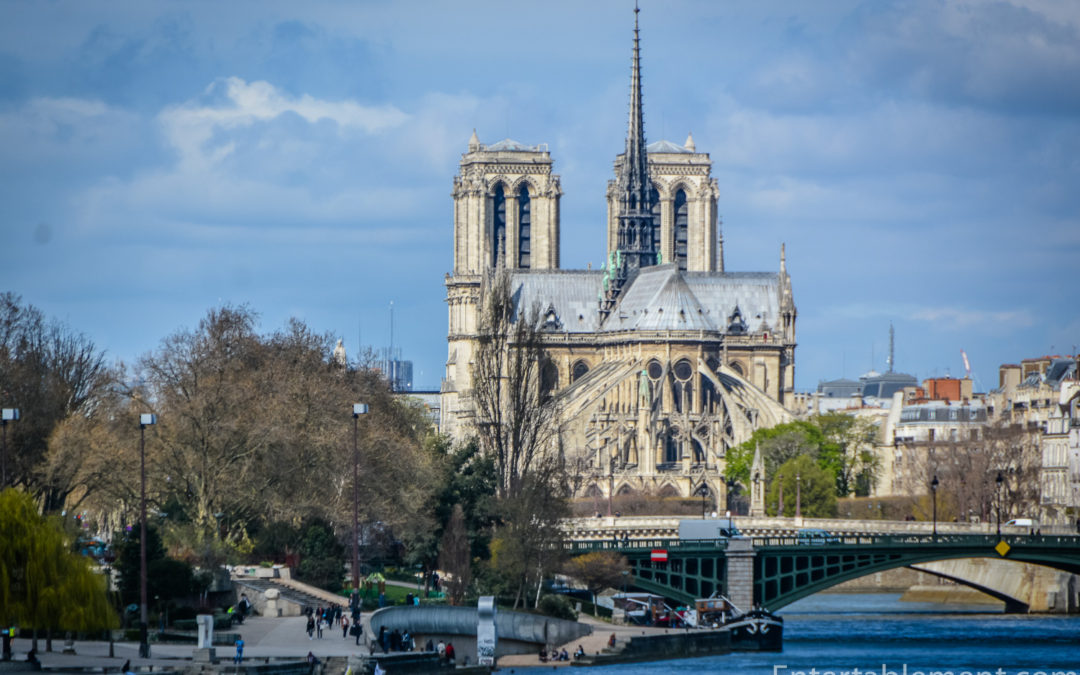
When the roof of Notre-Dame de Paris caught fire in April 2019, the images traveled around the world almost instantly. People watched the flames climb through the timber framework, watched the spire collapse, and wondered — for a moment — whether something irreplaceable had just been lost.
The response in Paris was swift and oddly calm. Plans for rebuilding began almost immediately. Craftsmen began studying medieval techniques. Stone by stone, beam by beam, the cathedral would be restored. It felt reassuring, but also strangely familiar.

Paris, after all, has been remaking itself for a very long time.

Long before the Gothic cathedral rose above the Seine, the small island on which it stands — the Île de la Cité — was already the heart of a Roman town called Lutetia.
By the fourth century, as the Roman Empire grew less secure, the inhabitants had retreated behind defensive walls on the island, recycling stones from earlier monuments to strengthen their defences.
The empire that had built those monuments would soon fade from the region entirely. Yet the settlement did not vanish. People remained. The bishop stayed. Markets continued.
The island — practical, defensible, and already familiar — remained the centre of life along this stretch of the river.

New rulers arrived in Gaul over the following centuries: Franks, Burgundians, Visigoths, and later even Viking raiders pushing up the rivers. Yet each wave, in its own way, adapted itself to the structures already in place. The city did not begin again from nothing. It simply changed hands.
Seen from that longer perspective, the rebuilding of Notre-Dame feels less like a dramatic recovery than part of a very old pattern.
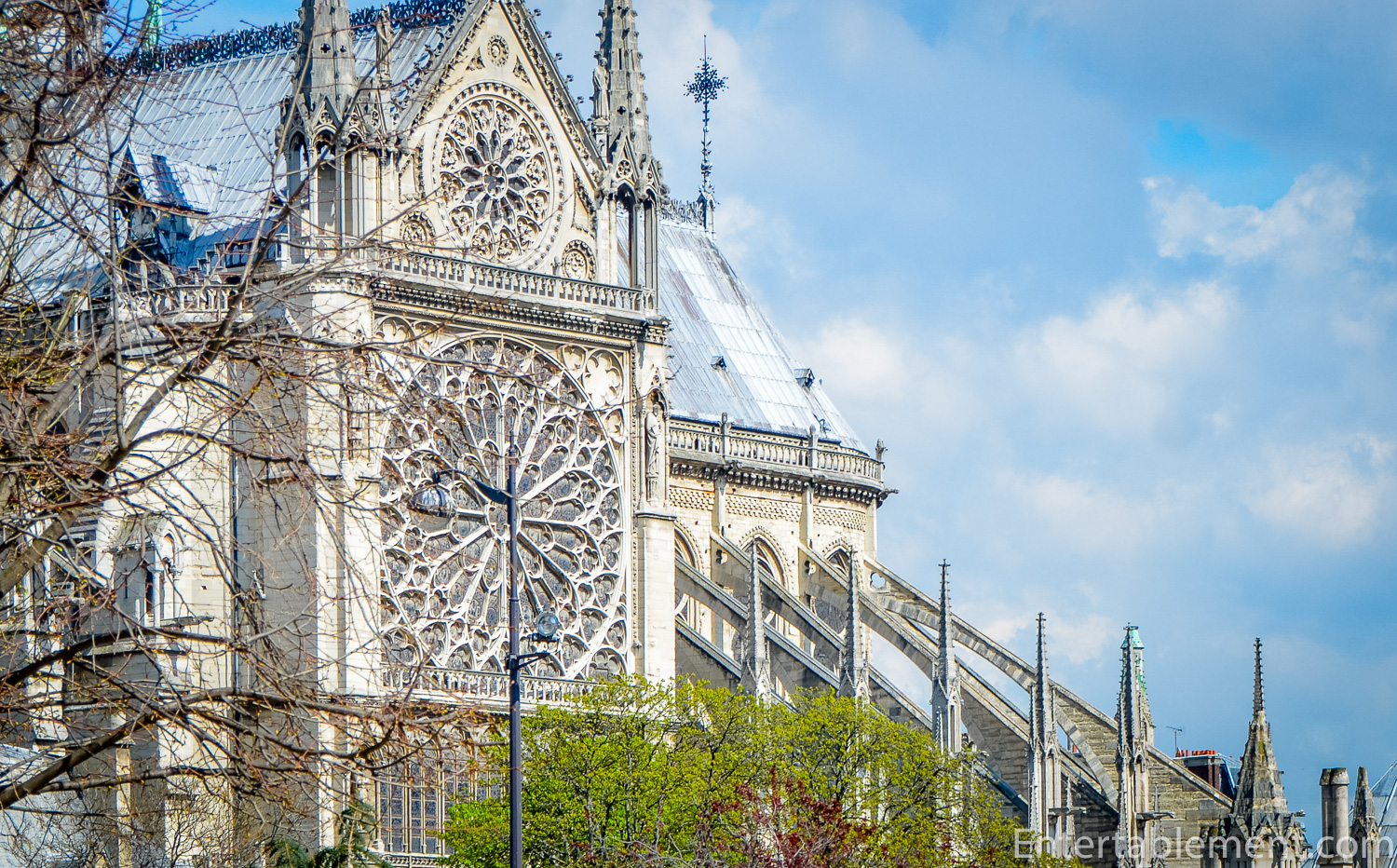
Paris has been remaking itself, carefully and persistently, for more than fifteen hundred years.
Around the year 400, what we now call Paris was still largely known by its Roman name Lutetia. It was not yet the dominant capital of France; instead it was a modest but functioning Roman provincial town whose life had gradually shifted onto the island in the Seine. But it was still a provincial town, not yet the grand capital we imagine today. Its population may have been only 10,000–20,000 people. When Roman authority faded in the 5th century, the island settlement remained inhabited and the bishop continued to wield influence.
In the late fifth century another turning point arrived. The Frankish king Clovis I gradually extended his authority across northern Gaul. After defeating the last Roman military governor at the Battle of Soissons, Clovis established control over much of the region.
Paris became one of his principal residences. When Clovis died in 511, he was buried there in the church of the Abbey of Saint Genevieve, not far from where the Panthéon now stands. That choice quietly signalled a shift.
During the eighth and early ninth centuries the political centre of power in Western Europe shifted again. The Frankish ruler Charlemagne forged an empire that stretched from the Pyrenees to the Elbe and from northern Italy to the North Sea. In 800 he was crowned emperor in Rome, reviving the imperial title in the West for the first time since the fall of the Roman Empire.
Yet Paris was not the centre of this new empire. Charlemagne’s court moved between royal residences across the Frankish world, eventually settling most often at Aachen. Paris remained a modest but functioning city along the Seine — important locally, but not yet the heart of a kingdom.
In the late ninth century Paris faced another test. A large Viking fleet sailed up the Seine and laid siege to the city in Siege of Paris (885–886). The attackers expected an easy victory. Instead they found the island city stubbornly defended behind its bridges and walls. For nearly a year the defenders held out under the leadership of Odo of Paris.
The Vikings eventually moved on. But the defence made Paris famous across the Frankish world. The city that had once been a modest Roman town had proved it could survive yet another storm. This event explains why Paris becomes politically important later.
A century later another quiet transformation occurred. In 987 the nobles of the Frankish realm elected Hugh Capet as king. Capet’s power at first was modest, but his base lay in the region around Paris. Over time the Capetian dynasty would turn the city into the political centre of the kingdom that gradually became France.
The medieval capital was beginning to take shape. The old Roman town had become part of a new Frankish kingdom. While many Roman cities in Britain declined dramatically, Paris kept functioning, slowly evolving from a Roman town into a medieval one.
The Church Steps In
If Roman administrators were slowly disappearing in the fifth century, someone still had to keep cities functioning. In many places across Gaul, that responsibility fell quite naturally to the Christian Church.
Roman towns already had bishops by this point, and those bishops were often among the few figures whose authority crossed generations. They oversaw charity, mediated disputes, and maintained networks of communication that stretched far beyond their own cities.
When imperial officials faded from the scene, the bishop frequently became the person people turned to.
The story of Genevieve of Paris offers a glimpse of how that might have looked in practice. In the fifth century, when the armies of Attila the Hun threatened the region, Genevieve helped organize prayer, provisioning, and public resolve in Paris. Whether every detail of the story is literal matters less than what it reflects: civic leadership and religious leadership were often intertwined.
The Church did not replace Roman administration so much as inherit parts of it.

Meanwhile, beyond the towns, another institution was quietly spreading across the countryside.
Monasteries
Communities inspired by figures such as Martin of Tours began appearing across Gaul, offering places of prayer, work, and refuge. Later the monastic rule developed by Benedict of Nursia helped standardize how many of these communities lived. To travellers, monasteries offered hospitality; to the sick and poor, they offered care; to nearby villages, they offered stability.
They also farmed land, stored grain, produced wine, copied manuscripts, and educated clergy. In a world where political authority could change abruptly, monasteries provided something more durable: continuity of practice.
Over time, abbots and bishops became deeply embedded in the communities around them. They managed land, oversaw production, and negotiated with local rulers. Monasteries might control vineyards or farmland; towns relied on bishops to mediate disputes or maintain order. The Church was not merely a spiritual presence. It had become part of the economic and social machinery of the region. What is striking, looking back, is how often these roles complemented one another. This balance was not inevitable.
Across the Channel in England, the relationship between bishops and monasteries sometimes became sharply contested. After the Norman Conquest, when William the Conqueror rebuilt many of the great Saxon cathedrals and reorganized church authority, conflicts between bishops and monastic communities occasionally erupted with surprising intensity. At Rochester Cathedral, disputes between cathedral clergy and monks escalated into open hostility. Questions about land, authority, and income could easily become political struggles.
In Gaul, the story often unfolded differently. Because Christianity had been woven into Roman civic life for centuries before the empire weakened, the Church’s institutions already occupied recognized spaces within society. Bishops inherited urban authority. Monasteries expanded into the countryside. Kings, when they emerged, frequently relied on both. The arrangement was not always peaceful, but it proved remarkably durable.
Arènes de Lutèce
The arena was built in the 1st century AD, when Roman Lutetia was a growing provincial town on the Left Bank. It was a hybrid structure — part theatre, part amphitheatre — able to hold perhaps 15,000 spectators. People gathered here for performances, public events, and occasionally gladiatorial spectacles.
But by the 3rd century, as the Roman world grew less secure, the arena was abandoned. Stones from the structure were even quarried to help build defensive walls around the Île de la Cité, where the population had retreated for safety. In other words, the arena literally helped fortify the city that replaced it. Over time the site disappeared under medieval houses and gardens. For centuries Parisians walked above it without realizing what lay underneath. It was only rediscovered in the 19th century, during urban works. The writer Victor Hugo was among those who helped campaign for its preservation.
Today the arena sits quietly in the Latin Quarter, surrounded by apartment buildings. Children play football on the sand where Roman crowds once gathered.
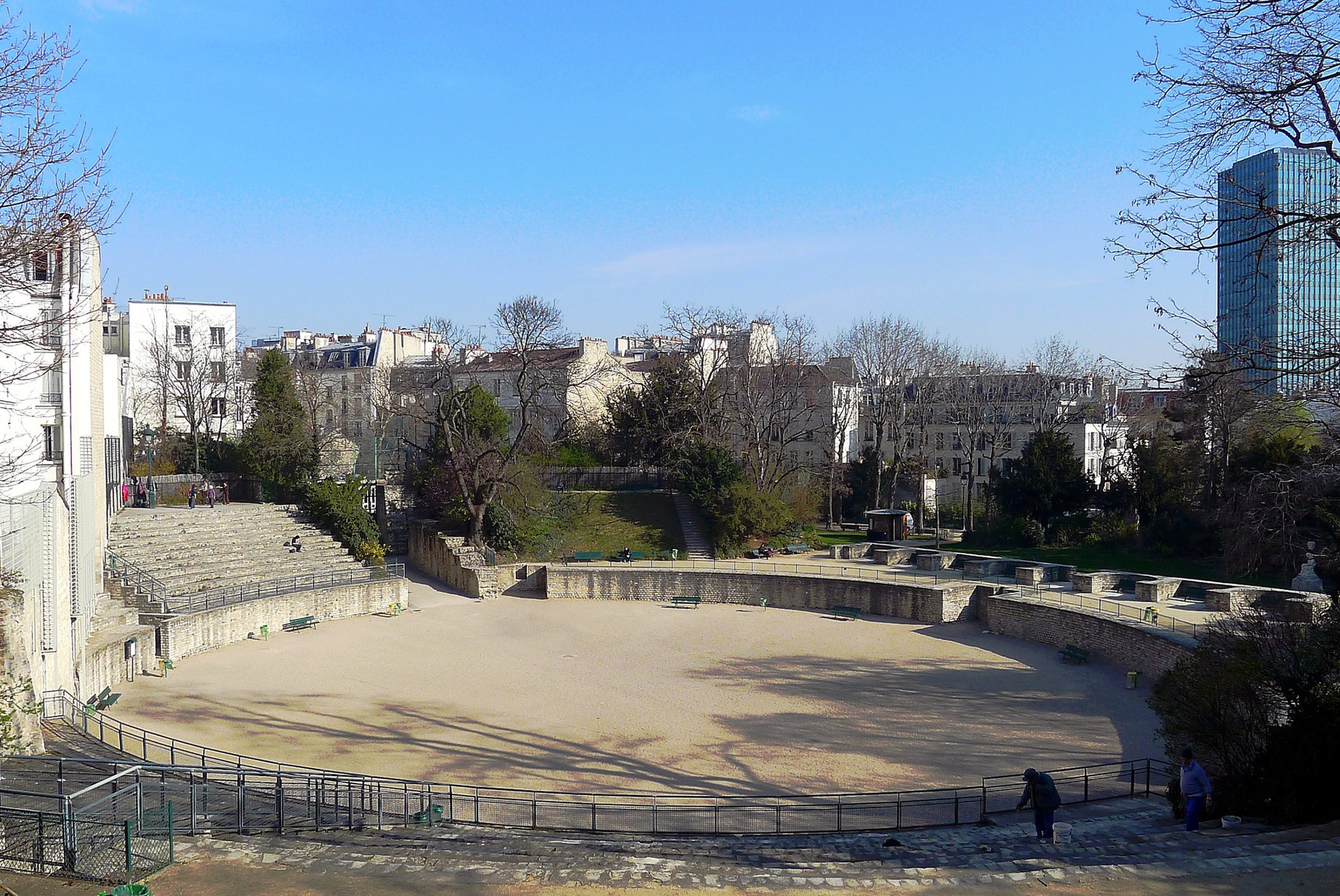
The Arènes de Lutèce survived largely because of a small piece of geography—and because later generations simply built over it rather than clearing it away. When the Romans built the arena in the 1st century, they placed it on the natural slope of the hill that rises from the Seine toward what is now the Latin Quarter.
That slope mattered. Roman amphitheatres were often partly cut into a hillside, using the earth itself to support the seating tiers rather than building the entire structure from freestanding masonry. It was cheaper, stronger, and easier to construct. At Lutetia the upper seating rested directly against the hillside. So when the arena fell out of use in the 3rd century and stones were removed to help build defensive walls around the Île de la Cité, a surprising amount of the structure remained simply because it was buried in the hill.

Over the centuries houses, gardens, and monasteries spread across the slope above it. The arena disappeared from view but was never fully dismantled. In effect, the ground itself protected it.
By the 19th century, when new streets were being cut through the neighborhood, workers began uncovering curved masonry that didn’t match anything medieval. Bit by bit the outline of the amphitheatre emerged again.
The writer Victor Hugo, already famous for defending historic architecture after the restoration debates around Notre-Dame de Paris, helped campaign to preserve the site rather than letting it vanish under new construction. Today the arena sits quietly between apartment blocks, almost hidden in plain sight.
A Street That Refuses to Disappear
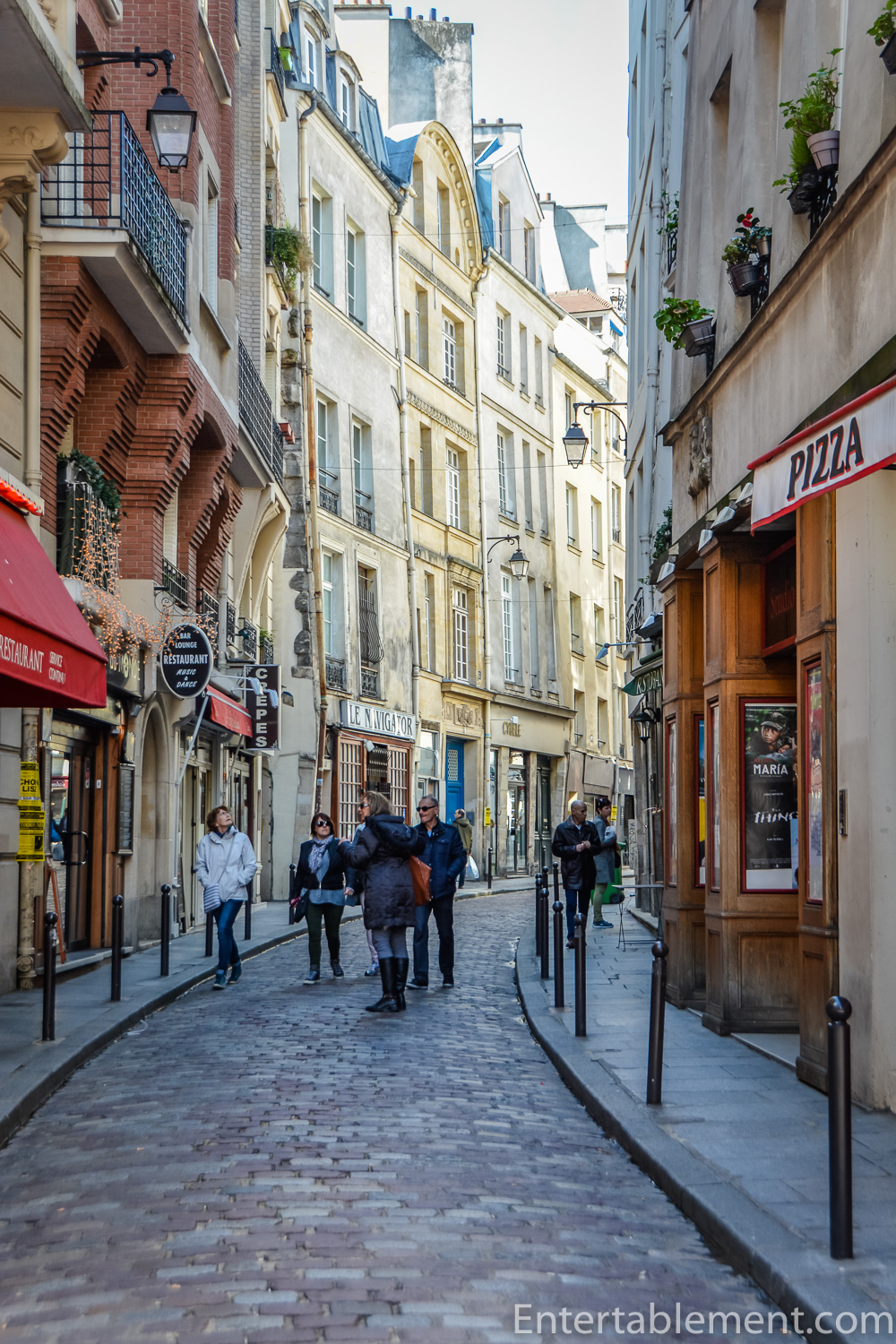
There is another small clue to Paris’s long memory, and it runs quietly through the Left Bank. Walk south from the Île de la Cité and you eventually find yourself on Rue Saint‑Jacques.

Today it feels like any other Parisian street — cafés, apartments, the occasional medieval façade tucked between newer buildings. But the line of the road is far older than the city that surrounds it.
Two thousand years ago this was the main north–south street of Roman Lutetia, the cardo maximus that carried travellers, merchants, and soldiers through the town. The Roman forum stood nearby. Public baths rose just to the west, the remains of which can still be seen today at Thermes de Cluny.
The empire that built those streets disappeared long ago. The road did not. Medieval pilgrims walked it on their way south toward Santiago de Compostela. Merchants and students later followed the same path as the university district grew around it. Today taxis and bicycles trace the same line through the city.
It is a small reminder that cities rarely begin again from nothing. They grow along the paths that already work.
The Pattern of Paris
Seen from that perspective, the rebuilding of Notre-Dame de Paris after the fire feels less like an extraordinary act of restoration and more like part of a familiar rhythm.
The Romans fortified the island and The Roman settlement on the Île de la Cité became the seat of the bishop. Centuries later, the great cathedral of Notre-Dame de Paris rose on the same ground. Kings eventually built their palace beside it. Generations repaired, rebuilt, and reshaped the city that grew outward along its ancient streets.
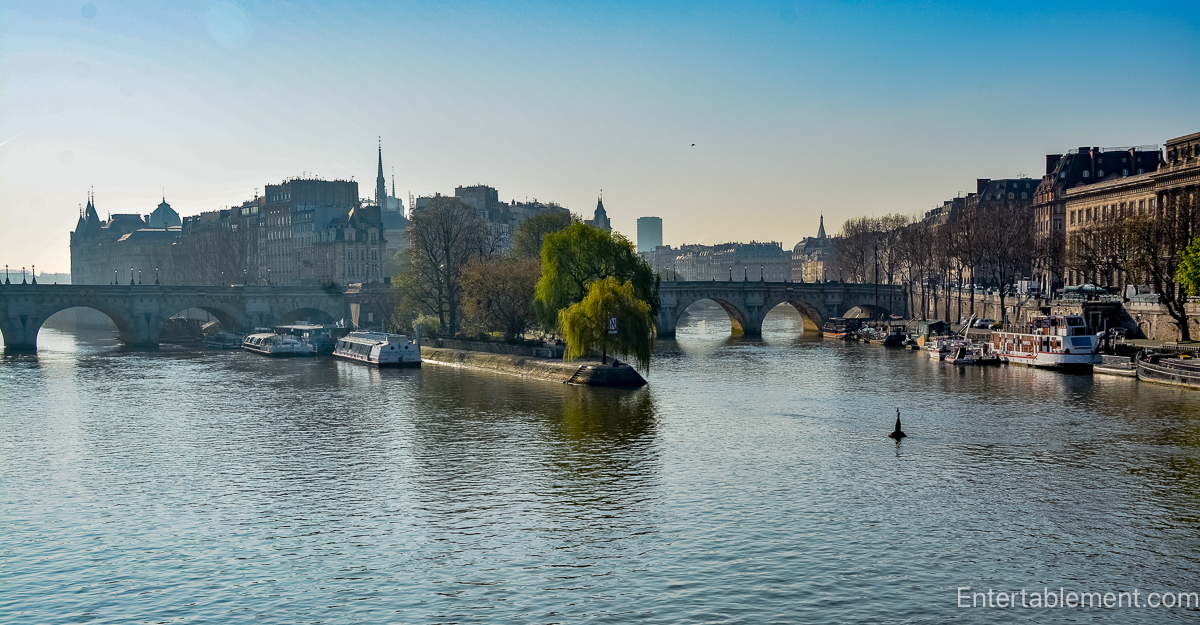
Paris has been doing this for a very long time. Not replacing itself entirely, but adapting — layer by layer — on foundations that still quietly guide the shape of the city today.
When the cathedral’s roof burned in 2019, Parisians did what the city has done many times before. They began again.
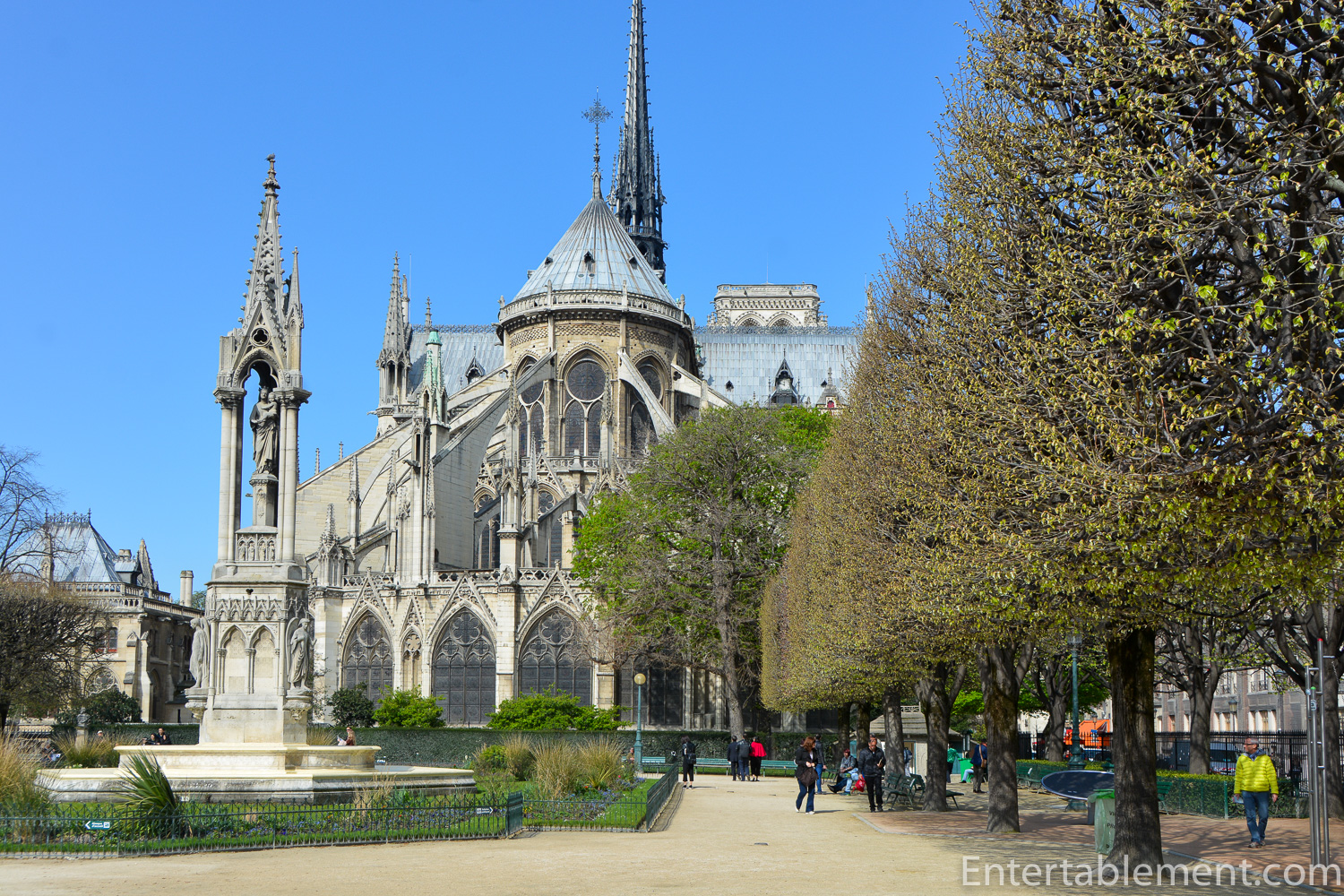
Perhaps that is why Paris feels so effortless in the spring. The cafés open again, the trees along the Seine turn green, and visitors wander streets whose outlines were drawn long before the cathedral spire ever rose above them.

Cities, like people, rarely begin again from nothing. They repair what can be repaired, reuse what still works, and carry on — season after season, century after century.
This essay is part of The Continental Thread — a series exploring how authority, culture, and daily life reorganized themselves as Europe moved from Roman order to the modern world.
- Previous in the series: Collapse, Scarcity, and Survival—When Rome Leaves the Room
- Next in the series: Meanwhile, Back at the Ranch, In Italy