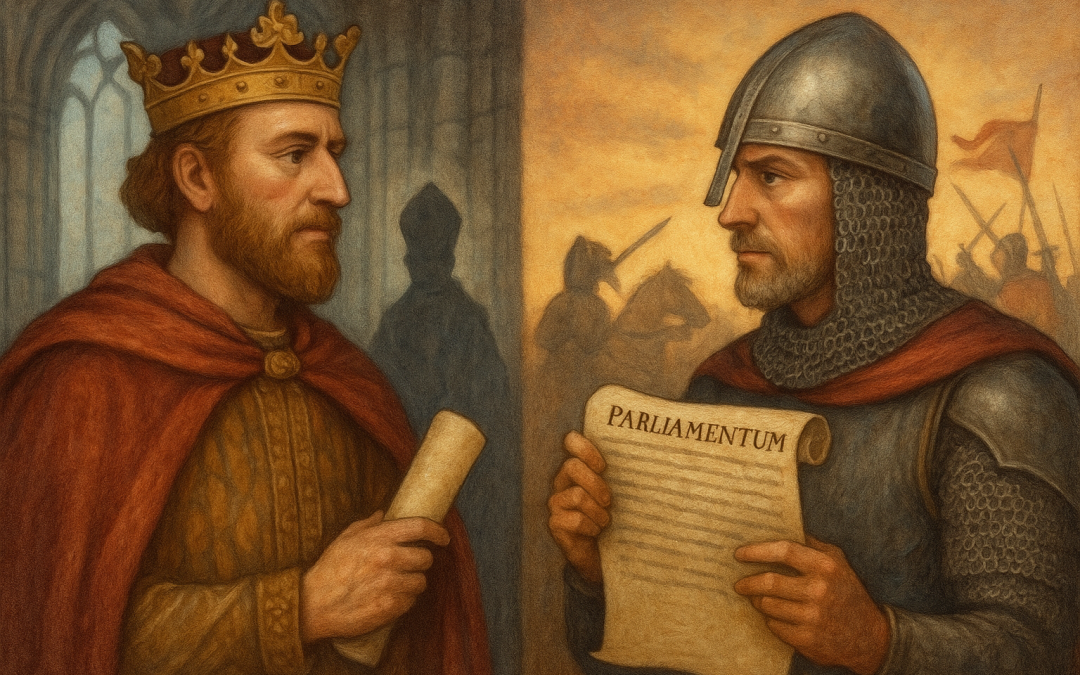
Henry II and Simon de Montfort Walk Into a Parliament…
You know what’s tricky about history? The people who make it happen are often the very ones you wouldn’t trust with the keys to your wine cellar.
Take Henry II and Simon de Montfort—two of the most influential men in English political history, separated by a century but bound together by ambition, idealism, and (let’s be honest) some fairly hefty control issues.
They weren’t friends. They never met. But you can’t really talk about one without bumping into the shadow of the other.
Let’s start with Henry.
The King Who Meant Business
Henry II didn’t so much inherit a kingdom as duct-tape it back together. His England was wobbling after civil war, and he got to work like a man possessed. Courts. Juries. Royal writs. Eyres. (No, not the Brontë kind. The travelling-judge kind).
He was determined to make the law stronger than the nobles, to turn justice into something a little less feudal and a little more… reliable. Not out of kindness, mind you. Henry wasn’t warm. He was practical. He knew a functioning legal system was good for business—and even better for kings.
Enter: The Upstart with a Scroll
Fast forward to the 13th century and Simon de Montfort, a French-born noble who married the king’s sister and eventually became the thorn in Henry III’s side. (Different Henry. Much less effective.)
Simon looked around and saw chaos: foreign advisers, runaway spending, baronial grumbling. And instead of just joining the whinge-fest, he did something wild—he called a Parliament. Not just lords and bishops, but knights and commoners. People who’d never had a seat at the table before.
It was part reform, part rebellion, and—let’s be honest—part power grab.
Two Very Different Men With the Same Obsession
Here’s where things get fun.
Henry II and de Montfort had very different styles. One ruled with parchments and penance. The other with swords and scrolls. But they were both trying to answer the same question:
How do you run a kingdom that doesn’t implode every 20 minutes?
Henry’s answer was “stronger law, tighter grip.”
Simon’s was “shared power, broader voices.”
In a weird way, de Montfort pushed the door open on the very system Henry had nailed shut. One centralized royal control; the other cracked it just enough to let in a breeze of representation.
It Didn’t End Well (for Either of Them)
Neither man got a happy ending.
- Henry II died in a muddy corner of France, betrayed by his sons, weeping over the latest in a long line of family backstabbing.
- Simon de Montfort died on a battlefield, hacked to pieces, his head stuck on a pike with… (wait for it) his genitals stuffed in his mouth.
Medieval subtlety at its finest. But the legacy? Oh, the legacy. We still live in the world these two helped shape.
Henry gave us the beginnings of common law, a court system that didn’t depend entirely on the mood of your local baron.
Simon gave us the idea of Parliament with actual people in it—not just dukes sipping claret but commoners speaking for their counties.
So—Did They Fail?
On paper? Maybe. One died betrayed and broken, the other dismembered on a battlefield. But in truth? No. They didn’t fail.
Henry II created the legal architecture that still shapes the English-speaking world. Simon de Montfort introduced the radical idea that power could be shared, even if imperfectly.
They didn’t live to see their visions fully realized—but visions like that don’t fit inside a single lifetime. They’re bigger than one reign, one rebellion, one crown.
History doesn’t reward clean endings. It rewards perseverance. And sometimes, the people who change the world are the ones who never get to enjoy the better version they helped build.
Henry and Simon lit the fuse. We’re still watching the fireworks.
Final Thought?
If you were setting the table for a dinner party of historical troublemakers, Henry II and Simon de Montfort would be seated across from each other, glowering over the soup. One would quote legal precedent. The other would roll his eyes and ask for more wine.
They’d argue, certainly. But deep down, they’d both recognize the other as a man trying to build something that might last.