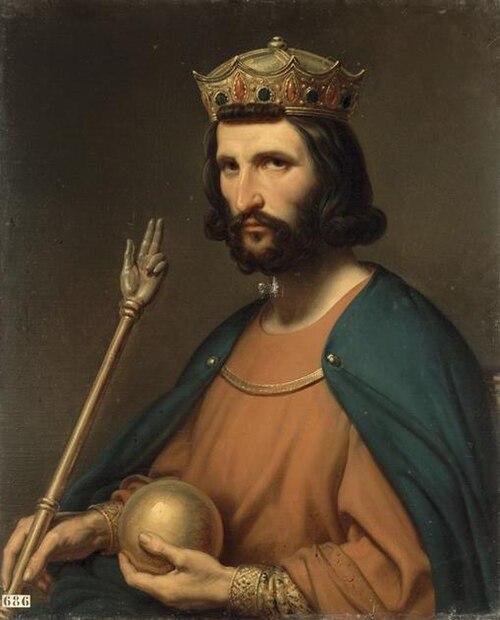
On the hill above the Seine, not far from the old Roman roads that once crossed the Left Bank, stood a monastery dedicated to Saint Genevieve. Nearby lay the small royal domain of a regional nobleman whose authority extended little farther than the lands surrounding the city.
In the year 987, that nobleman was elected king. His name was Hugh Capet, and his quiet rise marked the beginning of a dynasty that would shape France for centuries.
A Kingdom Divided
By the late tenth century the empire once ruled by Charlemagne had long since fragmented. Power across the region was dispersed among dukes, counts, bishops, and local rulers who governed their territories with considerable independence.
The king of the western Frankish realm still existed in theory, but royal authority had weakened considerably. When the last Carolingian ruler died in 987, the leading nobles of the kingdom gathered to choose a successor.
Rather than restoring the old dynasty, they selected Hugh Capet.
A King With Limited Power
At the time of his election, Hugh Capet’s personal lands were modest. His authority was strongest in the region known as the Île-de-France, the area surrounding Paris and the valley of the Seine.
Beyond that territory powerful nobles ruled their own domains — Normandy, Burgundy, Aquitaine, and others — with little direct interference from the crown. Hugh Capet was king, but in practice he was one lord among many.
The Beginning of a Dynasty
Yet Hugh Capet and his successors pursued a patient strategy. Rather than attempting dramatic conquests, they focused on strengthening their position within their own territory.
They secured alliances with the Church, supported monasteries and bishoprics, and gradually reinforced the idea that the royal title passed from father to son. Over generations the Capetian kings slowly expanded their authority. What began as a small royal domain along the Seine would eventually grow into the powerful kingdom of France.
Paris Becomes the Centre
Because the Capetian family’s power base lay around Paris, the city itself gained importance. The island settlement that had once been the fortified heart of Roman Lutetia gradually became the administrative and symbolic centre of the kingdom.
Royal palaces rose along the Seine. Churches and monasteries expanded. Markets and neighbourhoods spread outward along the riverbanks. The modest Frankish town inherited from earlier centuries began to evolve into the capital of a growing realm.
A Long Legacy
Hugh Capet could hardly have imagined the full consequences of his election. The dynasty he founded would rule France, in one form or another, for more than eight hundred years. Through wars, revolutions, and shifting borders, the Capetian line and its branches shaped the political identity of the kingdom.
And throughout that long history, Paris remained at the centre.
A Quiet Turning Point
Unlike many moments in medieval history, Hugh Capet’s rise did not involve a great battle or dramatic conquest. It was a quieter turning point. Yet from that moment forward, the fortunes of the French crown became closely tied to the city along the Seine.
The Roman town of Lutetia had survived the fall of an empire. Under the Capetians, the city that grew from it would become the heart of a kingdom.