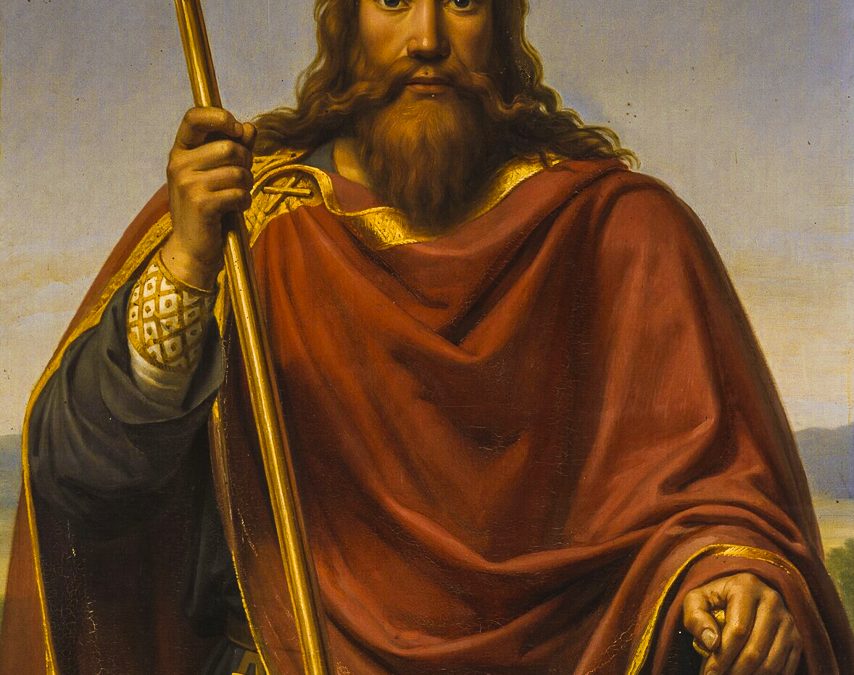
In the early sixth century, a church stood on a hill overlooking the small city of Paris. Within it lay the tomb of a king whose decisions would reshape the future of Western Europe.
His name was Clovis I, and during his lifetime the lands that had once been Roman Gaul began to transform into something new.
A World After Rome
Clovis was born around 466, during the final years of Roman authority in Gaul. For centuries the region had been part of the Roman Empire, connected by roads, governed by imperial officials, and dotted with prosperous cities such as Lyon, Arles, and Paris.
But by the late fifth century that system was fading. Roman troops had largely withdrawn. Local governors struggled to maintain control. Across the Rhine and along the frontiers, new kingdoms were emerging.
Among them were the Franks, a loose confederation of tribes who had gradually moved into northern Gaul. Clovis inherited leadership of one of these Frankish groups when he was still a young man.
The End of Roman Rule in Northern Gaul
In 486, Clovis confronted the last remnant of Roman political authority in the region. The Roman commander Syagrius controlled a small territory in northern Gaul that had survived after the fall of the Western Roman Empire. Their forces met at the Battle of Soissons. Clovis’s victory marked the effective end of Roman rule in the region.
What followed was not the destruction of Roman Gaul, but its transformation. Roman cities continued to function, bishops remained influential, and many elements of Roman law and administration survived. But the political leadership had passed into Frankish hands.
A Conversion That Changed the Balance
One of the most consequential moments of Clovis’s reign occurred not on a battlefield but in a church. According to tradition, Clovis vowed to convert to Christianity during a difficult battle, promising that if victory came he would adopt the faith of his wife, the Burgundian princess Clotilde. Sometime around 496 he was baptized in the cathedral city of Reims by Saint Remigius.
The decision had far-reaching consequences. Many Germanic rulers at the time followed a form of Christianity known as Arianism, which differed from the beliefs of the Roman Church. By adopting Catholic Christianity instead, Clovis aligned himself with the bishops and the largely Roman population of Gaul.
The alliance strengthened his legitimacy and helped knit together the different communities of the region.
Expanding a Kingdom
Clovis continued to extend Frankish control across Gaul. In 507 his army defeated the Visigoths at the Battle of Vouillé, pushing their kingdom south toward Spain and bringing much of western Gaul under Frankish rule.
By the time of his death in 511, Clovis governed a kingdom that stretched across most of what is now France. Yet the cities of Roman Gaul had not disappeared. Instead they were gradually becoming part of a new political landscape.
Paris in the Frankish Kingdom
Clovis spent time in Paris during the later years of his reign, and after his death he was buried there in a church dedicated to the apostles Peter and Paul. That church would later become associated with the memory of Saint Genevieve, whose monastery rose on the hill nearby.
Paris was still far from being the dominant capital of France, but its importance was quietly growing. The Roman town on the island in the Seine had survived the end of the empire. Under Frankish rule it continued to evolve.
A Kingdom That Outlived Its Founder
Clovis’s kingdom did not remain unified after his death. Following Frankish custom, the realm was divided among his sons, and the next centuries would see shifting alliances, rival kings, and frequent struggles for power.
Yet the framework he created endured. The Frankish kingdoms that emerged from his conquests would eventually give rise to the political landscape of medieval Europe. And in the centuries that followed, the lands once governed by Clovis would gradually coalesce into the kingdom we now call France.
The Bridge Between Two Worlds
Clovis stands at a turning point in European history. Behind him lay the long centuries of Roman Gaul. Ahead lay the kingdoms of the early Middle Ages.
His reign did not erase the Roman past. Instead it built upon it — combining Roman cities, Christian institutions, and Frankish leadership into a new political order. The world that emerged from that transformation would shape the history of Western Europe for generations.
And in the quiet city where he was eventually buried, the story of Paris continued to unfold.