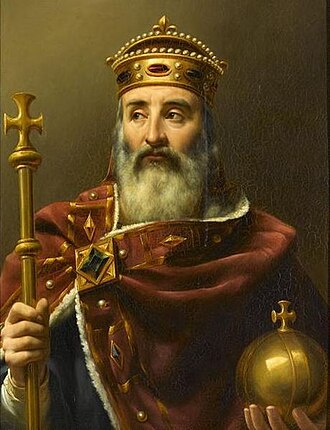
On Christmas Day in the year 800, a Frankish king knelt in prayer inside the ancient basilica of St Peter in Rome. As he rose, Pope Leo III placed a crown upon his head and proclaimed him emperor.
For the first time in more than three centuries, a ruler in Western Europe carried the title once held by the Roman emperors. That king was Charlemagne.
A Kingdom Inherited
Charlemagne was born around 742, the son of Pepin the Short, whose family had recently replaced the older Merovingian dynasty founded by Clovis I. The Frankish kingdom Charlemagne inherited already stretched across much of Gaul and western Germany.
Yet it remained a patchwork realm, governed through regional counts and bishops rather than a centralized state. When Charlemagne became king in 768, he began expanding that kingdom in every direction.
A Vast Empire
Over the following decades Charlemagne’s armies campaigned across Europe. He subdued the Lombards in northern Italy, pushed the frontiers of the Frankish realm eastward into Saxony, and extended his influence across parts of central Europe.
By the end of the eighth century his domain included lands that now form much of France, Germany, the Low Countries, northern Italy, Austria, and central Europe
It was the largest political realm Western Europe had seen since the fall of Rome.
The Imperial Coronation
Charlemagne’s coronation in Rome in 800 carried enormous symbolic weight. To many contemporaries it suggested that the idea of a Western Roman Empire had not vanished entirely. Instead, it had taken on a new form.
The emperor now ruled not from Rome itself but from a network of royal palaces scattered across the Frankish lands. Over time Charlemagne increasingly favoured the city of Aachen, where he constructed an impressive palace complex and chapel.
Paris, by contrast, remained a modest city along the Seine — important locally but not yet the political center it would later become.
A Revival of Learning
Charlemagne’s reign was not defined only by military campaigns. He also encouraged a revival of scholarship and education that historians now call the Carolingian Renaissance. Scholars from across Europe gathered at his court. Monasteries and cathedral schools were encouraged to improve the education of clergy. Classical texts from the Roman world were copied and preserved.
A new style of handwriting known as Carolingian minuscule was developed to make manuscripts easier to read and reproduce — a script whose influence can still be seen in modern printed letters. In these quiet ways, the intellectual legacy of Rome survived within the monasteries and libraries of the Carolingian world.
A Fragile Empire
Despite its impressive size, Charlemagne’s empire did not long remain unified after his death in 814. Within a generation the realm was divided among his grandsons by the Treaty of Verdun.
From those divisions emerged political entities that would gradually evolve into the kingdoms of France and Germany. The imperial experiment had been brief. Yet its influence endured.
The Legacy of a Frankish Emperor
Charlemagne’s reign helped shape the political and cultural landscape of medieval Europe. He strengthened ties between kingship and the Church, revived the idea of empire in the West, and supported a renewal of learning that preserved much of the classical heritage of the Roman world.
The empire he built would fragment, but the institutions it fostered — monasteries, schools, royal administration — continued to influence the societies that followed. And in the centuries after his death, the cities of his former realm continued their quiet evolution.
Among them was the small river city of Paris, whose story had begun long before Charlemagne’s empire and would continue long after it faded.