
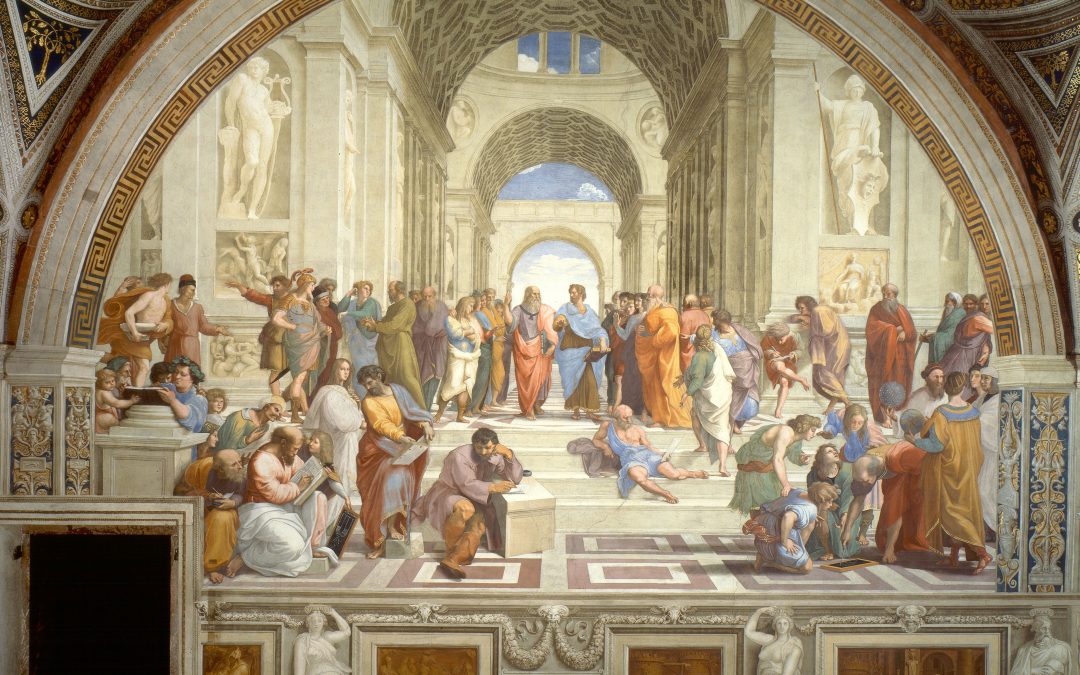
My working impression of Greece was embodied in the Vatican’s fresco The School of Athens by Raphael. In it, Socrates (left) argues in the crowd, Plato points upward toward higher truths beyond the visible world, and Aristotle, his hand held level, grounds philosophy in rational observation.
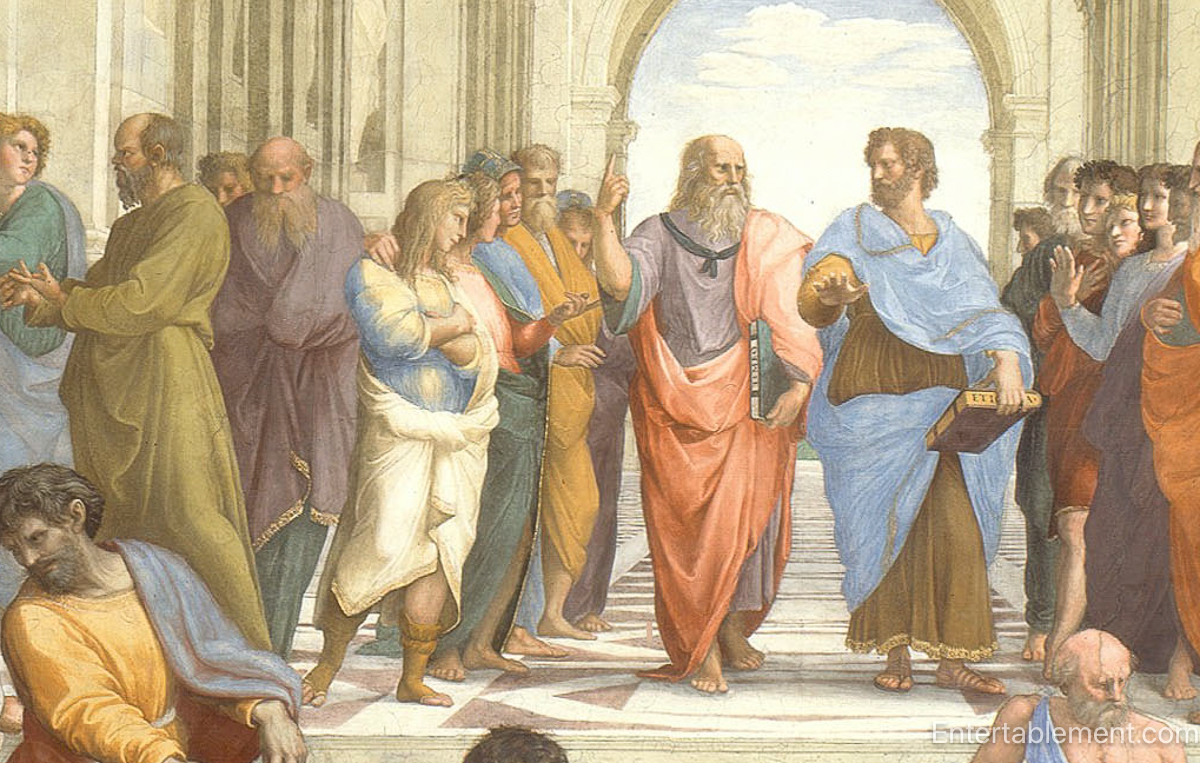
Greece seemed temples on hills, marble ideals, and abstract thought rising above ordinary life.

But when I actually walked through Athens, I discovered something more grounded — something surprisingly real.
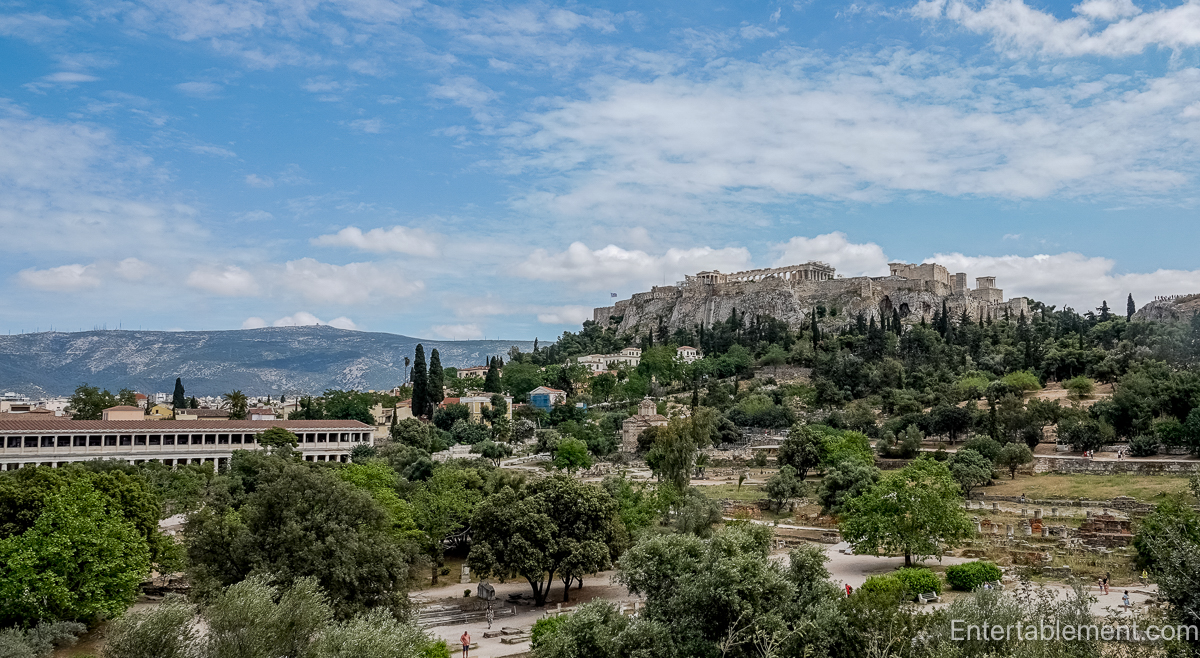
Where The Work Got Done
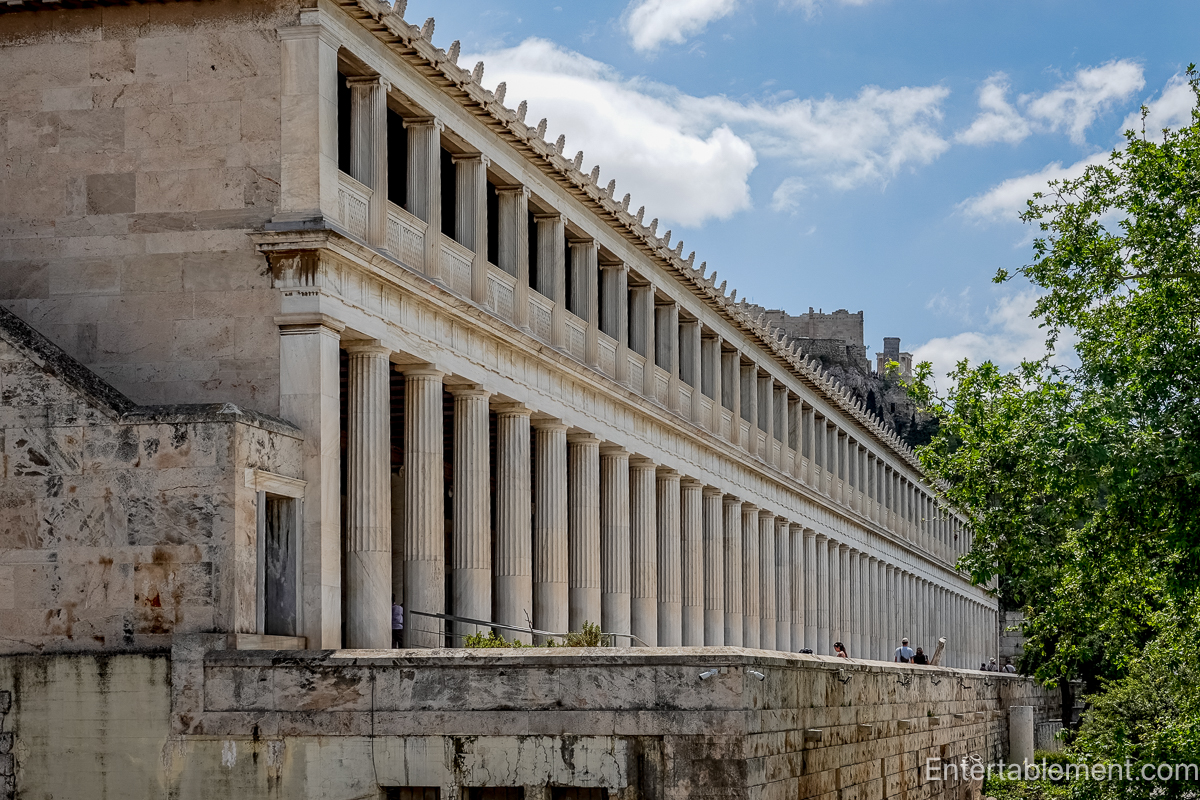
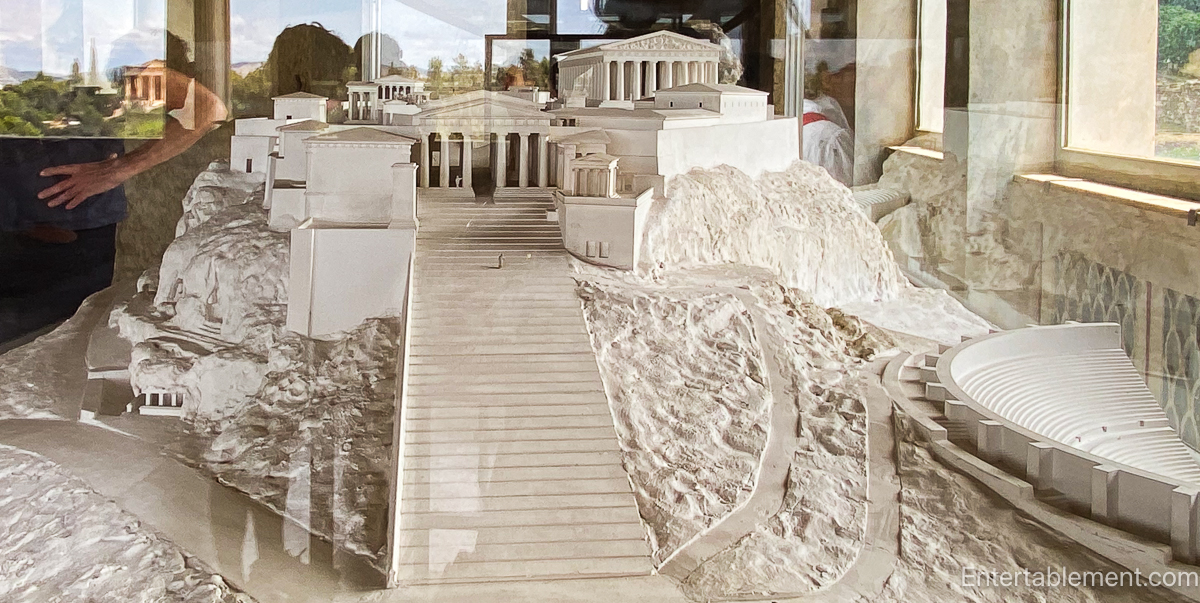
Walking back towards our hotel after finishing lunch, we noticed something unexpected. Right beside the train tracks was a large, intact classical building sitting at street level. What on earth was that?

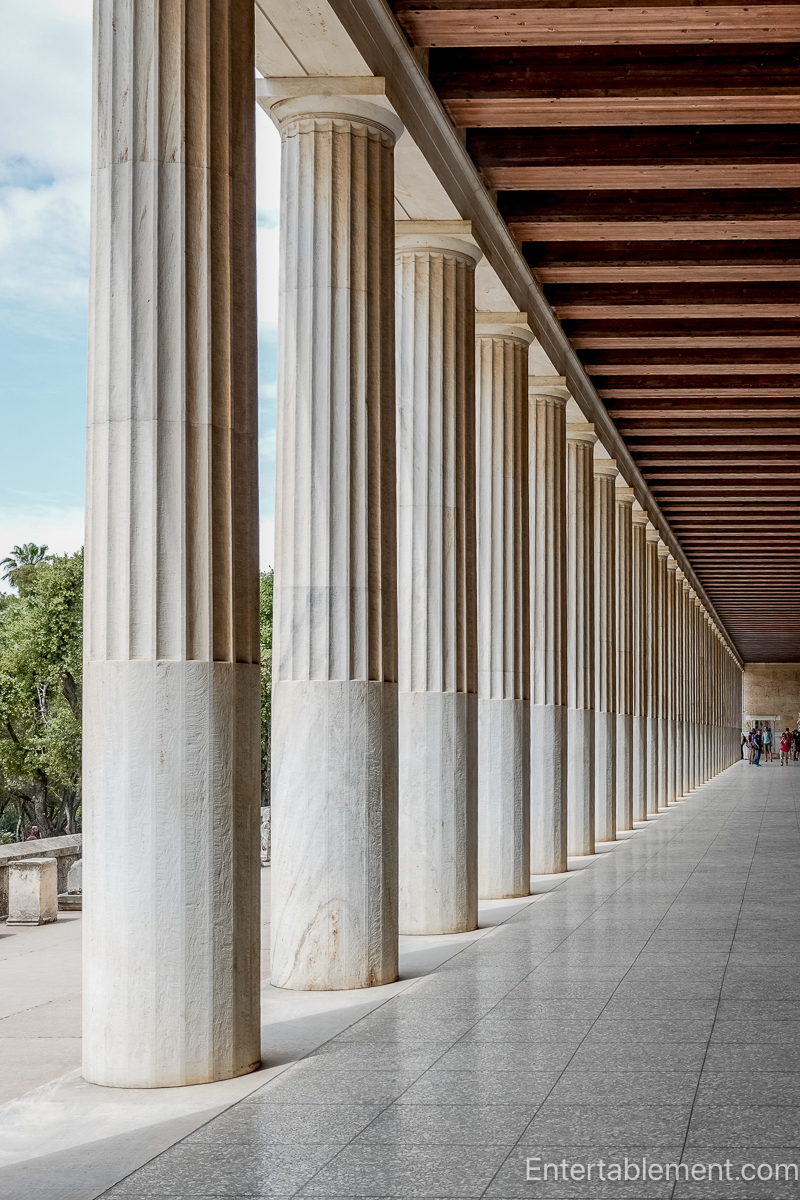
It turned out to be the Ancient Agora — or rather, a careful reconstruction of part of it, the Stoa. Curiosity piqued, we lined up and paid to enter.
I had read about it, vaguely, but the tourist descriptions were not intriguing: ancient marketplace. Hint to tourist bureau: you might want to do more to talk this up, because it is fascinating.
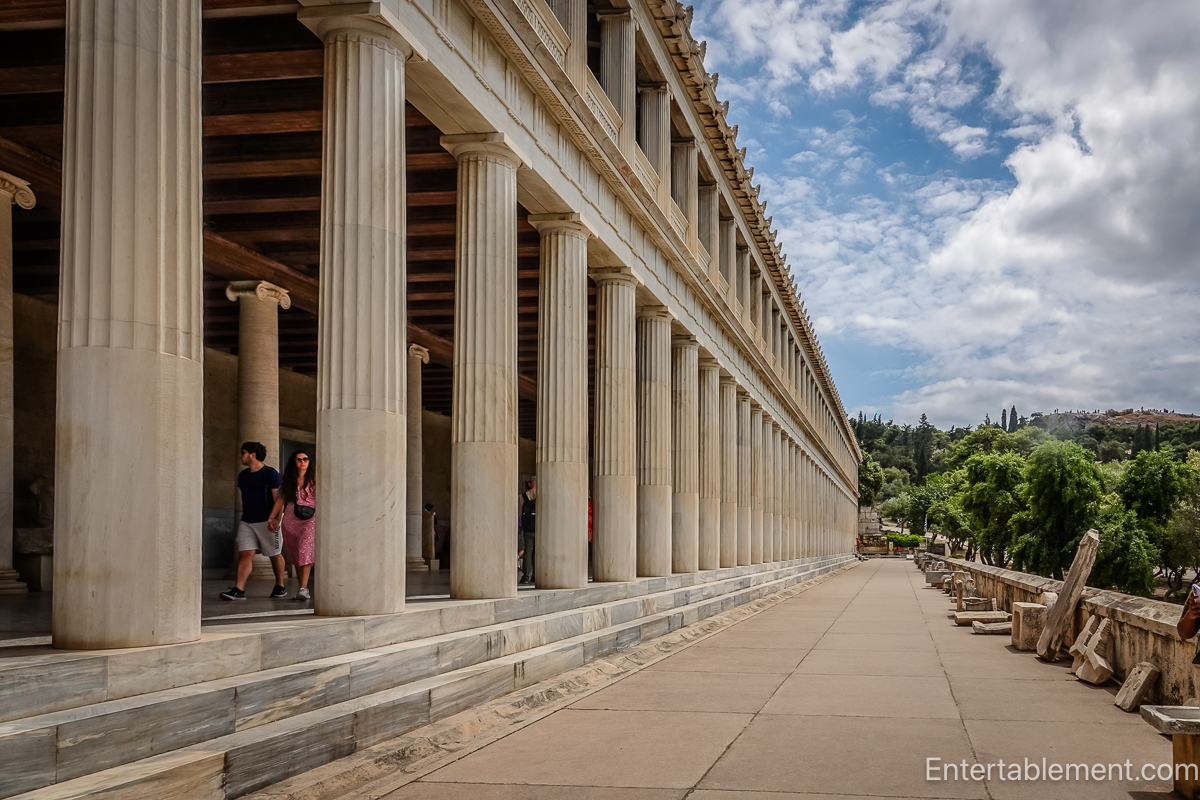
The Agora was not elevated. It was down and dirty—open, exposed and noisy, This was the working centre of the city and fulfilled several functions: a marketplace, a meeting place, a legal space, and a social one.
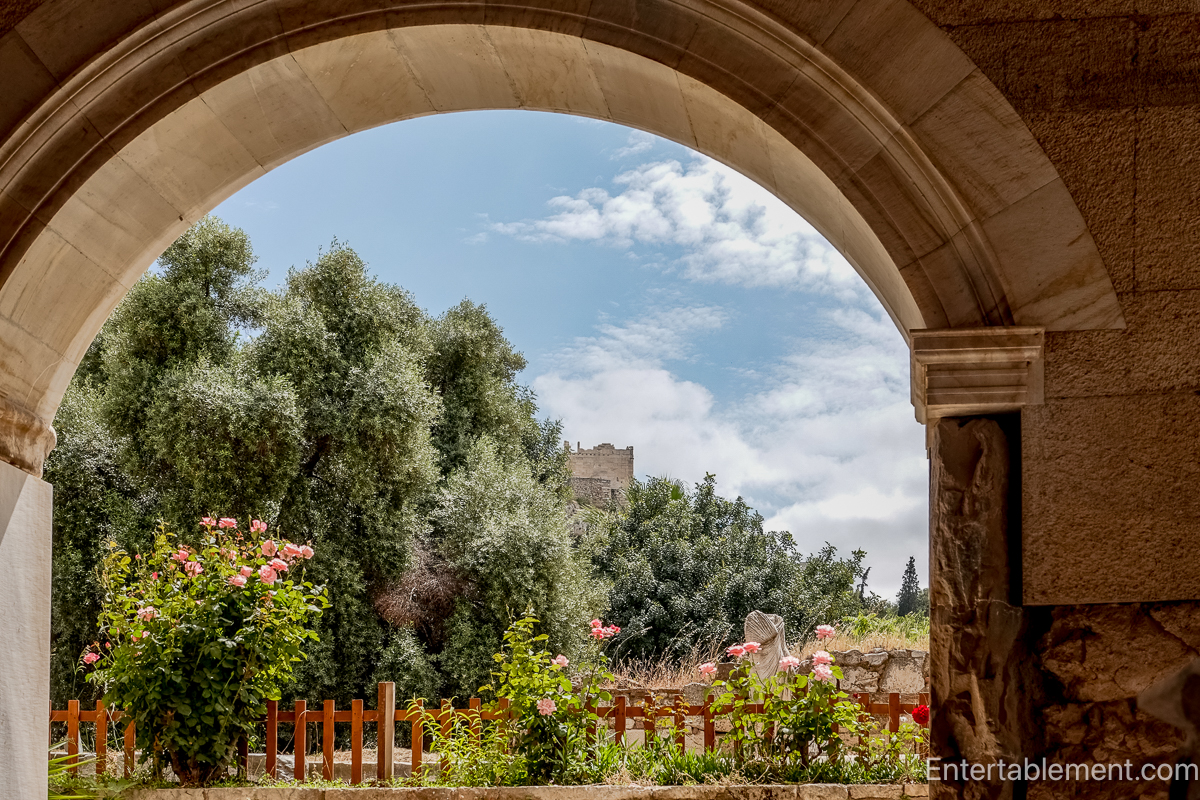
You came here to trade, to argue, to listen, to be counted. It wasn’t for leisure or lounging about. People stood and waited. It was hot. And opinions abounded – lots of them you disliked.

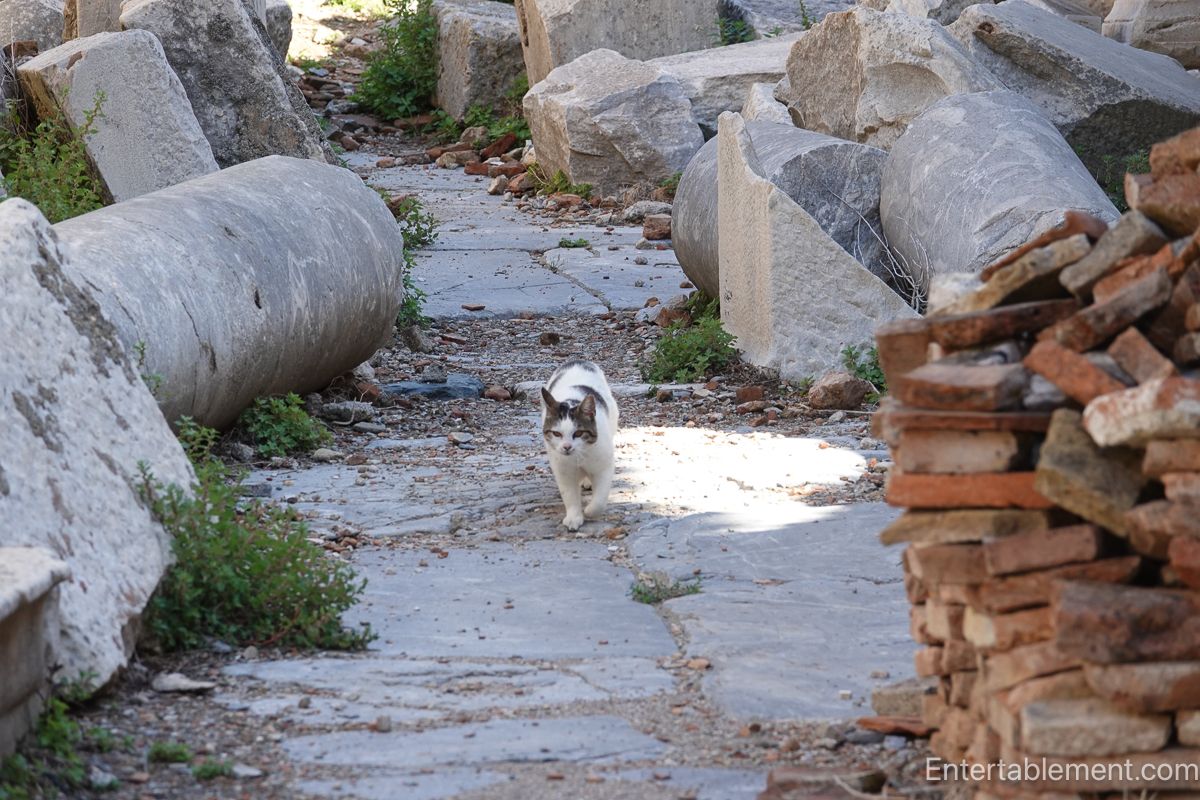
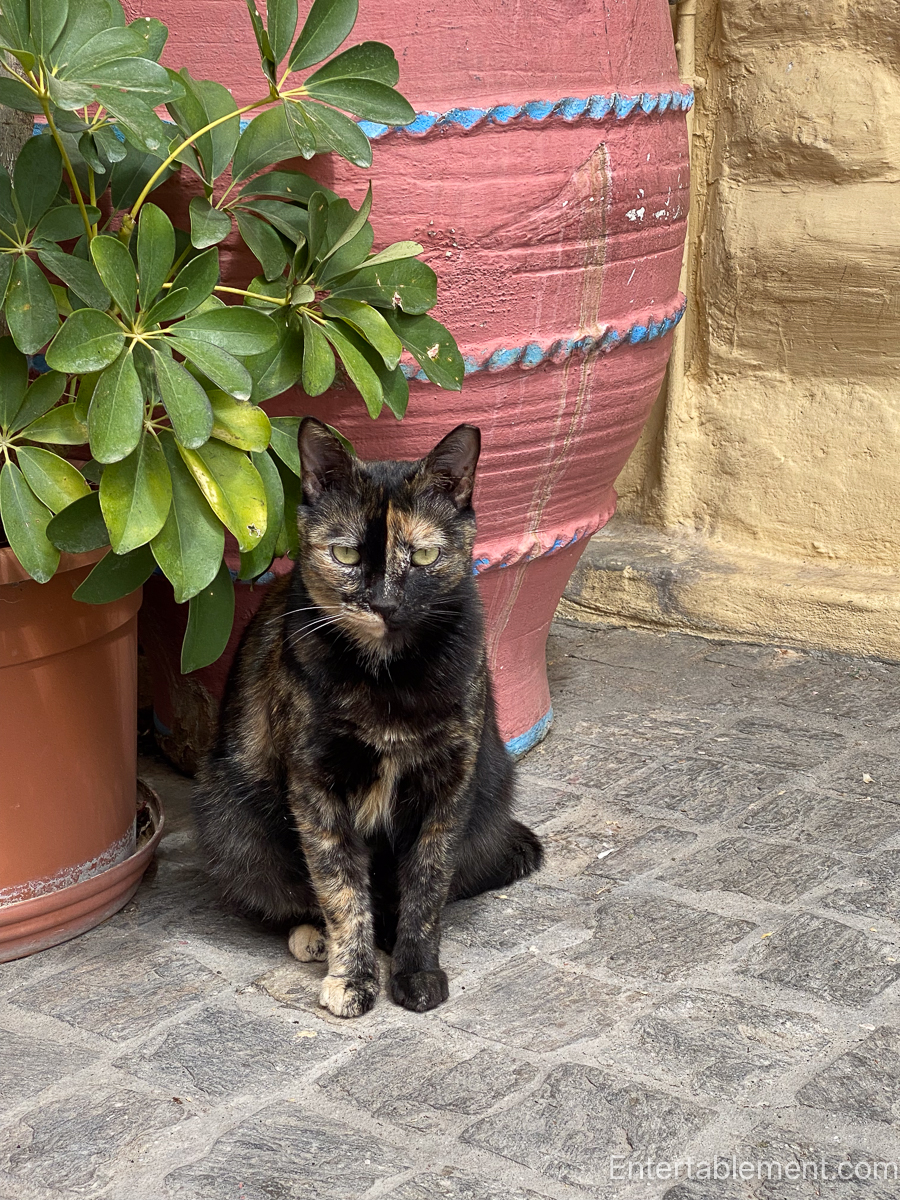
And today, you see cats. Lots of cats! The site officials spay or neuter them, then release them back to the site where they are fed daily by the ticket office people.. The cats trot among the tourists like small, furry guides.

Stopping to groom themselves with ballerina-like grace. Such a typical cat activity!

This was where Greek civic life actually happened.

What struck me almost immediately was how little the system relied on an elevated notion of human virtue. Instead, it assumed actual human nature — and engineered around it.
In the museum, one small object made this unmistakably clear: the jury selection device. Citizens’ names were placed into slots and randomly chosen. The process was deliberately mechanical. Not because the Greeks were cynical, but because they were realistic. People will always try to influence outcomes. Randomization made fairness tangible.
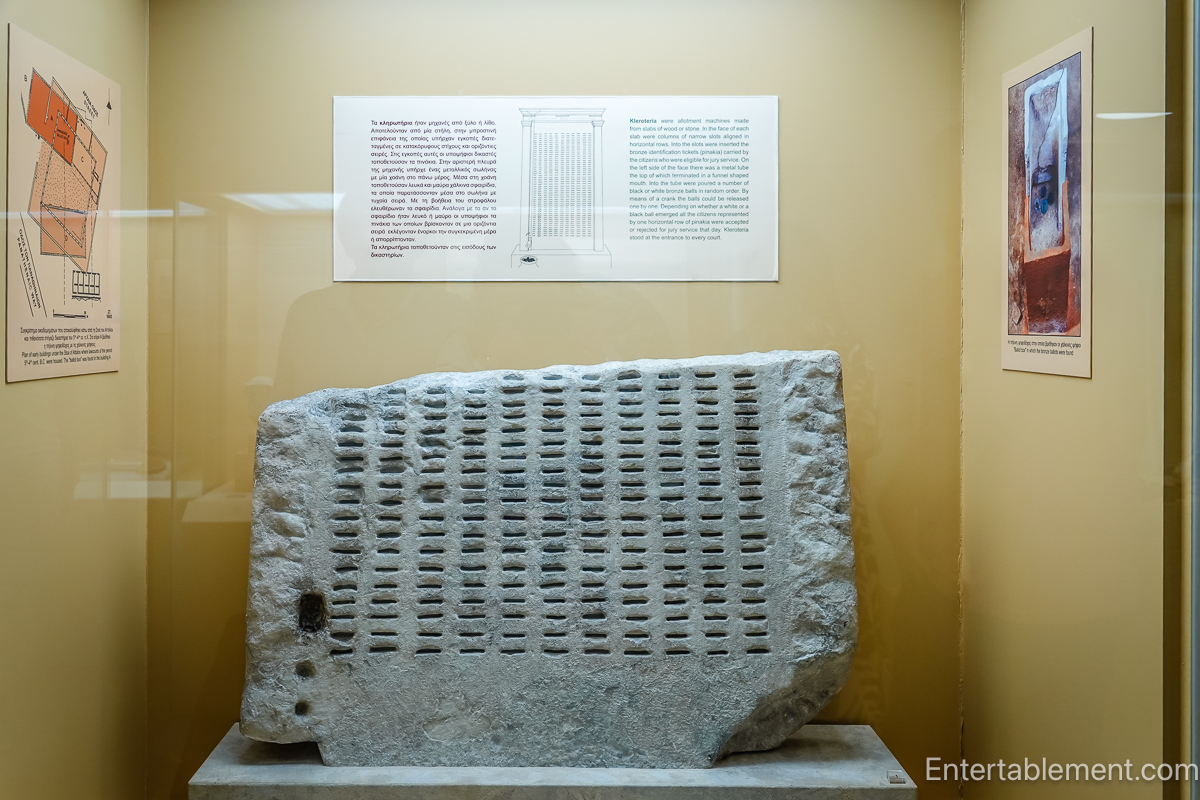
Rules existed not because people were trusted to behave well, but because they were trusted to behave predictably.

Nearby was another object that made me chuckle: a child’s potty-training chair. Civilization, it turns out, has always included toddlers. Public life does not pause for domestic realities. Children had to be trained. Bodies had needs. Life went on.

It was impossible, standing there, to maintain the illusion that ancient Greece was a world of pure abstraction. This was a society deeply concerned with logistics: how people moved, how they gathered, how decisions were made, and how disagreement was managed without tearing the whole thing apart.

The Hill and the Street
Elsewhere in the Greek world, the same assumptions held.

But Athens made the contrast clearer than almost anywhere.
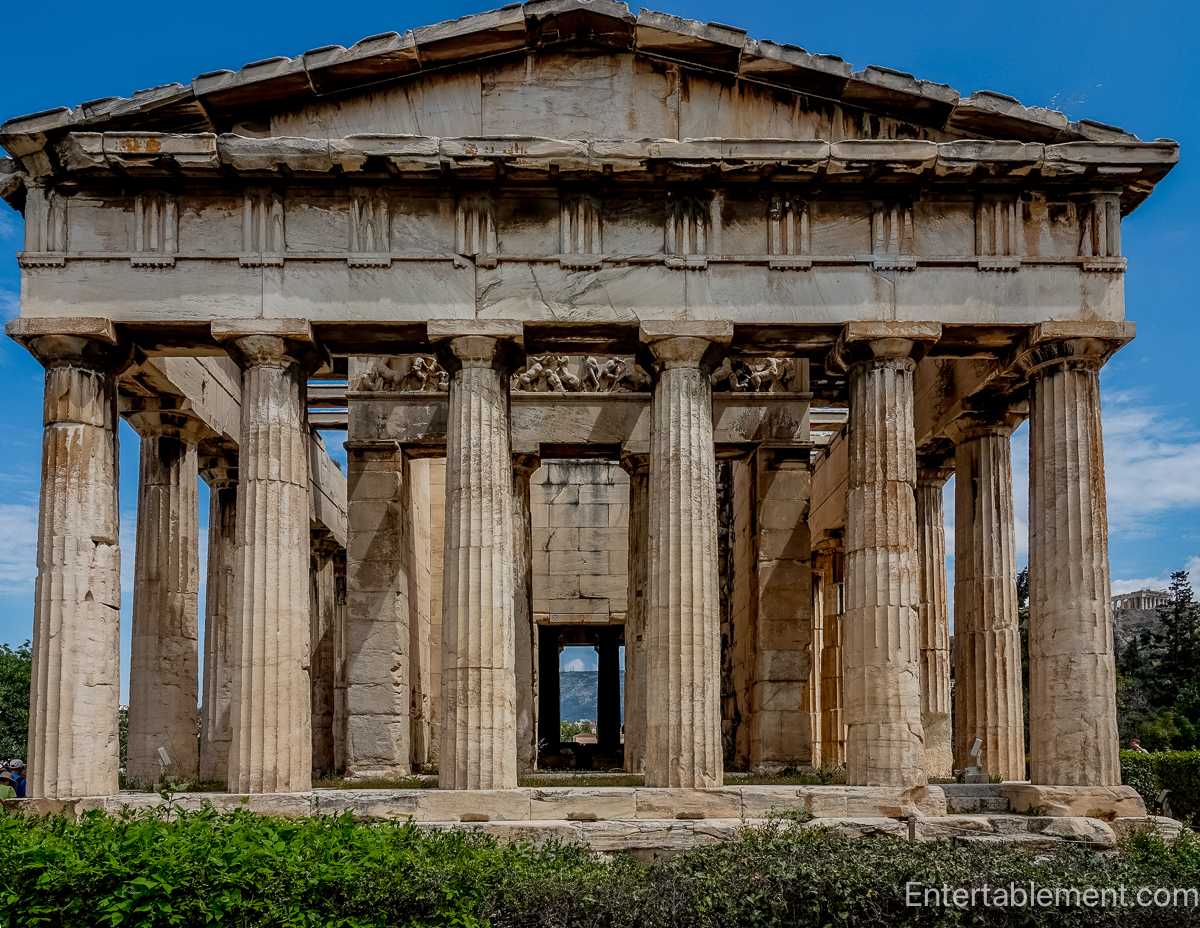
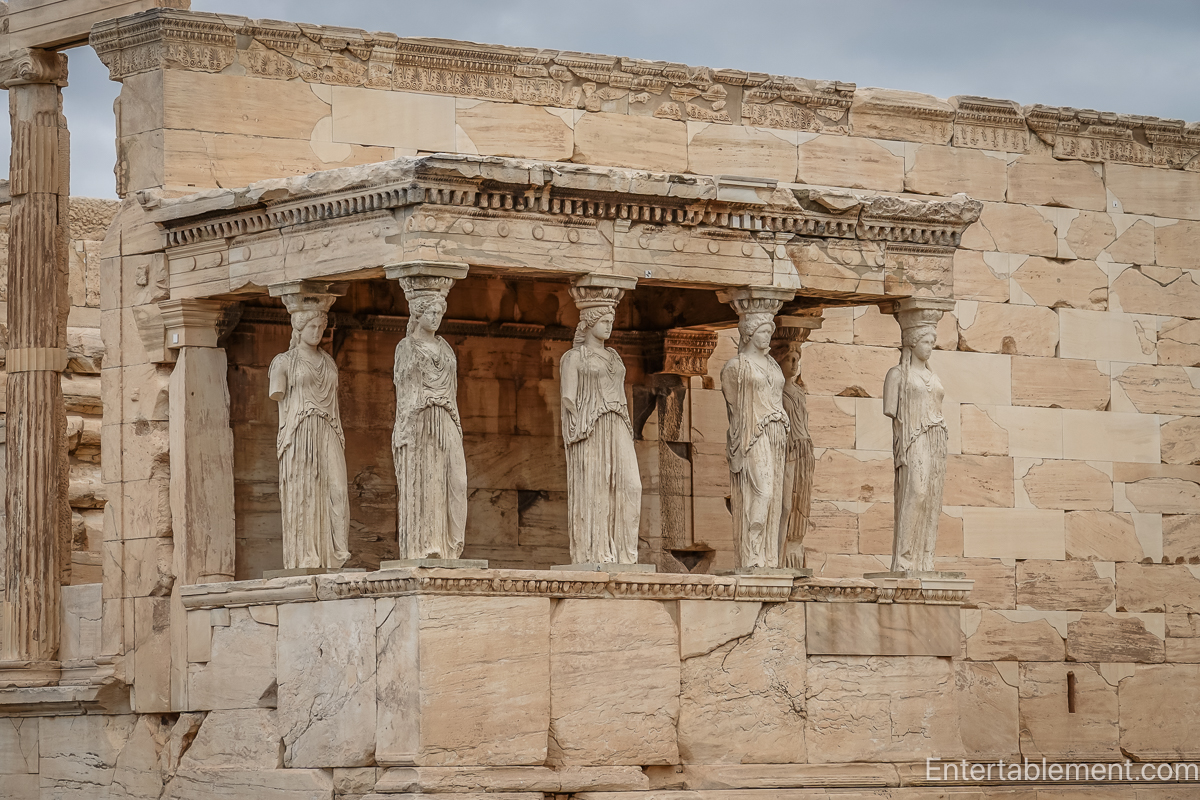
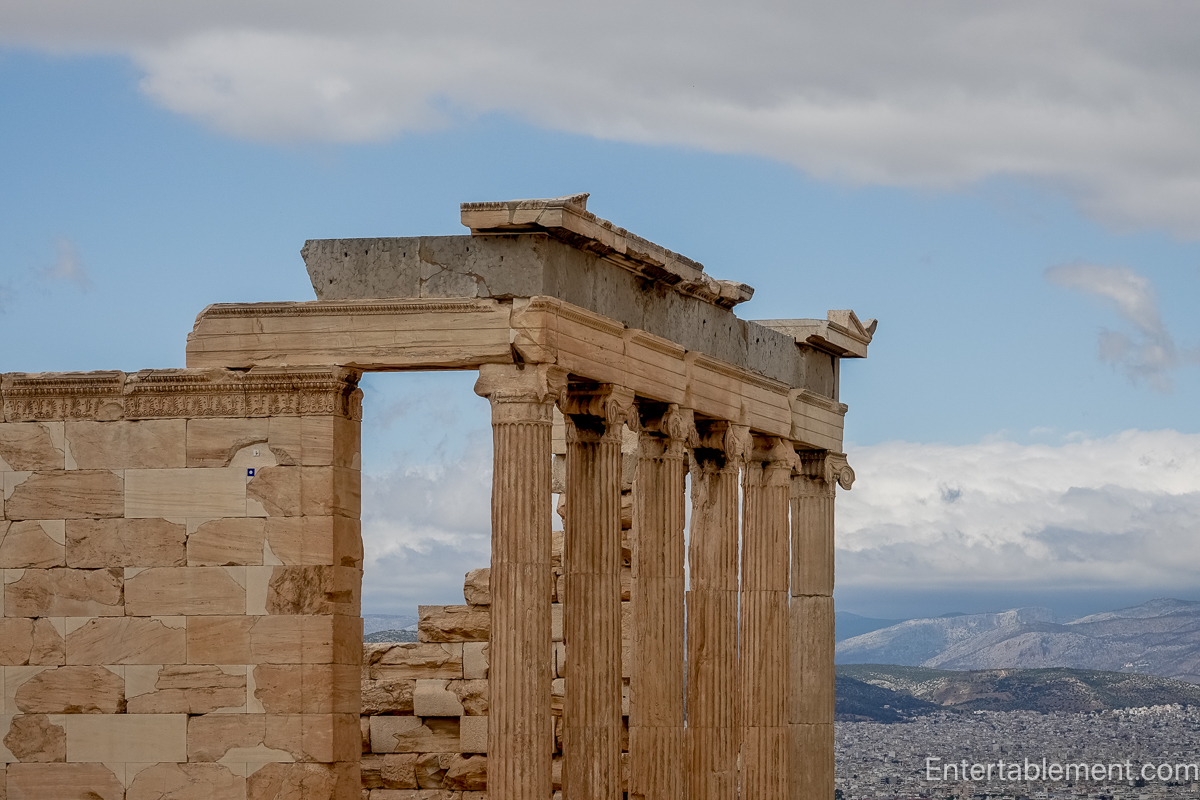
On the hill, the Acropolis stood as a reminder of ideals. Temples like the Parthenon and the Erechtheion — with its load-bearing Caryatids — spoke of beauty, proportion, and aspiration.

These structures don’t reach into daily life. They watch, remind and elevate. They denote values, not processes.
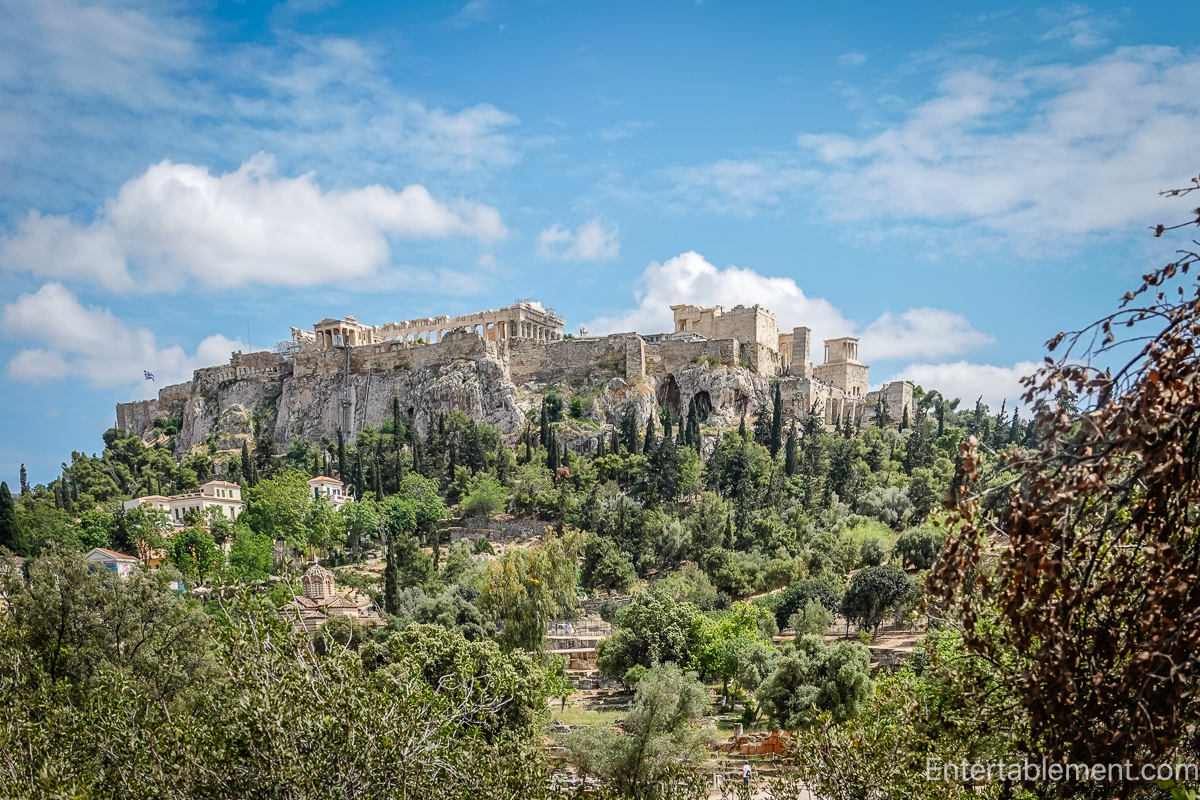
Down below, the Agora said something almost opposite: civilization is messy, human, embodied, and continuous. Life didn’t pause because a temple was built. It carried on, stubbornly, insistently.

And then there was the theatre — the Theatre of Dionysus. This was where Athenians came together to watch stories where kings failed, gods were unhelpful, families fractured, justice misfired, and human desires collided with human rules.

Theatre wasn’t distraction. It was public emotional processing. Tragedy and comedy weren’t entertainment so much as a communal way of confronting what happens when our ideals don’t hold up under pressure.
An Ancient Pattern We Still Live
What struck me most — and what stayed with me long after the travel brochures faded — was how deliberate this society was about its assumptions.
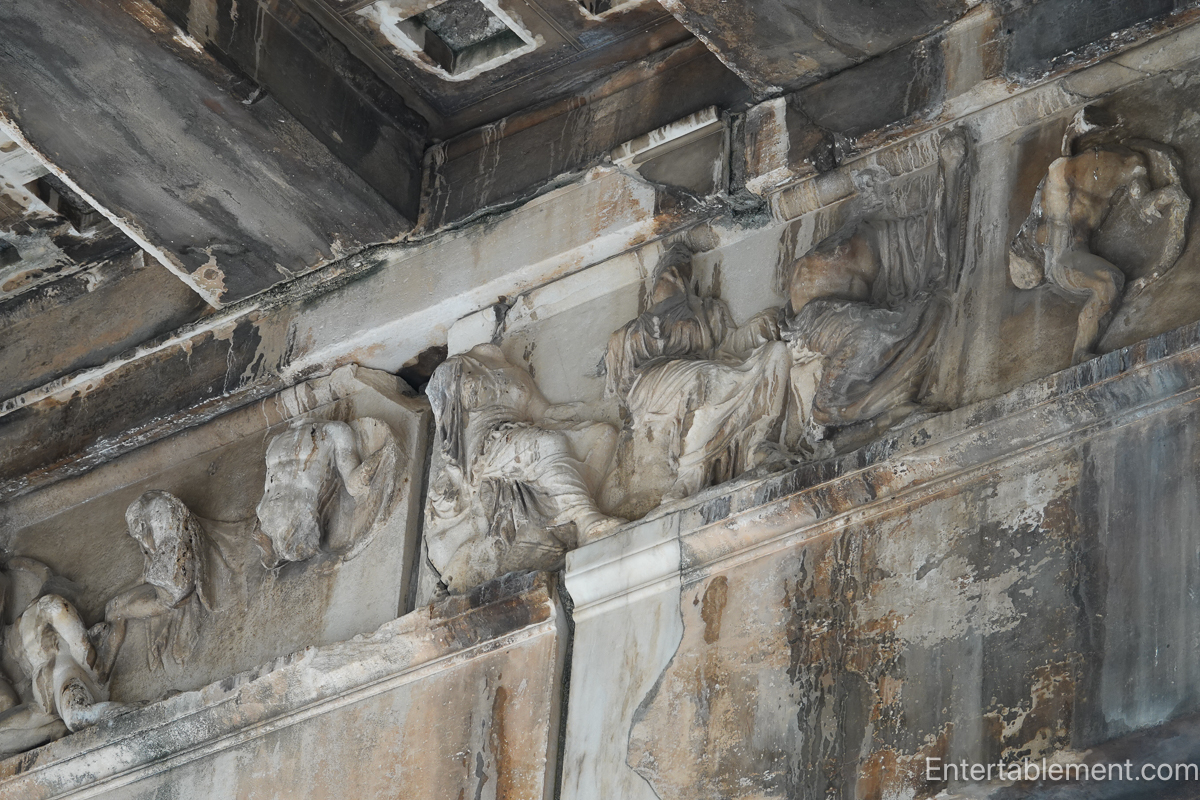
Athens didn’t believe people were naturally virtuous. It assumed disagreement, self-interest, distraction, ambition, comfort-seeking, fatigue, envy, frustration, resentment — all the messy stuff human beings bring to public (and private, for that matter) life.

So instead of wishing it away, or pretending it didn’t exist, Athens built around it. Systems were designed with human nature in view, not fantasy. Laws didn’t appeal to character, but to process. Institutions didn’t rely on heroic restraint, but on rotation, on randomness, on visibility.
In that sense, Athens doesn’t feel old. It feels familiar — because it confronts what has never changed about people. Or cats.
Addendum
Beatrice, one of my most faithful readers, reminded me of Plaka, an historic neighbourhood in Athens, tucked beneath the Acropolis It’s one of the city’s oldest continuously inhabited areas, with narrow streets, cafés, tavernas, shops, and homes layered over centuries. While the Agora formalized public debate, neighbourhoods like Plaka still absorb it — over coffee, in the street, mid-argument, blocking the pavement if necessary
Too Much of a Good Thing
Walking those ruins, something else became clear: ideals and human nature are not in opposition. They co-exist — and sometimes that results in a tense, noisy conversation. When we forget that, the balance tips.
Justice turns to vengeance.
Freedom drifts into chaos.
Order calcifies into tyranny.
Equality curdles into resentment.
Those aren’t modern problems. They’re patterns, visible across centuries because they’re rooted in what people do, not what they imagine they should do.
When societies lean too far in one direction — toward unbounded idealism — the reaction is predictable. People begin to crave simplicity, certainty, and control. They reach for clear answers rather than systems that manage complexity. That “tough guy” paradigm — the leader who promises to make chaos stop — is not a new invention. It’s an old echo, appearing whenever balance weakens and hope blurs into frustration.

For those of us who reached adulthood in the early 80s, there was a comfortable assumption that some of these lessons had been learned once and for all. But history doesn’t end; it cycles. We’re back here again, and the Greeks remind us that these tensions have been lived, negotiated, and engineered around for thousands of years.
What We Still Need
Life isn’t free. We still have to get up and go to work when we don’t feel like it. We still need purpose, direction, self-discipline, and habits that tether us to something bigger than our momentary feelings. Those aren’t antiquated values. They’re the bridge between ideals and life.
The Greeks didn’t live in a world without desire or variability. They lived in a world that accepted human nature as a constant — not something to be negotiated away, fetishized, or eliminated, but something to be managed with mechanisms that acknowledge its reality.

And that’s the relief you feel walking those sites: not the enchantment of idealism, but the groundedness of a civilization that understood life never pauses for purity.
And Then There Was Rome
We’ll go next to Rome — not because Athens failed, but because it succeeded. It teaches just enough to make Rome intelligible: what happens when power stops rotating among citizens and settles into permanent offices, growing larger, more centralized, and harder to dislodge.
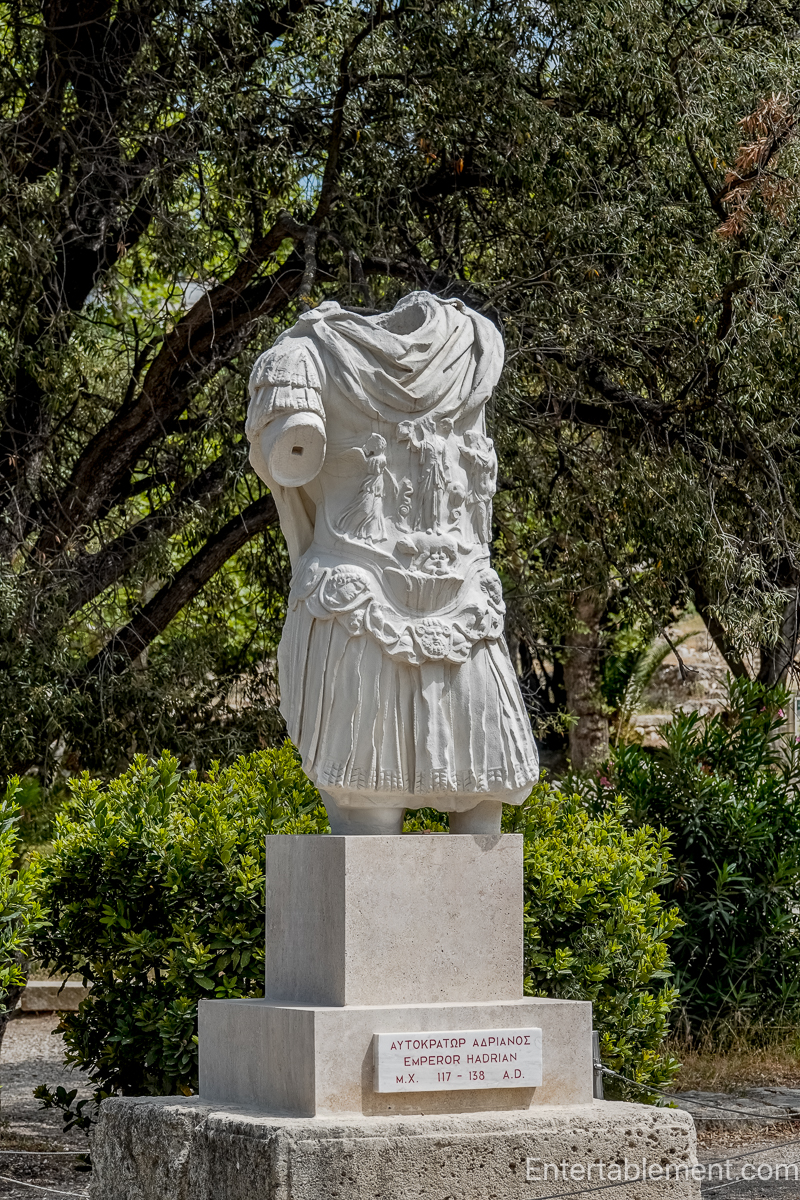
But that’s the next chapter.
For now, the hill and the open street stand with this quiet message:
Ideals matter. Human nature matters more. And civilizations survive — not by ignoring one or the other — but by building spaces where both can be lived, processed, and made to coexist.

And co-exist with cats. 🙂
This essay is part of The Continental Thread — a series exploring how authority, culture, and daily life reorganized themselves as Europe moved from Roman order to the modern world.
- Previous in the Series: Turin—An Accidental Highlight
- Next in the Series: Rome — Scale, Infrastructure, and the Relief of Decision





Dear Helen, thanks for this thoughtful meander around Athens, which I last visited in 1980. (BTW, I would add the Plaka to your list of public debating places.) Back then there were no signs in English, so I had taught myself basic Greek letters. By sounding out the words, I could guess at the meaning, extrapolating from English or Latin words. Besides, coming off the ferry I could beat all the tourists to the choice locations. Modern evidence: In 2015, OH and I were in Crete just before the crucial and very fraught national referendum vote on accepting the EC/IMF/ECB bailout. A couple of old Greek men stopped to argue, blocking the sidewalk in front of us. One turned to the other, and in perfect English shouted, “Anthony–YES or NO???!!!” So on it goes…
Beatrice, that anecdote about the two Greek men arguing is just brilliant! As you say, on it goes… And thank heaven that it does. Give me me shouted argument over unilateral diktat anytime.
Thanks for the tip about the Plaka. I shall amend!
I LOVED this! Thank you for sharing your thoughts and analysis.
I am so glad, Barb! History is so vast, I have been really enjoying the process of piecing together the disparate bits and weaving them into a thread. Lots more to come!
Things haven’t changed from thousands of years ago. People are still out in the streets protesting and arguing like they did then. Life goes on uninterrupted as before. Great history read. And of course, The Cat!
Things really haven’t changed at all, have they? People are people and human nature does not seem to change, no matter how much technology we get!
i loved your post on the Egyptian Museum in Turin, too. I added the Book of the Dead to my Amazon cart. I’m learning so much from you!
Oh good! Isn’t it marvellous how today we can immediately get more information on things in which we are interested?