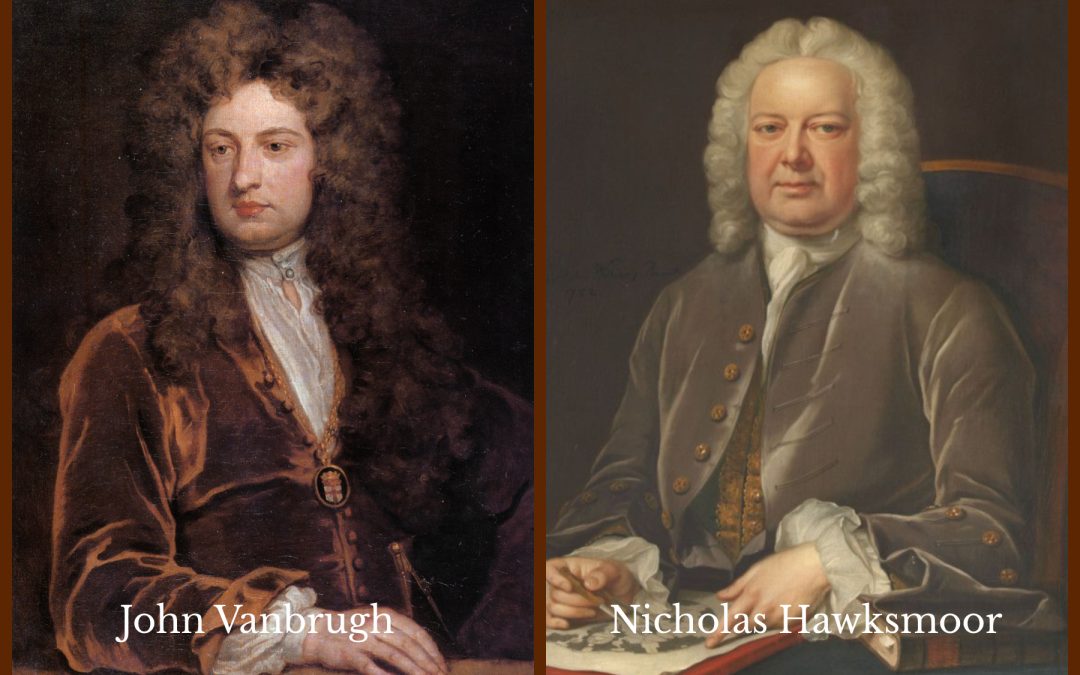
John Vanbrugh (1664–1726) and Nicholas Hawksmoor (1661–1736) formed one of the most dynamic partnerships in English architectural history. Together, they crafted some of the most ambitious and theatrical buildings of the English Baroque period, blending drama, power, and Classical grandeur. While Vanbrugh was the visionary, Hawksmoor provided the technical expertise, ensuring that their monumental designs were structurally sound and enduring.
John Vanbrugh: The Theatrical Visionary
Vanbrugh had an unusual path to architecture. Initially known as a playwright and soldier, he was imprisoned in France as a suspected spy, where he likely encountered the grand Baroque architecture of Versailles. Upon his return to England, he became involved in architecture through his connection with the influential Whig statesman Charles Howard, 3rd Earl of Carlisle.
Politically aligned with the Whigs, which granted him access to major commissions like Castle Howard and Blenheim Palace, those same connections made him a lightning rod during periods of Tory resurgence. His famous falling out with Sarah Churchill, Duchess of Marlborough, over Blenheim Palace stemmed not just from aesthetic disputes but from deep-seated personal and political differences. Though politically well-connected, Vanbrugh’s flamboyance and strong opinions could make him a polarizing figure.
Nicholas Hawksmoor: The Master Builder
Hawksmoor trained under Christopher Wren, working with him on major projects from around 1684 to 1700, including Chelsea Hospital, St Paul’s Cathedral, Hampton Court Palace, and Greenwich Hospital. Unlike Vanbrugh, he had formal architectural training, excelling in drafting, structural engineering, and classical composition. His deep knowledge of ancient Roman, Gothic, and Renaissance architecture made him an indispensable collaborator.
Thanks to Wren’s influence as Surveyor-General, Hawksmoor was named Clerk of the Works at Kensington Palace in 1689 and Deputy Surveyor of Works at Greenwich in 1705.
However, in 1718, during the reign of King George I, Wren’s Tory alignment cost him dearly. He was dismissed and replaced by the amateur William Benson, a political appointee aligned with the newly ascendant Whig government. And Hawksmoor was stripped of his positions to make room for Benson’s brother. This unjust dismissal was part of a broader political reshuffle that prioritized loyalty and affiliation over experience and merit.
Vanbrugh lamented in 1721: “Poor Hawksmoor. What a barbarous age have his fine, ingenious parts fallen into. What would Monsr: Colbert in France have given for such a man?” Hawksmoor was partially reinstated in 1726 as secretary, though the more senior clerkship went to Henry Flitcroft.
This episode underscores a broader historical theme: the quietly industrious and technically brilliant are often sidelined by flamboyant or better-connected rivals, particularly during times of political change. Hawksmoor’s dismissal did not halt his career, but it curtailed his official advancement and likely cost England further architectural achievements from his hand.
Major Collaborations
The partnership between Vanbrugh and Hawksmoor produced two of the greatest landmarks of English Baroque:
- Castle Howard (1699–1712) – Commissioned by the Earl of Carlisle, Castle Howard was a bold departure from traditional English country houses. With its grand central dome (inspired by St. Paul’s Cathedral) and sweeping wings, it set a new standard for aristocratic estates.
- Blenheim Palace (1705–1722) – Built as a gift from Queen Anne to John Churchill, Duke of Marlborough, for his military victories, Blenheim Palace is a monumental expression of triumphal Baroque. Its massive colonnades, intricate ornamentation, and imposing silhouette reflect Vanbrugh’s taste for theatricality and Hawksmoor’s precision in structural composition.
Hawksmoor’s Later Works
After Vanbrugh died in 1726, Hawksmoor continued his career with several notable commissions, particularly in ecclesiastical architecture:
- Six London Churches (1712–1730s) – Designed under the 1711 Commission for Fifty New Churches, these included St. Mary Woolnoth and St. George’s, Bloomsbury, blending classical geometry with Gothic verticality. He also updated the West Towers at Westminster Abbey.
- Oxford’s Radcliffe Camera (1737–1749, posthumous completion) – A perfect example of Hawksmoor’s fusion of Palladian and Baroque influences.
Influence and Legacy
Vanbrugh and Hawksmoor defined the bold, sculptural style of English Baroque, influencing later architects such as William Kent and Robert Adam. Their grand, expressive designs pushed the boundaries of English country house and church architecture, leaving an enduring mark on Britain’s architectural landscape.
Their collaboration represents one of the most fascinating intersections of visionary ambition and meticulous execution in architectural history, solidifying their status as giants of English Baroque.