It has become fashionable to speak of the Enlightenment as a failed project. Depending on the argument of the day, it is blamed for everything from inequality to environmental strain to social fragmentation. The language is often sweeping: “broken,” “exhausted,” “no longer fit for purpose.” And yet, walking through places shaped by that period, one is struck by something quite different. The system does not look broken It looks evolved.
What The Enlightenment Upended
It’s hard to imagine now, but not too long ago, doubting religious orthodoxy could get you killed. In 1697, a 20-year-old Scottish student named Thomas Aikenhead was executed—for blasphemy. His crime? Allegedly mocking the Trinity and suggesting that religion might be… less than infallible. He’d been reading a few too many forbidden books. Today, we’d probably send him to a philosophy lecture—or at least a vigorous debate in a university café. But back then, saying the wrong thing could be fatal.
This chilling episode reveals the world the Enlightenment would upend. Thomas Aikenhead was the last person in Great Britain to be executed for blasphemy.
At that time, religious institutions still held enormous power, even in post-Reformation England. As early as 1215, the Magna Carta introduced the concept of habeas corpus, a legal principle that protects individuals from being detained without due process of law. (Habeas corpus: “you shall have the body” in Latin. It requires that anyone arrested be brought before a judge and informed of the reason for their detention. It stops governments from imprisoning people arbitrarily or indefinitely.)
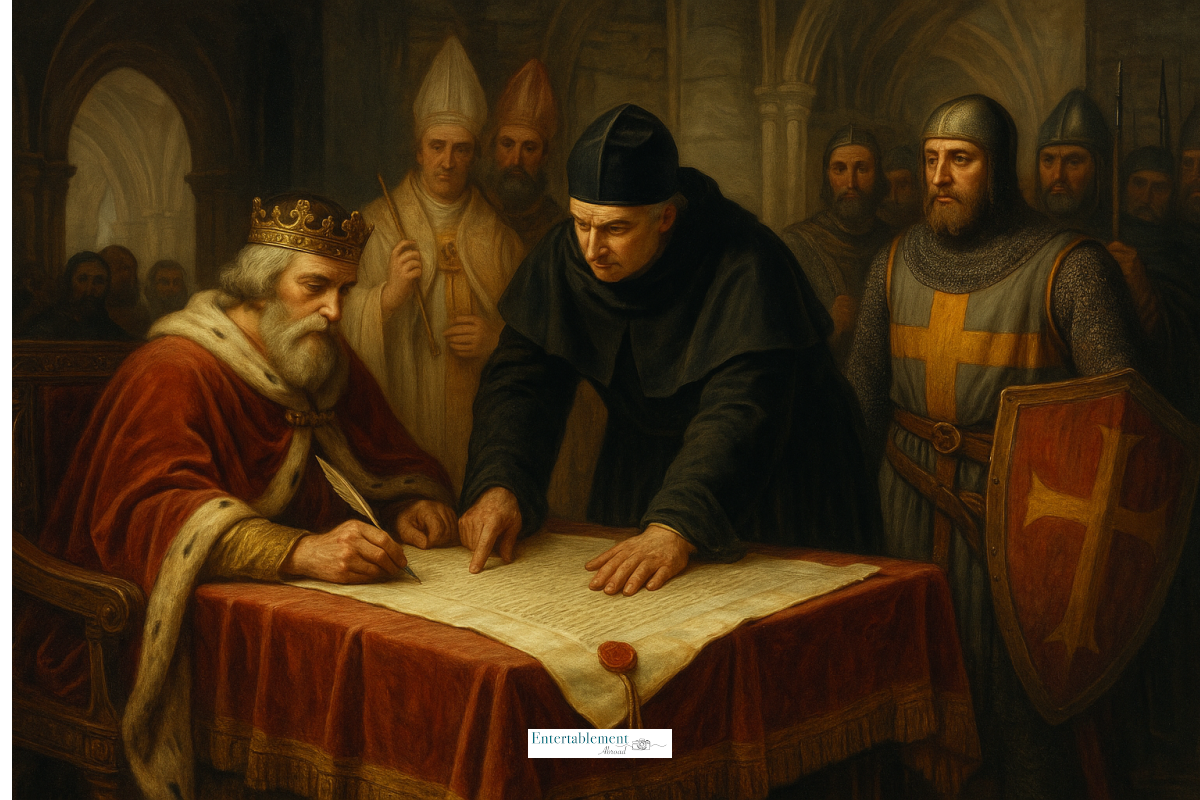
Henry VIII’s Divorce Didn’t End the Control of the Church
When Henry VIII severed ties with the Roman Catholic Church, the monarch became the head of the Church of England, replacing the Pope with the Crown. But Divine authority stayed firmly in charge, just in new hands. But for most people, daily life still revolved around religious doctrine. Question it at your peril.
Enter the Enlightenment—a bold reimagining of how humans might live, think, and govern themselves. It was a revolution not fought with muskets and bayonets (though some would follow), but with quills, printing presses, and copious cups of coffee.
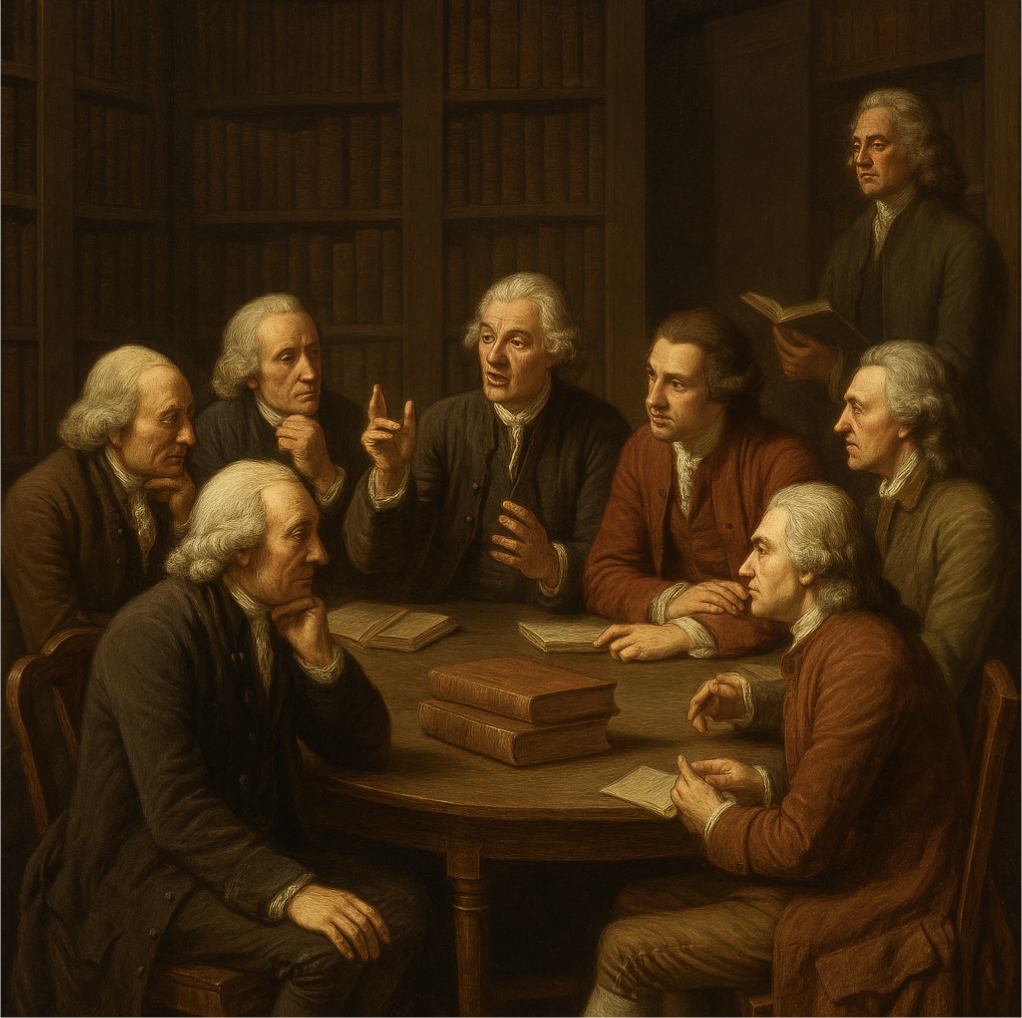
Reason Over Revelation
The Enlightenment championed the radical notion that human reason—not divine command or inherited tradition—should be the starting point for knowledge. Philosophers such as Voltaire, Diderot, Rousseau, and Montesquieu in France; Kant in Prussia; Hume and Smith in Scotland; and Jefferson and Franklin in the nascent United States, argued for logic, inquiry, and a healthy skepticism.
What the Enlightenment Actually Was
The Enlightenment was not a single doctrine or ideology. It was, more simply, a way of approaching the world. Thinkers such as David Hume and Adam Smith were not designing perfect societies. They were observing how people behaved and asking how systems might work better. They assumed that human beings are imperfect, that knowledge is partial anthat outcomes are often unintended
And from those modest assumptions, they built something remarkably durable: a habit of inquiry, adjustment, and improvement.
A Discipline, Not a Sentiment
There is another aspect of Enlightenment thinking that is easy to overlook. It was not sentimental. It was disciplined. It asked people to pause before reacting. To look for evidence. To test assumptions. To examine their own thinking as carefully as they examined the world around them.
Benjamin Franklin approached this quite literally, setting himself a rotating cycle of self-examination—thirteen weeks, thirteen virtues—returning again and again to the question of how to improve his own conduct.
This was not “pearl-clutching,” nor was it a set of polite rules designed to avoid disagreement. It was a practical method;
- Lower the temperature.
- Observe more carefully.
- Respond with intention rather than impulse.
Disagreement remained. But it was approached with the aim of understanding a problem well enough to improve it—not simply to win.
Systems, Not Ideals
At its core, Enlightenment thinking is not about perfection. It is about systems.
- How do people coordinate their efforts?
- How do institutions support stability?
- How do incentives shape behaviour?
Smith looked at markets. Hume looked at human nature. Neither expected flawless outcomes. Both expected iteration.
A Different Way of Deciding
There is another aspect of Enlightenment thinking that is easy to overlook: It encourlaged a particular way of making decisions. Not quickly or loudly. Not through assertion or force, but by pausing, looking for evidence, testing ideas and listening to opposing views. Adjusting conclusions when new information appeared.
It was, in its way, a discipline of restraint. Voices were lowered rather than raised. Arguments were made through reason rather than volume. Authority was questioned, but not discarded lightly. This did not eliminate disagreement—far from it. But it changed how disagreement was handled. The goal was not to win an argument, but to understand a problem well enough to improve it.
That habit—of slowing down, observing carefully, and responding with measured judgement—may be one of the Enlightenment’s most valuable legacies.
And perhaps one of its most difficult to sustain.
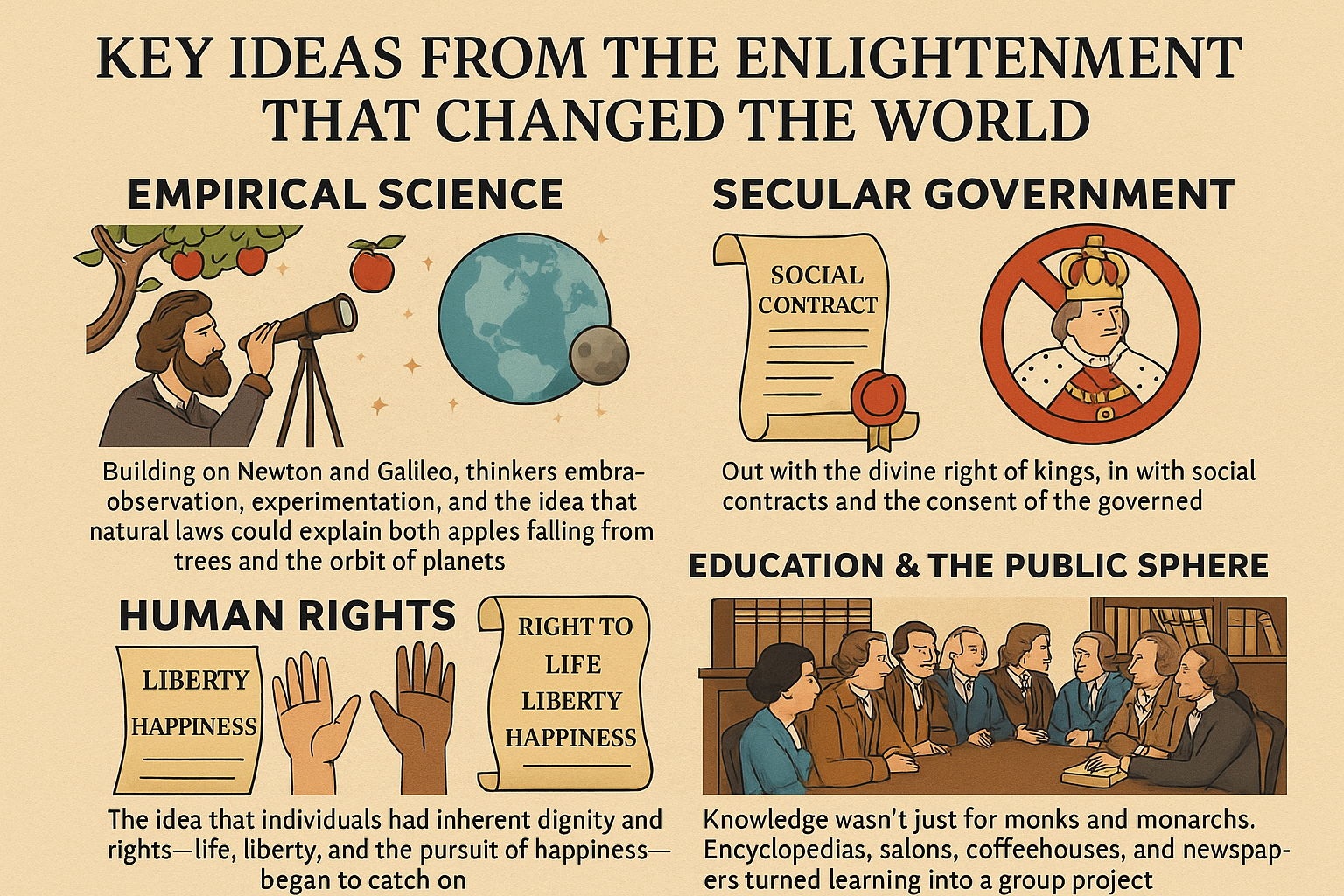
Key Ideas That Changed the World
- Empirical Science: Building on Newton and Galileo, thinkers embraced observation, experimentation, and the idea that natural laws could explain both apples falling from trees and the orbit of planets.
- Secular Government: Out with the divine right of kings, in with social contracts and the consent of the governed.
- Human Rights: The idea that individuals had inherent dignity and rights—life, liberty, and the pursuit of happiness—began to catch on.
- Education & the Public Sphere: Knowledge wasn’t just for monks and monarchs. Encyclopedias, salons, coffeehouses, and newspapers turned learning into a group project.
The Enlightenment at Home
The ideas of the Enlightenment weren’t confined to treatises and university halls. They showed up in floor plans, upholstery, and garden paths:
- Architecture: Symmetry, clarity, and classical restraint replaced the showy exuberance of the Baroque. Think straight lines, balanced wings, and columns that looked like they belonged to Cicero.
- Gardens: Nature got a makeover. Wildness was shaped into rational, geometric patterns—an idealized vision of order and control (Villandry’s gardens are a case in point).
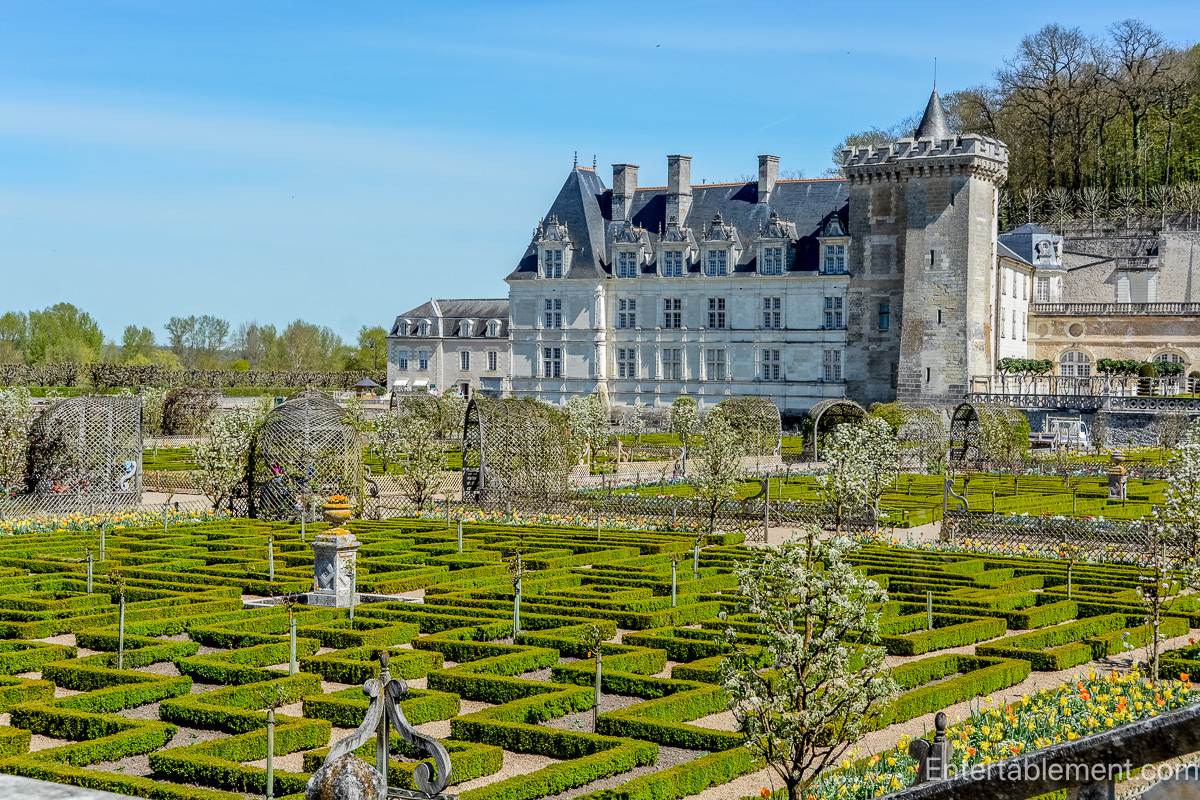
Gardens at Villandry
- Private Life: Interiors began to emphasize intimacy, comfort, and refinement. Drawing rooms replaced vast, echoing halls; bedrooms became more private. The home became a sanctuary for ideas and conversation (see Cheverny).

Library at Cheverny
These weren’t just houses—they were manifestos in stone and silk.
A Living Legacy
The Enlightenment didn’t solve every problem—it had blind spots you could drive a coach and six through. Many of its greatest thinkers espoused liberty—for the chosen few—and ignored slavery (for the time being). But the core ideals—reason, inquiry, education, and personal dignity—continue to shape our world.
At places like Villandry and Cheverny, you can still see those values etched into architecture and landscape. They are tangible echoes of a time when people believed the world could be remade—not by force, but by thinking.
A Quiet Continuity
The Enlightenment did not promise perfection, and it did not eliminate conflict, error, or human frailty. What it offered was something more practical: a way of proceeding. observe carefully, question assumptions, test ideas against evidence, adjust, and try again.
That approach can still be seen—not only in books, but in the world itself. In working landscapes, in evolving institutions, and in the small, repeated decisions that keep complex systems functioning over time.
David Hume reminds us what we are like. Adam Smith shows how systems can work anyway. Benjamin Franklin demonstrates the discipline required to bridge the two.
Taken together, they do not offer certainty. They offer a method. And in a world inclined toward speed, noise, and reaction, that method still has something to recommend it. Quietly, and without fuss, it continues to work.