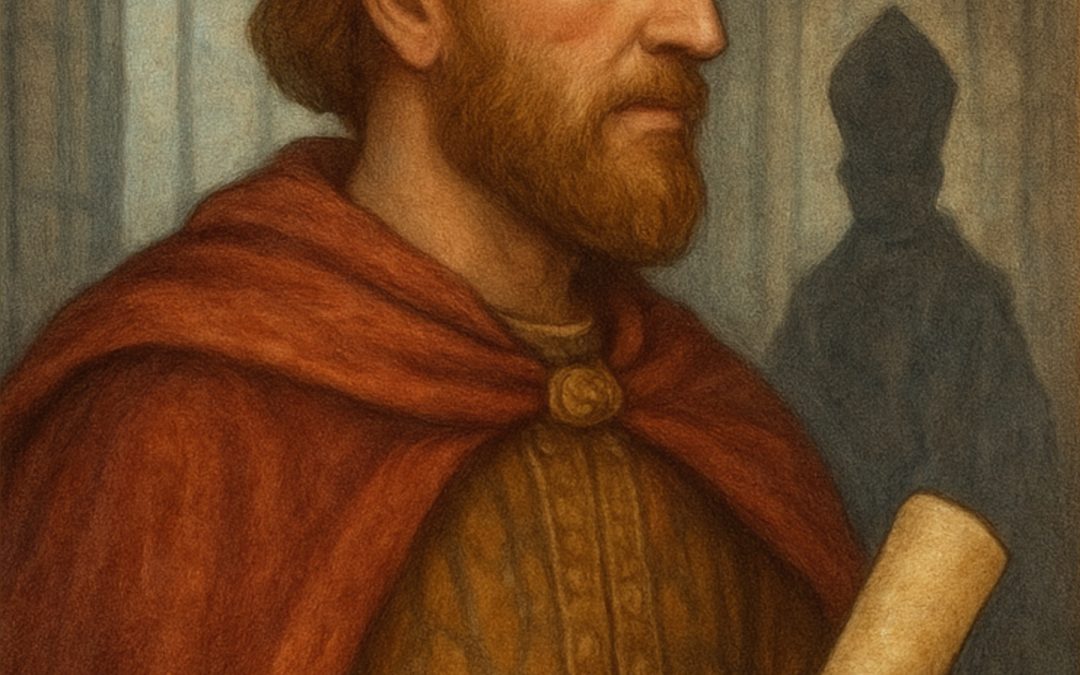
He built a kingdom on law and loyalty—then watched both fail him.
If you’re looking for a medieval king with flair, look elsewhere. Henry II wasn’t flamboyant, he wasn’t pious, and he certainly wasn’t warm. What he was? Smart. Restless. Ruthlessly capable. The kind of man who could rule an empire before breakfast and start a family feud by lunch.
He spoke multiple languages, rarely sat still, and had the kind of memory that terrified his enemies. His reign was a masterclass in political maneuvering—more courtroom than battlefield, more writ than war cry.
But for all his legal brilliance and territorial ambition, his reign ended in betrayal, heartbreak, and a lonely death in armour. So—where to begin?
A King Who Inherited Little and Took Everything
Henry wasn’t supposed to inherit an empire. Born in 1133 to Matilda (daughter of Henry I) and Geoffrey of Anjou, he technically had a claim to the English throne—but no one expected much. England was in chaos after years of civil war (remember Stephen vs. Matilda?), and young Henry had everything to prove.
And prove it he did.
By 21, Henry had married Eleanor of Aquitaine—an astonishing match that gave him control of southwestern France and a wife who was as clever, cultivated, and insubordinate as he was. Between inheritance, marriage, and conquest, he became ruler of what historians call the Angevin Empire—a realm stretching from the Scottish border to the Pyrenees.
The Lawmaker
What made Henry remarkable wasn’t just the size of his empire—it was how he governed it. He didn’t rely on barons to keep order. He wanted law. Order. Bureaucracy.
So he reformed the courts.
- He introduced royal writs—standardized, written orders that helped enforce law across the land.
- He launched the Assize of Clarendon (1166), laying the foundation for trial by jury and a centralized legal system.
- His justices travelled the country in “eyres,” bringing the king’s justice to every corner of the realm.
It was a shift from might to right, at least, in theory. Henry believed the law should be accessible, enforceable, and above all else, his.
The Becket Affair
Of course, no story about Henry is complete without Thomas à Becket—his closest friend turned bitter rival. Henry made Becket Archbishop of Canterbury, thinking he’d be a loyal ally in reforming the church.
Becket had other ideas.
He became fiercely independent, clashing with Henry over the rights of the clergy. The fight escalated until, in a fit of frustration, Henry supposedly muttered something like:
“Will no one rid me of this turbulent priest?”
Four knights took that as a royal hint and murdered Becket at the altar of Canterbury Cathedral in 1170. The outcry was immense. Henry had to do public penance and was forever haunted by the scandal.
The Family Feud from Hell
If the Church was one front of conflict, Henry’s own family was the other. His sons—Henry the Young King, Richard (the Lionheart), Geoffrey, and John (yes, that John)—all rebelled against him, often with help from Eleanor, their own mother.
Henry’s empire, built with precision, was cracking under the pressure of bloodlines, ego, and ambition. In 1189, betrayed again—this time by Richard—he fell ill and died, defeated and alone.
The Legacy
Henry’s reign didn’t end in triumph, but his influence was enormous. He professionalized the English monarchy, expanded royal authority, and laid the groundwork for the development of common law, which still shapes the legal systems of the English-speaking world.
He was a ruler before his time, obsessed with justice, but incapable of managing the chaos within his own house. A builder of laws, undone by love and loyalty.
Final Thought
If Simon de Montfort asked, “How do we hold a king accountable?” then Henry II was the king trying to answer, “How do I govern a kingdom with rules, not just swords?” He succeeded—and failed. Often at the same time.