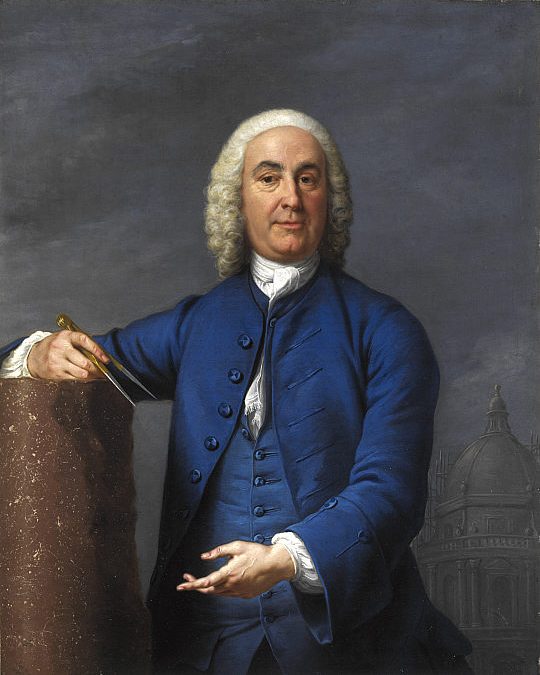
James Gibbs was one of the most influential architects of 18th-century Britain, known for his ability to blend Baroque grandeur with Palladian elegance. His work ranged from grand public buildings to refined country houses, and his architectural treatise, A Book of Architecture (1728), became a cornerstone for later architects in Britain and America. Gibbs was a versatile designer, adapting his style to suit the needs of his clients, balancing drama, ornamentation, and classical harmony.
Early Life and Education
Born in Aberdeen, Scotland, in 1682, Gibbs showed an early interest in architecture. He traveled to Rome in 1703 to study under Carlo Fontana, one of the leading Baroque architects of the time. This training deeply influenced his work, particularly his ability to integrate Italian Baroque dynamism with the Palladian restraint that was gaining popularity in England.
Upon returning to Britain, he established himself as a leading architect, gaining royal and aristocratic commissions that placed him among the most sought-after designers of his era.
Major Works
Gibbs’ architectural portfolio includes some of Britain’s most recognizable buildings, reflecting his talent for combining Classical principles with Baroque ornamentation:
- St. Martin-in-the-Fields, London (1722–1726) – Perhaps his most famous work, this church set the standard for Protestant church architecture, with its grand portico and soaring steeple influencing churches across Britain and America.
- Radcliffe Camera, Oxford (1737–1749, posthumous completion) – A landmark of English Palladianism, this striking circular library remains one of Oxford’s most iconic buildings.
- Gibbs Building, King’s College, Cambridge (1724–1729) – A refined example of his skill in designing elegant yet functional academic architecture.
- Ditchley Park, Oxfordshire (1720s) – A grand country house designed for the Earl of Lichfield, embodying Palladian ideals while maintaining Baroque detailing.
- Beningbrough Hall, Yorkshire (interiors, 1716–1718) – Though the exterior was designed by William Thornton, Gibbs was responsible for the striking Baroque interiors. The house, now managed by the National Trust, remains open for visitors and is a fine example of early 18th-century country house design.

Architectural Style and Innovations
Gibbs’ work blended Baroque complexity with Palladian clarity, distinguishing him from his contemporaries. His key stylistic traits included:
- Monumental porticos and steeples – Seen most prominently in St. Martin-in-the-Fields, which became the model for churches across the English-speaking world.
- Grand, sculptural compositions – Influenced by his Roman training, Gibbs incorporated dynamic spatial arrangements and richly decorated facades.
- Balanced ornamentation – Unlike the extravagant Baroque of Vanbrugh, Gibbs favoured a more measured use of decoration, particularly in his Palladian works.

Influence and Legacy
Gibbs’ influence extended well beyond his lifetime, particularly due to his architectural treatise, A Book of Architecture (1728), which provided designs for country houses, churches, and public buildings. His designs were widely adopted in both Britain and the American colonies, shaping the look of churches and civic buildings in places like Boston and Philadelphia.
His work bridged the gap between the theatricality of English Baroque and the rational elegance of Palladianism, making him a key transitional figure in British architectural history.
Did You Know?
- Gibbs’ St. Martin-in-the-Fields inspired thousands of churches worldwide, especially in the United States.
- His A Book of Architecture was widely used as a pattern book, influencing builders who had never trained formally in architecture.
- The Radcliffe Camera was one of the first circular libraries in Britain, an innovative departure from traditional rectangular or square designs.
- Despite his Roman training, Gibbs successfully adapted his style to suit the rising British Palladian movement, showing remarkable flexibility as an architect.
James Gibbs’ architectural legacy remains visible today, from the grandeur of Oxford and Cambridge to the countless churches that bear his influence. His ability to adapt Baroque drama into a more restrained, Palladian framework ensured his place as one of Britain’s most important architects of the 18th century.