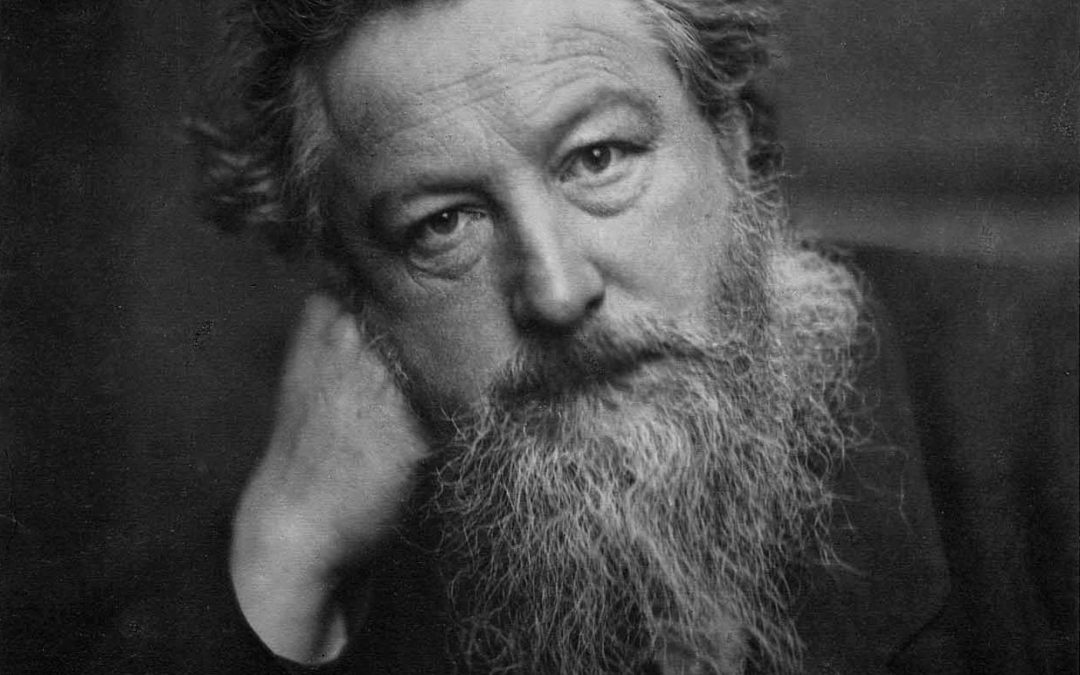
William Morris had an impressive, diverse resume: craftsman, entrepreneur, and political thinker. As a pioneering force in art, design, and social reform, he shaped the Arts and Crafts Movement, championing traditional craftsmanship over industrial mass production. His influence on interior design, textiles, and architecture endures today, making him one of the most significant cultural figures of the 19th century.
Early Life and Education
Born in 1834 in Walthamstow, England, William Morris grew up in a prosperous family with a deep appreciation for medieval history and Gothic architecture. He studied at Exeter College, Oxford, where he became deeply influenced by John Ruskin’s writings and met lifelong collaborators such as Edward Burne-Jones and Dante Gabriel Rossetti.
Though he initially trained as an architect, Morris’s passion for design, literature, and social ideals led him to pursue a broader creative career.
The Birth of the Arts and Crafts Movement
Morris co-founded Morris, Marshall, Faulkner & Co. in 1861, later known as Morris & Co. His firm rejected the artificiality of industrialized goods, instead reviving traditional handcrafting techniques.
His vision was clear: beauty should be accessible to all, and craftsmanship should be valued over mechanization. This philosophy became the foundation of the Arts and Crafts Movement, which inspired generations of designers, craftsmen, and architects.
Morris & Co.: Reinventing Interior Design
Morris’s company produced some of the most iconic designs of the 19th century. His work encompassed:
- Exquisite textiles and wallpapers – Featuring intricate floral and nature-inspired patterns, such as Trellis, Strawberry Thief, and Willow Boughs.
- Stained glass windows – Designed for churches and private homes, often in collaboration with Philip Webb and Burne-Jones.
- Handmade furniture – Crafted with an emphasis on durability, form, and function.
- Calligraphy and typography – His love for medieval manuscripts led him to create the Kelmscott Press in 1891, reviving fine book printing.
His designs were rich, decorative, and deeply connected to nature, emphasizing a return to the beauty of handmade artistry.
Kelmscott Manor and Red House: Homes That Defined His Vision
Morris’s artistic philosophy was reflected in his own homes.
Red House (built in 1859 by Philip Webb) was Morris’s first home, designed as a medieval-inspired retreat filled with handcrafted furnishings and decorative motifs. It became a prototype for the Arts and Crafts Movement, showcasing the ideals of craftsmanship and unity between architecture and decoration.
In 1871, Morris’s country retreat, Kelmscott Manor, a 16th-century house in Oxfordshire, became surrounded by idyllic countryside. It profoundly influenced his later designs and writings, inspiring his famous News from Nowhere.
Both homes stand as testaments to Morris’s belief that beauty should be present in everyday life, and they remain places of pilgrimage for those who admire his legacy.
Socialist Ideals and Political Activism
Morris was not just an artist—he was a social reformer. Frustrated by the exploitation of workers in the industrial age, he advocated socialism, believing that art and labour should go hand in hand.
- He joined the Socialist League in 1884 and wrote extensively on labour rights and utopian ideals.
- His book News from Nowhere (1890) envisioned a socialist utopia where beauty and craftsmanship flourished.
- He gave public lectures, arguing that art should serve all people, not just the elite.
His political views often informed his designs, promoting an aesthetic that was not just about beauty but also about fair labour and ethical production.
Legacy: A Timeless Influence
William Morris died in 1896, but his legacy lives on in art, design, and architecture. The Arts and Crafts Movement paved the way for Art Nouveau and modern design philosophies, influencing figures such as Frank Lloyd Wright.
Today, Morris’s patterns still adorn wallpapers, textiles, and home decor, proving his vision of beauty and craftsmanship remains timeless.
As he once said, Have nothing in your houses that you do not know to be useful or believe to be beautiful. His ideals continue to inspire those who believe in the power of design to shape the world.